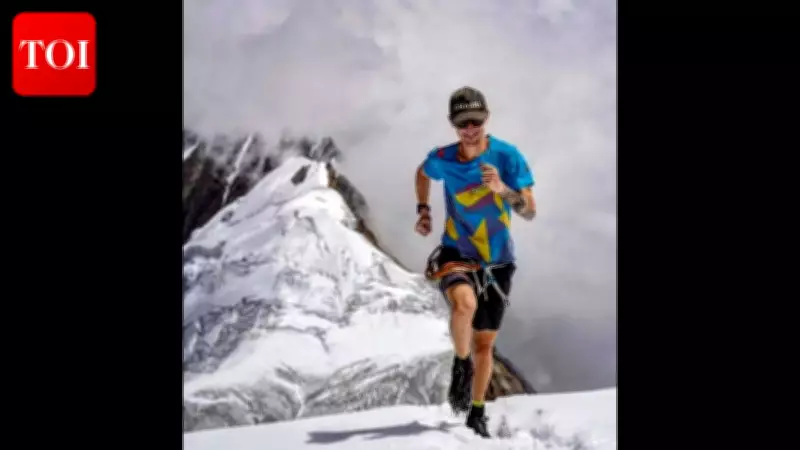
American endurance athlete and mountaineer Tyler Andrews, a 36-year-old cancer survivor, has become the first non-Sherpa climber to hold the Mount Everest South Base Camp speed record. He achieved this feat by climbing from Nepal's 5,364-meter Base Camp to the 8,848.86-meter summit in 9 hours and 55 minutes on Thursday. This successful ascent came after four failed attempts across two climbing seasons, with the most recent attempt occurring less than a week ago.
Breaking a Two-Decade-Old Record
Andrews broke the 23-year-old benchmark of 10 hours and 56 minutes set by Nepali climber Lhakpa Gelu Sherpa in 2003. This record had endured through two decades of increasingly commercialized Everest expeditions. Andrews' achievement marks a significant milestone in mountaineering history.
Personal Journey and Previous Achievements
At the age of six, Andrews was diagnosed with aplastic anaemia, a form of cancer that prevents the body from producing enough blood cells. He underwent several rounds of chemotherapy before recovering. In recent years, he established speed records on several other mountains, including Manaslu and Ama Dablam in Nepal, Kilimanjaro in Tanzania, Aconcagua in Argentina, Ojos del Salado in Chile, and Cotopaxi in Ecuador.

The Record-Breaking Ascent
Andrews began his climb at 7:11 PM on Wednesday, just as darkness settled over the Khumbu Icefall. He stood on the summit at 5:06 AM on Thursday after a continuous overnight ascent through the Khumbu Icefall, the Western Cwm, the Lhotse Face, and the 'death zone' above the South Col. The climb covered 14 kilometers with a vertical gain of 3,500 meters. Most climbers take four to seven days for this ascent after weeks of acclimatization.
Verification and Official Recognition
Though the record still requires formal verification from Nepal's mountain authorities, Andrews' team broadcast live GPS tracking of the climb through his social media account. His expedition leader, Dawa Steven Sherpa of Asian Trekking, confirmed the summit shortly after. Himal Gautam, an official with Nepal's department of tourism, stated that Andrews and his expedition leader will brief tourism officials once they are in Kathmandu. The ascent will be verified through GPS logs, summit photographs, and statements from expedition staff and Sherpa guides before the record is formally recognized.
A Two-Year Pursuit
Tyler's feat was the culmination of a two-year pursuit repeatedly interrupted by setbacks. Thursday's ascent was his fifth serious attempt at the record across two Everest seasons and his second within days. Earlier efforts unraveled because of unstable weather, avalanche danger, oxygen shortages, and gear failures at extreme altitude. During one attempt last year, a boot malfunction near Camp III forced him to descend due to frostbite risk.
Overcoming Major Setbacks
His most dramatic setback came last week. Andrews originally intended to target the unsupported, oxygen-free speed record, but high winds and severe altitude-related complications forced him to abandon the climb and descend after using emergency bottled oxygen. He was later evacuated by helicopter from Camp II. He acknowledged that Everest's unpredictability weighed on him more heavily than the physical challenge itself. He returned to Base Camp, recovered for several days, and decided to make one final attempt, this time with oxygen support.
Support System and Historical Context
Andrews' attempt combined solo climbing with a coordinated support system. While he climbed alone on the route, Sherpa guides were posted ahead of him with oxygen cylinders, food, and water. He delayed using supplementary oxygen until Camp II, at around 6,750 meters, climbing the lower sections of the mountain without bottled support despite attempting the oxygen-assisted category. Before Andrews' climb, every holder of Everest's speed record from the Nepal side was a Sherpa climber. Other endurance athletes, including Hans Kammerlander and Kilian Jornet, had achieved their speed records from the North Base Camp on the Tibet side of the mountain.

Fastest Times to the Summit
- 9 hours, 55 minutes — Tyler Andrews (2026)
- 10 hours, 56 minutes — Lhakpa Gelu Sherpa (2003)
- 12 hours, 45 minutes — Pemba Dorje Sherpa (2003)
- 14 hours, 31 minutes — Phunjo Jhangmu Lama (2024) (Woman's record)
- 16 hours, 56 minutes — Babu Chiri Sherpa (2000)
- 20 hours, 24 minutes — Kazi Sherpa (1998) (No oxygen-support record)