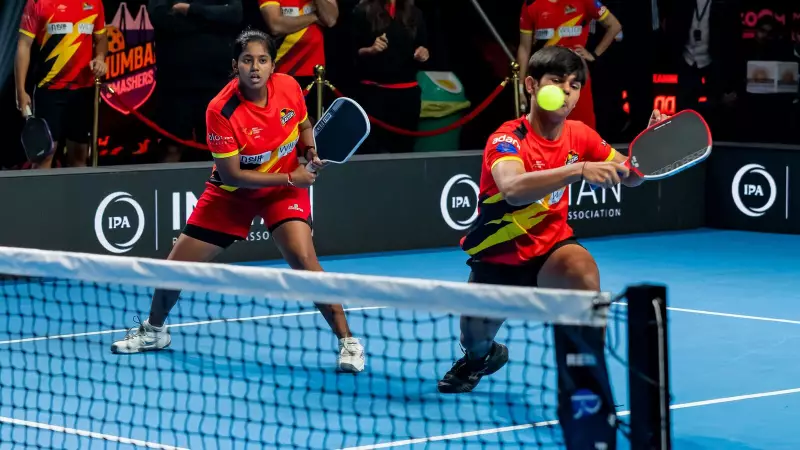
Once a simple backyard game, pickleball has exploded onto the Indian sports scene, becoming one of the nation's fastest-growing athletic pursuits. This engaging paddle sport, which cleverly blends elements of tennis, badminton, and table tennis, is now captivating players across the country, often drawing them away from more traditional Olympic disciplines.
The Origins and Journey to India
The story of pickleball began in 1965, invented by three friends: Joel Pritchard, Bill Bell, and Barney McCallum. What started as a family pastime has evolved into a structured sport with a global governing body. Its journey to India began when Sunil Valavalkar encountered the game in Canada in 1999. He introduced it to India in 2006 and formally established the All India Pickleball Association (AIPA) in 2008. The AIPA's growing stature was recognized internationally when it gained affiliation with the International Pickleball Federation in 2015.
How is Pickleball Played? Understanding the Game
Pickleball is played on a court identical in size to a doubles badminton court, measuring 20 feet by 44 feet. A net, slightly lower than a tennis net, divides the court. Players use smooth-faced paddles to hit a lightweight, perforated plastic ball over the net. The sport can be enjoyed in both singles and doubles formats, with doubles being the most popular.

The Essential Rules of Pickleball
Mastering pickleball requires understanding its unique set of rules, designed to create exciting, strategic rallies.
The Serve: The serve must be executed underhand, with the paddle contacting the ball below the server's waist. The server must stand behind the baseline and hit the ball diagonally into the opponent's service court. Only one serve attempt is permitted.
The Two-Bounce Rule: This fundamental rule eliminates the "serve and volley" advantage. After the serve, the receiving team must let the ball bounce before returning it. Then, the serving team must also let that return bounce before playing it. After these two bounces, players may volley the ball (hit it in the air) or play it off the bounce.
The Non-Volley Zone (The Kitchen): This is a 7-foot area extending from the net on both sides. Volleying is strictly prohibited inside this zone. A player cannot even volley while touching the NVZ lines. Stepping into the Kitchen due to momentum after a volley is considered a fault. Players may only enter this zone to play a ball that has already bounced.
Scoring: Similar to other racket sports, points are scored only by the serving team when the opponent commits a fault. A game is played to 11 points, and a team must win by a margin of two points.
The Indian Pickleball League: A Major Leap Forward
Pickleball gained significant professional momentum in India with the launch of the inaugural Indian Pickleball League (IPBL) in 2025. This landmark tournament features six franchise-based teams, bringing a new level of competition and visibility to the sport.
The six founding franchises of the IPBL are:
- Mumbai Smashers
- Chennai Super Warriors
- Lucknow Leopards
- Bengaluru Blasters
- Hyderabad Royals
- Capital Warriors Gurgaon
The establishment of the IPBL marks a pivotal chapter, transforming pickleball from a recreational activity into a professional spectacle with a dedicated fan base. With its simple rules, accessible equipment, and fast-paced nature, pickleball is poised to continue its rapid ascent, carving out a permanent space in India's diverse sporting landscape.