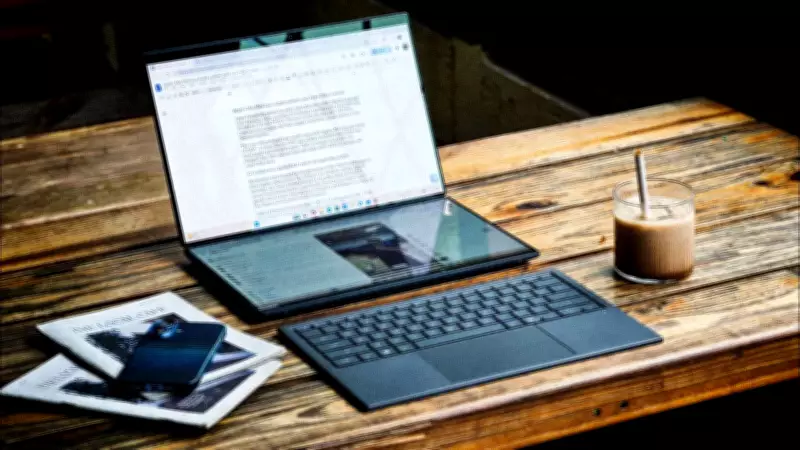
The Zenbook Duo has always been a laptop that needed explaining. Two screens. A detachable keyboard. A kickstand on the bottom. You would set it up at a cafe or a coworking space and someone would inevitably lean over and ask what you were using. The pitch was good: two 14-inch screens in one chassis, the screen real estate of a desktop dual-monitor setup in something you can carry around. But the product always had just enough friction to keep it in interesting gadget territory rather than everyday laptop territory. The gap between the screens was wide. The battery was short. Windows did not always know what to do with two displays, and neither, sometimes, did you.
The 2026 Zenbook Duo is the version where that friction is mostly gone. Asus redesigned the hinge and brought the gap between the screens down from 25 mm to 7.66 mm. The battery jumped from 75 Wh to 99 Wh. The Ceraluminum gives it a material identity most laptops do not bother with. The dual-screen setup, after a few weeks of daily use, has stopped being the thing you talk about first when someone asks what you are working on. You just tell them it is a Zenbook. The two screens come up later, almost as an afterthought. For a product that has spent its entire existence leading with two screens, that shift from party trick to second nature might be the most telling upgrade of all. At Rs 2,99,990, though, the details matter.
Surface and Space
There is a thing that happens with laptop surfaces. You notice them on day one, and by day three they disappear into the background. The Ceraluminum on the Duo has not done that. Three weeks in, and you are still aware of it every time you pick the laptop up. Ceramised aluminium, matte, faintly granular. Asus has been putting it on Zenbooks for a couple of years now, but the Duo is the first time it feels like the material is defining the product rather than just decorating it. How it ages matters more than how it feels. On older Zenbooks, the Ceraluminum started showing its history around month three with desk scratches and zipper marks. This one has been leaving the house daily for weeks, and there is nothing to show for it. The build underneath has been just as quiet. The keyboard dock still snaps the same way. Pogo pins still line up. Nothing creaks, nothing has loosened. At 1.65 kg with the keyboard docked, it is not light, but it should not be with two 14-inch OLEDs, a kickstand, and a detachable keyboard. The chassis is about 5 per cent smaller than the last Duo, and the charger is small enough to not think about. The port spread is reasonable: two Thunderbolt 4 USB-C, one USB-A 3.2 Gen 2, full-size HDMI 2.1, and a 3.5 mm combo jack. The HDMI is a genuinely useful inclusion. What is missing, and should not be, is an SD card slot. At this price, on a laptop with two colour-accurate OLEDs, needing a dongle to import from a camera feels like an oversight. The 1080p IR webcam handles Windows Hello without fuss. Face unlock is your only biometric, and it works, but having both would be better.

The hardware is all there, mostly. A desk, in desktop mode with both screens vertical and the keyboard off, is home. Everything sits right. A couch is a negotiation. The kickstand wants a flat surface. An airline tray works barely at the shallowest angle. A bed does not work at all. The Duo has opinions about where you use it. And then there is the gap. The older Duo had about 25 mm between its two displays. Asus redesigned the hinge entirely, slimmed the bezels to 3.88 mm, and got the gap down to 7.66 mm. Both panels sit flush now, same plane, no offset. The screen-to-body ratio is 93 per cent. The hinge holds 15 kg of load. The touchscreen does not wobble. That last part matters more than it sounds, because the bottom panel becomes a screen you touch. Scrolling tabs, dragging windows, tapping into apps. The stylus is also an option. For the first few days, you still think in two screens. By the end of the first week, that dissolves. You open things and they land where they land. A document stretches across both displays and you scroll through the seam without catching it. On every older Duo, the gap was wide enough to keep that from ever fully happening. On this one, you just have one workspace that folds. The only reminder of the hinge is the warmth that gathers under sustained load. Never hot, but there after a long afternoon.

The Screens and Everything on Them
Two 14-inch Lumina Pro OLEDs. 2880 x 1800, 144 Hz, full DCI-P3, Pantone validated, 1000 nits peak in HDR. Variable refresh between 48 and 144 Hz. Gorilla Glass on both. Those are the specs, and they are good specs. But the thing that actually holds the dual-screen experience together is that the two panels match in colour temperature, brightness, and tone. No drift between top and bottom. You would think that would be a given on a laptop built around staring at two screens all day. It is not. Asus got it right. There is a new anti-reflection coating this generation. Still glossy, but after weeks of working near windows and under overhead lights, the reflections stay in the background. The 144 Hz is similar; go back to a 60 Hz panel after a couple of weeks and the screen feels like it is dragging behind your fingers. Colour accuracy out of the box has been reliable enough that you never feel the need to plug in an external display. For photo editing and colour-sensitive work, both panels are trustworthy.
What you do with two screens settles early. Draft on top, tabs on the bottom. Call up top, notes below. Reference image on one, edit on the other. It is what you would do with a second monitor on a desk, except there is no desk and no cable. You pull the keyboard off, prop the Duo on its kickstand, and that is it. By week two, you stop arranging things. The two screens stop being a decision and start being a surface you work on. That is what the smaller gap makes possible. The vertical orientation in desktop mode is where this really comes through. Both screens stacked give you a tall, narrow workspace. A 3,000-word article draft is visible almost in its entirety. A long spreadsheet does not feel like it is hiding half its rows. You scroll less and see more. The keyboard fits into that rhythm. Off when you are in desktop mode, docked when you are not. Bluetooth when detached, pogo pins when stored. Typing is solid with 1.7 mm travel and Ceraluminum keycaps. The touchpad is smooth. You forget the keyboard is detachable, which is probably the best thing a detachable keyboard can achieve. What you do not forget is the tilt. There is none. Dead flat on a desk. An hour of sustained typing and your wrists start a quiet protest. Two small feet would fix it.
Desktop mode got about 70 per cent of your time. Laptop mode with the keyboard docked handled the rest. In desktop mode, the webcam sits higher and closer to eye level. The sharing mode, where you lay the Duo flat so two people across a table each get a screen, got used once. The bottom screen for doomscrolling while the top one looks productive has not gotten old. The reason it works is that you do not think about which screen does what. After three weeks, one screen does not. Windows, though, has not had the same epiphany. Snap behaviour gets pushy with two displays. ScreenXpert covers some gaps. Task Groups let you launch app arrangements across both screens. The gesture system you either learn in the first week or you do not. The virtual keyboard and touchpad are forgettable. Occasionally, after waking from sleep, the second screen goes dark for a few seconds. Minor, but you notice. The speakers are six drivers with Dolby Atmos. They get loud and are good enough for calls and videos, but anything you care about hearing properly deserves headphones.
Keeping the Lights On
Intel Core Ultra 7 355. Panther Lake, Core Ultra Series 3. 32 GB of LPDDR5x, up to 2 TB of PCIe 4.0 storage. TDP capped at 45W. That last number tells you what the Duo is optimising for: the ability to run two 3K OLED panels at 144 Hz through a full workday without the battery tapping out. In daily use, the processor does not draw attention to itself. Chrome tabs across both screens, Slack, Spotify, a Photoshop file on the bottom panel. Nothing stutters. Heavier workloads like a Premiere Pro project with 4K clips and colour correction are smooth for the most part, with occasional hitches when stacking effects. Exports are reasonable. Lightroom Classic handles imports and batch exports without complaint. The fans spin up during heavy work, audible in a quiet room, easy to forget with music on. The chassis gets warm around the hinge. Nothing throttles. The NPU does 49 TOPS and is Copilot+ PC. Windows Studio Effects and Live Captions are useful in passing, but most AI features you try once and move on. The battery, though, is the spec that actually changes how you use the laptop. The 99 Wh cell replaces the 75 Wh from the older Duo. Both screens on, moderate brightness, a full workday of writing, browsing, email, Slack, some photo editing, and Spotify consistently yields seven to eight hours without any power-saving measures. On the older Duo, the battery was the thing that kept the dual-screen experience from being reliable all day. That is gone now. Both screens stay on. Single-screen mode with the keyboard docked stretches to ten or eleven hours. The variable refresh rate helps. The 100W USB-C charger reaches 60 per cent in about 50 minutes. Battery Care Mode caps charging at 80 per cent for long-term health.
The Ask
Rs 2,99,990 is a lot of money for any laptop. The Duo does not get to skip that conversation just because it has two screens. What you are paying for: two 14-inch 3K OLED touchscreens that match out of the box, a Ceraluminum build that still feels considered three weeks in, a hinge Asus finally figured out, a keyboard that works well enough to forget it detaches, a 99 Wh battery that lasts a full workday with both screens running, and a processor that handles creative workloads without getting in the way. The dual-screen experience, for the first time, does not need a disclaimer attached to it. What you are not paying for: a version of Windows that is fully figured out for two displays, a laptop that works equally well on a couch and a bed, an SD card slot, or a keyboard that tilts. Whether that trade-off works depends on one thing: will you use both screens every day? If yes, if your workflow involves enough tabs and reference material that a second display is a relief, the Duo gives you something no single-screen laptop can. If no, this is a Rs 3 lakh, 1.65 kg, 14-inch laptop with one very good screen. There are cheaper ways to get that. Three weeks ago, the Duo was a dual-screen laptop. Now it is just a laptop. That is the shift. The two screens have become invisible in the way good design is supposed to be. Windows still gets in the way sometimes, but it is not enough to undo what the hardware gets right. The gap is small enough to disappear. The battery lasts long enough. Everything still feels tight. None of that changes the price, but if you are the person this was made for, you already know. Our rating: 4/5.