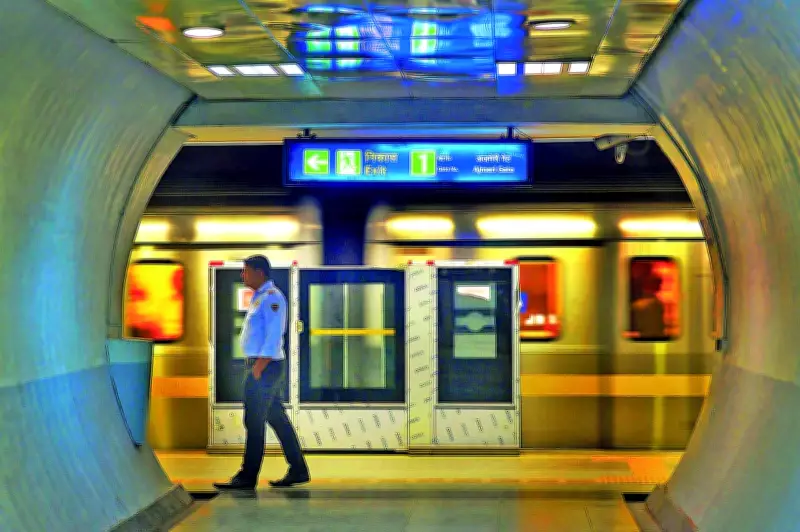
The Telecom Regulatory Authority of India (TRAI) has carried out independent drive tests across the Delhi-National Capital Region (NCR) metro and rapid transit network, spanning nearly 490 kilometers, to evaluate the quality of mobile services experienced by commuters.
These tests were conducted in April to independently verify the on-ground performance of telecom networks for communication, work, entertainment, and digital transactions during journeys. The regulator released its findings on Monday, revealing significant differences in performance among various network operators.
TRAI noted that the observations represent performance at specific locations and times of testing. The findings have been shared with the service providers, according to TRAI.

A statement from the Ministry of Communications on June 15 indicated that the tests were conducted between April 1 and 4 and again on April 14, using live voice and data sessions on 2G, 3G, 4G, and 5G networks. The evaluation covered coverage, call setup success rate, call drops, voice quality, and download and upload speeds, among other parameters.
Regarding download speeds, Reliance Jio recorded the highest average of 141.28 Mbps on its 5G network, followed by Airtel at 81.72 Mbps. Vodafone Idea (Vi) registered an average download speed of 23.94 Mbps, while MTNL recorded 4.30 Mbps on its 4G network. For upload speeds, Airtel topped with an average of 25.98 Mbps, followed by Jio at 19.99 Mbps and Vi at 16.96 Mbps. MTNL recorded an average upload speed of 1.84 Mbps.
The drive test also assessed network coverage by measuring instances where signal strength fell below prescribed thresholds. MTNL recorded the highest coverage gaps, with poor signal strength in 20,768 out of 43,220 samples. In comparison, Airtel, Jio, and Vi recorded coverage gaps in fewer than 3% of the samples collected.
MTNL showed 51 dropped calls out of 346. Airtel reported five dropped calls and 491 successful calls, while Jio and Vi recorded eight and ten dropped calls, respectively.
The Delhi Metro Rail Corporation (DMRC) last upgraded its mobile network connectivity in 2023, introducing 5G services in all its underground stations and tunnels. At that time, DMRC stated that it had established infrastructure across its network, including telecom towers, small cells, and in-building solutions, to enhance mobile connectivity, especially in underground areas or within buildings, up to 5G capacity.
Small cells also help boost mobile coverage in nearby areas, covering about 100 meters. These cells are installed on pillars of the Airport Express line as it passes through ridge and defense areas, which generally have fewer towers, impacting signal quality.
DMRC officials said that upgrading mobile connectivity is an ongoing process and that DMRC continuously improves with appropriate directions to telecom providers.