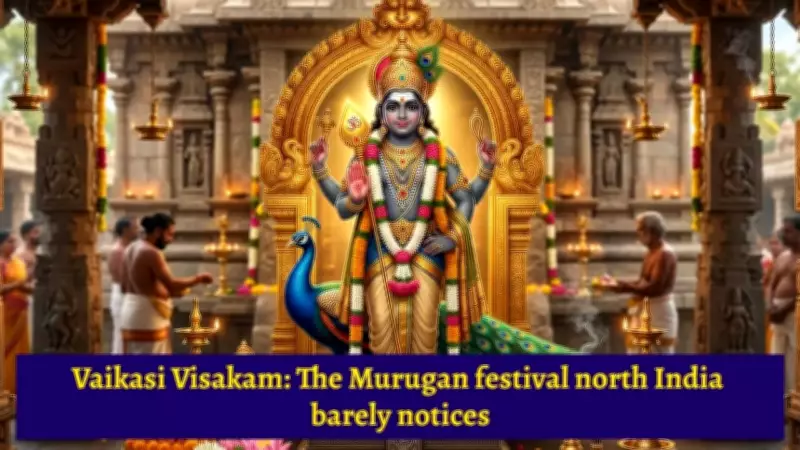
At dawn, the brass bell rings first, and then in countless Tamil homes, a person draws a fresh kolam, the rice-flour design on the threshold. They set aside flowers, sandal paste, and a small bowl of panchamritam, the sweet concoction used for worship. The most spoken name is Murugan, the god of young warriors, beloved across Tamil Nadu and far beyond. Yet in most of North India, Vaikasi Visakam remains nearly invisible. For many families, however, it is more than just the birth celebration of one of Hinduism's most revered deities.
Quick Details for Readers
Date: Tamil Vaikasi for New Delhi. Observed as: Vaikasi Visakam. Best reader action: Check local panchang if outside India. For 2026, many timing-dependent sources place Vaikasi Visakam on May 30 for New Delhi, with Visakam Nakshatra (the lunar asterism Visakha) running from May 29 to May 30. Since this observance is based on the Tamil month Vaikasi and the Visakam star, local panchang calculations are crucial, especially for those outside India. If you are in Singapore, Malaysia, Sri Lanka, the Gulf, Europe, North America, or Australia, do not duplicate Chennai or Delhi temple advertisements assuming they match your town.
When Murugan's Star Returns in Vaikasi
Vaikasi Visakam occurs in Vaikasi, the second month of the Tamil calendar, when the moon aligns with Visakam Nakshatra. This day is regarded as the appearance or birth celebration of Lord Murugan, also called Skanda, Kartikeya, Subrahmanya, and Kumara. In North India, many know him as Kartikeya, son of Shiva and Parvati. In Tamil tradition, Murugan is not a marginal figure; he is family. He is the god of hills, beauty, youth, courage, wisdom, and victory over inner and outer darkness.

That emotional closeness is often missed in national festival coverage. We write easily about Janmashtami, Navratri, and Diwali, but Vaikasi Visakam carries the same pulse for Tamil devotees. In many homes, this is not an obscure regional date; it is a living, intimate festival. Puranic tradition links Murugan's manifestation to a moment of cosmic need. When the asura Surapadman and other hostile beings disturbed the worlds, divine energy emerged from Shiva. That blazing tejas (divine radiance) took form as the child-warrior who would later defeat adharma. Regional legends, temple lore, and devotional poetry tell the story with great love. Murugan is not just the leader of the gods; he is also the infant whom devotees love to adorn, feed, praise, and parade.
Why This Day Feels So Personal in Tamil Homes
There is a reason that even small Murugan shrines attract a different kind of devotee on Vaikasi Visakam. The mood is festive yet intimate. The murti (sacred image) is bathed with honey, curd, milk, and rosewater in the abhishekam ritual. Offerings include archanai (recitation of names with flowers). Children are dressed in bright silk, and elders sing Kanda Sashti Kavasam, a well-loved Tamil prayer for protection, or songs from Tiruppugazh, the exhilarating Murugan poetry by Arunagirinathar.
In Tamil Nadu, major temples like Palani, Tiruchendur, Swamimalai, Tiruttani, Pazhamudircholai, and Marudamalai are crowded with people. They are among the most well-known Murugan Kshetras (sacred places), but local temples are equally brimming with emotion. In the diaspora, Vaikasi Visakam has become a symbol of continuity. A family living in Toronto or Durban might not have the typical temples of Tamil Nadu, but they still rise early, offer flowers and fruits, and ensure children understand the significance of this day. The diaspora thread is important in 2026. Murugan worship has traveled with Tamils for generations through migration, labor routes, trade, and modern professional life. In Kuala Lumpur, London, New Jersey, or Sydney, Vaikasi Visakam often becomes more than a temple date; it becomes a way of staying in conversation with home.

What to Actually Do If You Want to Observe It This Year
Start with the simplest thing: mark the correct local date from a trusted panchang, then keep the day clean, prayerful, and intentional. You do not require elaborate arrangements to observe Vaikasi Visakam properly. Most devotees begin with an early bath and a small sankalpam (spoken prayer to worship). If you have an altarpiece, Murugan image, or hanging picture at home, wash the altar, light a lamp, and offer flowers, water, fruit, and a sweet treat. Yellow, red, and orange flowers are typically preferred, but any fresh flower offered with bhakti (devotion) is accepted. If possible, offer sandal paste and vibhuti (sacred ash).
Many observe a vratam (religious fast) in a form that suits their health and family practice. Some take only fruits and milk until the puja. Others avoid garlic, onions, or heavy foods and eat only one simple sattvic meal. If you are pregnant, elderly, sick, diabetic, traveling, or caring for children, do not turn the fast into a struggle. The goal is restraint and remembrance, not showmanship. If you know Murugan prayers, recite them. "Om Saravanabhava" is a widely used mantra, as is "Om Subrahmanyaya Namah." Tamil devotees can sing Tiruppugazh, Kandar Anubhuti, Kanda Sashti Kavasam, or simply chant "Muruga, Muruga" with folded hands. If a temple is nearby, attend the abhishekam or evening deeparadhana (lighting of lamps). The moment of sharing, with bells ringing, camphor flame rising, and children craning for darshan, often becomes the center of the day.
The Spear, the Peacock, the Child-God Who Fights Darkness
Murugan's iconography explains why his festival carries such force. His vel (divine spear) is not just a weapon; it is Jnana Shakti, the power of wisdom that cuts through fear and confusion. His mayil (peacock mount) suggests majesty and the taming of pride. His youthful form reminds devotees that divine power does not always arrive as age or severity; sometimes it appears as freshness, clarity, and fearless grace. That symbolism is one reason Vaikasi Visakam still speaks across generations. Parents bring children to Murugan not only for blessings in exams, health, or marriage, though those prayers are common, but also to a deity who represents discipline without coldness, strength without cruelty, and beauty without vanity.
In some local traditions, devotees undertake kavadi (a physical offering carried for Murugan) or walk in procession. Some also sponsor annadanam (giving of food). The day in temples may include music, nagaswaram (traditional temple instrument), and the scent of jasmine, incense, and ghee lamps. In diaspora temples, the same rituals are often performed in smaller form, such as a shorter puja, a communal lunch, or children singing shlokas in accents shaped by two realms.
Why National Calendars Should Pay More Attention
The idea of calling Vaikasi Visakam a "regional" festival is factually correct but could be misleading. Regional does not mean minor. India's religious life has always moved through languages, temple geographies, and local calendars. A festival can be centered in Tamil experience and still deserve national notice. In fact, that is exactly why it should be covered better. Murugan himself exemplifies how Hindu worship exceeds neat regional boxes: he is Kartikeya in Sanskritic and pan-Indian tradition, Subrahmanya in many southern temples, and Murugan in the deep emotional realm of Tamil bhakti. The names shift; the love does not.
For readers in North India, Vaikasi Visakam is also a chance to notice how much of Hindu practice sits outside the familiar festival circuit of Hindi television calendars. For Tamil readers, especially those living away from home, seeing this day acknowledged in national coverage is not about token inclusion; it is about recognition. Your festival counts too.
Carry the Observance Home, Wherever Home Is Now
If you are a first-generation immigrant, you might already know the procedure: find the closest Murugan temple, contact them ahead to inquire about puja timings, and bring fruit if offerings are allowed. If you are second-generation and half-forgot the date until a parent texted the family WhatsApp group, keep it simple: light the lamp, learn one Murugan mantra, and make one offering with attention. If you are outside India, remember that temple calendars can differ by time zone and local sunrise calculations. Some sources place festival timing by Indian reckoning, but your local observance may shift. Check your city's panchang or temple notice before finalizing a fast or visit.
On Vaikasi Visakam, what remains with many devotees is not the astronomy itself, though it is important; it is the feeling of being before Murugan like a person who is both royal and close, dressed in flowers, with vel gleaming, the face still youthful, and the priest raises the final flame, making the entire sanctum glow with gold for a short moment.
About the Author: AstroDevam is a premium organization providing ancient and authentic knowledge of astrology, Vastu, numerology, and innovative corporate solutions with a contemporary perspective. With patrons in more than 100 countries, AstroDevam has been promoted by Achary Anita Baranwal and Achary Kalki Krishnan, who hold Master's Degrees in astrology and have been teaching scientific astrology, Vastu, and numerology for over three decades.