

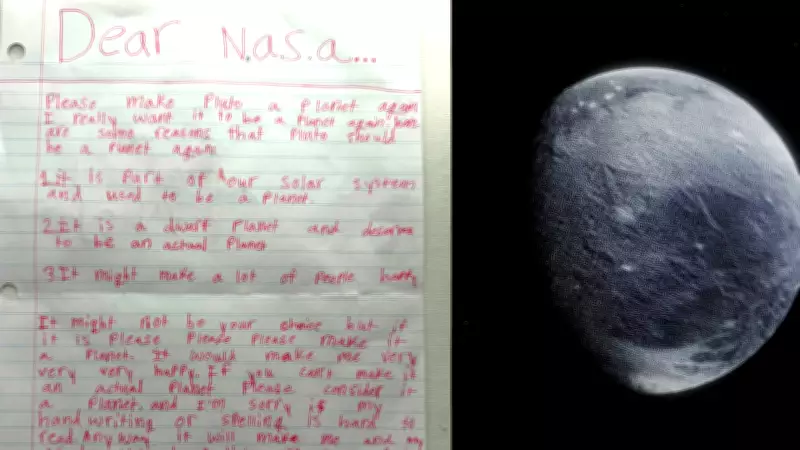
A handwritten note from a 10-year-old has accomplished what years of classroom lessons, documentaries, and online arguments could not: it has brought Pluto back into the spotlight. In a letter that is equal parts earnest, curious, and disarmingly polite, Kaela asked NASA to "make Pluto a planet again," and the internet responded exactly as it tends to do when children say something simple and sincere about a complicated world—it paid attention.
The Letter's Impact
What makes the letter stand out is not just its charm but its confidence. Kaela does not write like someone repeating a half-remembered fact from school. She makes a case. Pluto, she notes, is part of the solar system. It used to be a planet. It is now classified as a dwarf planet, but in her view, it deserves to be restored. She even adds that the change could make "a lot of people happy," a line that gives the note its emotional pull. Behind the spelling and the childlike handwriting is a clear instinct: if something matters to people, maybe it should matter to science too.
Dated February 5, 2026, the letter has traveled far beyond a classroom desk. It was shared online and quickly drew attention for the way it mixes innocence with research. Kaela did not stop at wishful thinking. She backed up her appeal with a handful of facts she clearly knew well. Pluto, she wrote, is located in the Kuiper Belt, was discovered in 1930 by Clyde Tombaugh, is smaller than Earth's moon, and has five known moons. For a child writing to NASA, that detail matters. It transforms the letter from a sweet plea into a miniature science argument.

NASA's Response
NASA's response only added to the story's momentum. Jared Isaacman, the NASA chief, replied with a brief line: "Kaela, We are looking into this." It was not a promise of change, and it did not suggest a rewrite of planetary science. But it was enough to send the story racing across social media, where readers praised the girl's curiosity and enthusiasm. Some called her a Pluto expert in the making. Others simply enjoyed the fact that one child had managed to revive a debate that astronomers, educators, and space fans have been having for nearly two decades.
The Science Behind Pluto's Status
Of course, Pluto's status was never changed on a whim. In 2006, the International Astronomical Union reclassified Pluto as a dwarf planet after it failed to meet all three criteria for a planet. It orbits the Sun and is spherical, but it does not clear its orbital neighborhood. That technical detail is the heart of the controversy. Pluto shares its region with many other icy bodies in the Kuiper Belt, and that is what sets it apart from the eight recognized planets.
Still, scientific classification and public affection are not always the same thing. Pluto has never stopped being beloved simply because of a label. For many people, it remains the planet they grew up learning about, the one that once completed the childhood map of the solar system. That is part of why Kaela's letter resonates so strongly. It is not a scientific paper, but it captures something science often forgets to measure: attachment.
A Reminder of Curiosity's Power
In the end, the little note is a reminder that curiosity still has the power to stir big conversations. A child asked a question in plain language, and the world leaned in. Pluto may not be changing its classification anytime soon, but for a brief and charming moment, a 10-year-old made the solar system feel personal again.






