The Discovery That Changed Physics
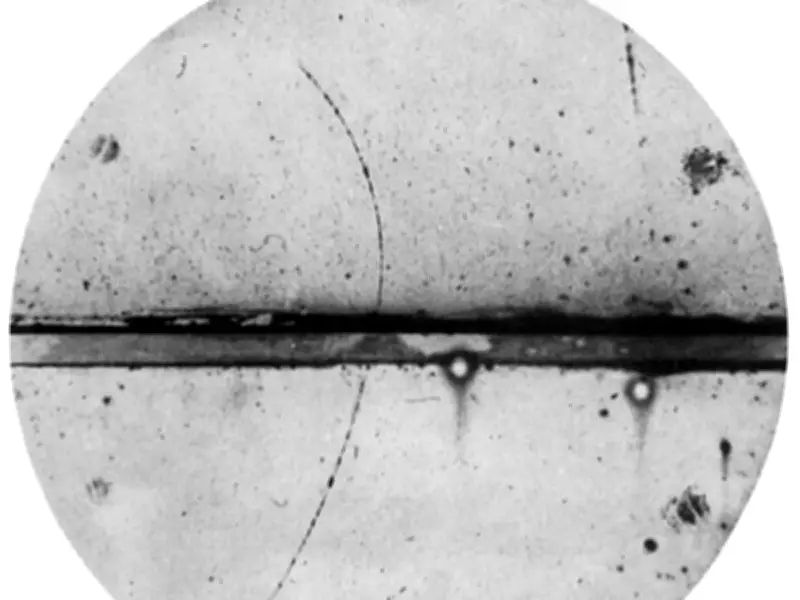
In August 1932, while investigating cosmic rays at the California Institute of Technology, Carl Anderson observed peculiar behavior in a cloud chamber photograph. The image showed a particle track curving in a direction opposite to that of an ordinary electron under the influence of a magnetic field. This seemingly minor observation turned out to be the first evidence of the positron, the positively charged counterpart of the electron. According to the American Physical Society, the particle had the same mass as an electron but carried a positive charge, ruling out any known particle at the time.
The Experiment That Revealed the Impossible
Anderson used a cloud chamber, a device that makes invisible subatomic particles visible by leaving trails in supersaturated vapor. By analyzing the curvature of these trails in a magnetic field, physicists can determine a particle's charge and momentum. Electrons curve one way, but the unknown particle curved the opposite way, indicating a positive charge. Crucially, its low mass ruled out a proton. NobelPrize.org notes that Anderson's finding marked the discovery of the positron.
To confirm his observation, Anderson inserted a lead plate into the cloud chamber. Particles lose energy passing through the plate, and by comparing the curvature before and after, he could deduce the particle's properties. A proton would not have behaved the same way under energy loss. The implications were staggering: nature allowed an identical but positively charged version of the electron.

A Theory Becomes Reality
The discovery validated a hypothesis by physicist Paul Dirac, whose equations predicted the existence of opposite-charge counterparts to particles like the electron. Anderson's positron was the first antimatter particle ever discovered, proving a hidden symmetry in the universe. Matter was no longer unique.
Remarkably, the proof came from a simple curved line in condensed vapor, not from a massive experiment or a dramatic explosion. The cloud chamber photograph of the first positron remains an iconic image in science.
Antimatter: From Science Fiction to Scientific Fact
Popular culture often portrays antimatter as science fiction, but its discovery was rooted in rigorous experimentation and analysis. Anderson did not set out to find antimatter; the cloud chamber provided physical evidence through geometric, curvilinear, and ionization properties that disproved simpler explanations. This exemplifies how scientific innovation often arises from noticing details that contradict established assumptions.
Why the Discovery Still Matters
The positron's discovery extended far beyond particle physics. It led to applications such as PET scanning, which uses antimatter for medical diagnostics. Initially a curiosity from cosmic rays, it became one of history's most remarkable achievements. The story of the positron also reflects a human narrative: a peculiar line that first seemed incorrect eventually became historically significant.
The positron discovery stands as a testament to how science progresses through careful observation of discrepancies. A single cloud chamber photograph from 1932 revealed that our universe is stranger and more symmetrical than ever imagined.