9 Bizarre Objects Still Drifting in the Vastness of Space
Space remains an infinitely expansive frontier, teeming with mysteries that challenge our understanding. The regular motion of our Solar System occasionally reveals visitors from beyond, such as 'Oumuamua, whose behavior defies the typical classifications of comets and asteroids. While physics helps categorize these objects, their chemical compositions—potentially made of hydrogen or nitrogen ice—add layers of intrigue. Beyond these, phenomena like 'Zombie Stars,' white dwarfs that reignite or survive explosions under extreme conditions, captivate astronomers. NASA Science highlights that wandering interstellar objects, including Comet 2I/Borisov, offer invaluable insights into the chemistry of distant star systems.
Urine Crystals from Human Space Travel
During the early days of space exploration, astronauts released liquid waste that instantly froze into sparkling golden ice crystals, drifting through the void. Those on Apollo missions described these puffs as 'magnificent' sights en route to the Moon. Today, the International Space Station employs advanced filtration systems that recycle about 98% of human fluids into purified water, effectively ending this glittering phenomenon.
Tesla Roadster and 'Starman'
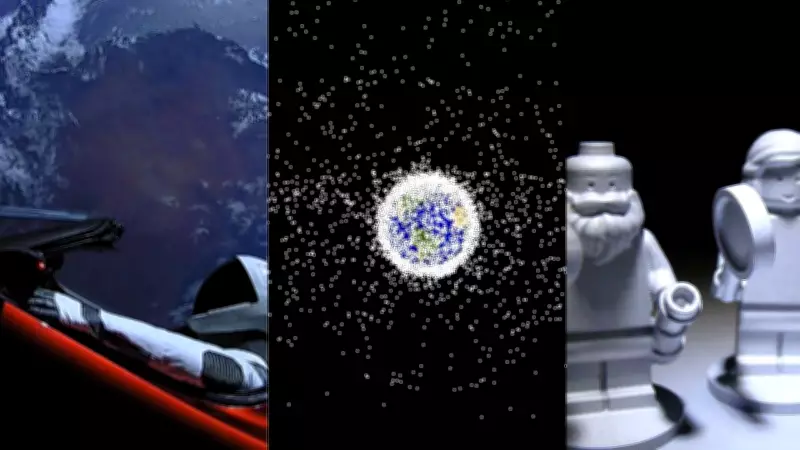
Elon Musk's Tesla Roadster has been silently cruising the Solar System since its launch into orbit in February 2019. As of March 2026, it travels in an endless loop between Earth and Mars, over 285 million kilometers from our planet. This vehicle stands as a high-speed testament to the triumphs of private spaceflight in the 21st century, showcasing the remarkable advancements in aerospace technology.

Voyager's Golden Records
The twin Voyager spacecraft, journeying through outer space, each carry a golden record curated by Carl Sagan. These records serve as messages to potential extraterrestrial life, featuring over 55 languages, 155 encoded photographs, and diverse sounds ranging from a baby's cry to music by Bach and Chuck Berry. They represent humanity's final archival record of existence in the cosmos.
Kessler Cloud: The Peril of Space Debris
Earth's orbit currently harbors more than 35,000 pieces of debris larger than 10 centimeters, including defunct satellites and rocket remnants. Traveling at speeds exceeding 17,500 miles per hour, even a fleck of paint can cause catastrophic damage. Scientists warn of Kessler Syndrome, where cascading collisions from accumulated debris could render orbital space unusable for future generations.
J002E3: The Mysterious Cylinder
Discovered in 2002 by an amateur astronomer, J002E3 was initially mistaken for an asteroid. Analysis revealed it was coated in white titanium dioxide paint, identical to that used on NASA rockets. Astronomers concluded it is the third-stage S-IVB rocket from the Apollo 12 mission, which returned to a highly elliptical Earth orbit after three decades in space.
480,000,000 Copper Needles
During the Cold War, the United States launched Project West Ford, injecting 480 million tiny copper needles into orbit to create an artificial ionosphere for military communication protection against Soviet threats. While most needles have decayed, some clumps still orbit Earth, remnants of this ambitious and controversial endeavor.
The Floating $100,000 Toolbag
In November 2023, astronauts accidentally released a toolbag during a solar array repair mission on the International Space Station. This white toolbag orbited as a tracked satellite for about six months, visible from Earth with binoculars, before failing to deorbit and burning up upon reentry in early 2024.
Moon Museum
The Andy Warhol 'Moon Museum,' a miniature ceramic wafer with works by six artists, was allegedly smuggled onto the Apollo 12 lunar module in 1969. Though never officially approved by NASA, an engineer reportedly hid the tile in the module's insulation. Warhol's contribution, a controversial anatomical representation of his initials, adds to its mystique.

Lego Minifigures Orbiting Jupiter
Aboard the Juno spacecraft, three 1.5-inch aluminium Lego figurines—representing Galileo Galilei, Jupiter, and Juno—orbit the gas giant. Designed to withstand Jupiter's intense radiation, this collaboration with LEGO aims to inspire children's interest in STEM fields and space exploration, blending science with creativity.