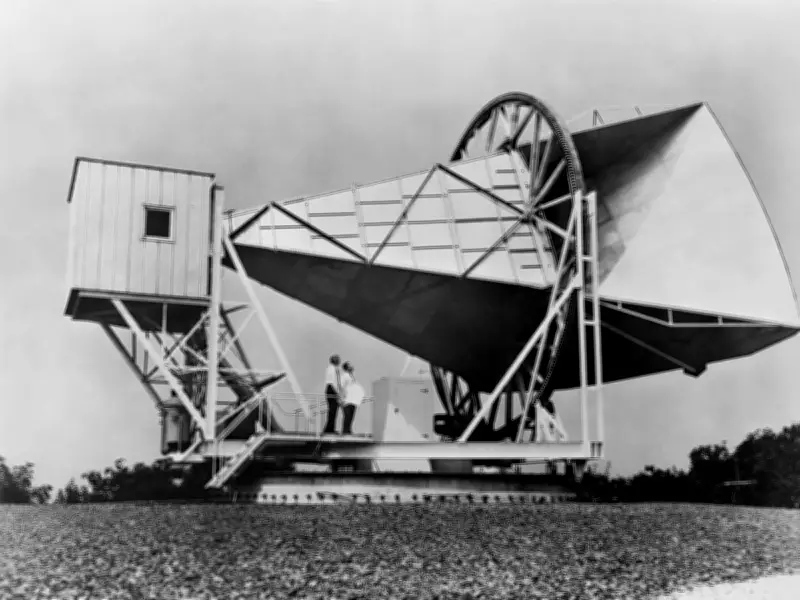
In 1964, two astronomers working at Bell Telephone Laboratories in Holmdel, New Jersey, were plagued by a constant issue. Arno Penzias and Robert Wilson were using a large, 20-foot horn antenna to carry out sensitive radio measurements. However, they were constantly encountering a stubborn background noise. The sound was like a mild microwave buzz that would not disappear, regardless of which direction they pointed their instrument or how much they adjusted the settings.
The initial response of the researchers was not a sweeping declaration about the universe but a serious effort to repair what appeared to be bad data. The researchers were debugging. According to the official Nobel Prize summary, the unusual signal did not behave like normal local-based interference. The signal was constant throughout the day and night and did not change with changes in the weather.
Ruling Out Local Interference
To eliminate the sound, Penzias and Wilson thoroughly analyzed every possible terrestrial source. They considered whether the signal was leaking from the sprawling urban areas of New York City or perhaps was the residual remnant of nuclear tests conducted years earlier. However, the background noise was homogeneous, defying any explanation.

The search for a clear signal ultimately led to a well-known and unscientific trip through the throat of the antenna. Pigeons had made their home in the antenna and had sprayed the inside with what Penzias later dryly called "white dielectric material." To resolve this issue, the scientists trapped the birds and cleaned the machine.
But, as later accounts explain, even after the birds were removed and the equipment was cleaned of their droppings, it still hummed. It was not due to an issue with the device. The instrument was working well and capturing sounds that were a part of the very fabric of reality.
From Background Noise to Cosmic Evidence
The real origins of the hiss were exposed when the Bell Labs researchers connected with physicists from nearby Princeton University. The team, led by Robert Dicke, was investigating the notion that if the universe had been expanding from a hot, dense state at the beginning, there would be a faint remnant radiation that could still be part of the universe.
After Penzias and Wilson aligned their observations with theoretical calculations, the significance of this glitch became obvious. The background hiss was not random but instead the cosmic microwave background—the old, stretched-out light from the beginning of time. It was an actual glowing thermal remnant of the universe's birth.
Before this accidental discovery, the Big Bang model was considered an appealing yet highly controversial concept without solid observational evidence. The persistent hum heard in New Jersey changed that entirely. It offered one of the strongest proofs that the universe was born from an extremely hot, dense start, helping to bring Big Bang cosmology firmly into the realm of scientific research.
Revising the Rules for Discovery
The cosmic microwave background exemplifies how science advances. The most significant breakthroughs do not always occur through massive telescopes or monumental announcements. Often, they are hidden within small annoyances and persistent background noises that engineers try hard to suppress.
The discovery was made because Penzias and Wilson had the determination and perseverance to study the source of the hum instead of ignoring it. Because of their meticulous work and the subsequent revolution it created in precision cosmology, Penzias and Wilson were awarded the 1978 Nobel Prize in Physics.
The tale has a distinctly personal appeal. It is the story of two diligent researchers who attempted to fix a routine technical problem only to discover that the sound they wanted to eliminate was actually the whispers of the universe's beginning.
An article on technical issues published in 1965 by the astronomers, titled "A Measurement of Excess Antenna Temperature at 4080 Mc/s," and detailed notes in Robert Wilson's Nobel speech and lecture prove that the initial goal was to determine the temperature of cold gas surrounding the Milky Way. Their commitment to data integrity enabled a continual engineering annoyance to transform into an incredibly insightful glimpse into cosmic history.

About the Author
The TOI Science Desk is an inquisitive team of journalists ceaselessly delving into the realms of discovery to curate a captivating collection of news, features, and articles from the vast and ever-evolving world of science for readers of The Times of India. Consider them your scientific companion, delivering a daily dose of wonder and enlightenment. Whether it is the intricacies of genetic engineering, the marvels of space exploration, or the latest in artificial intelligence, the TOI Science Desk ensures you stay connected to the pulse of the scientific world. At the TOI Science Desk, they are not just reporters but storytellers of scientific narratives, committed to demystifying the intricacies of science and making it accessible and engaging for readers of all backgrounds.