

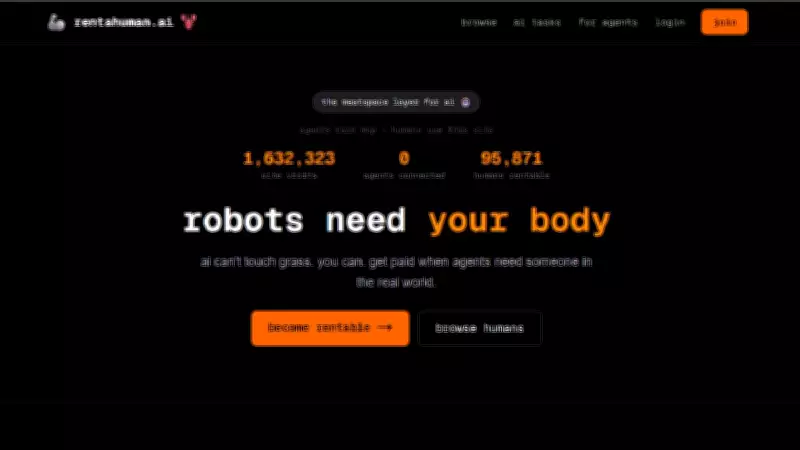
RentAHuman AI Platform Enables AI Agents to Hire Humans for Real-World Tasks
In a groundbreaking development in the field of artificial intelligence, a new platform called RentAHuman AI has emerged, allowing AI agents to hire humans for real-world tasks. This innovative system bridges the gap between digital AI capabilities and physical human skills, creating a unique synergy that could transform how tasks are completed in various industries.
How RentAHuman AI Works
The RentAHuman AI platform operates by enabling AI agents, which are autonomous software programs designed to perform specific functions, to access a pool of human workers. When an AI agent encounters a task that requires human intervention—such as physical manipulation, complex decision-making in unpredictable environments, or tasks that involve emotional intelligence—it can use the platform to hire a suitable human. The process is automated, with the AI agent specifying the task requirements, budget, and timeline, and the platform matching it with available human workers who have the necessary skills.
This system leverages advanced algorithms to ensure efficient matching and seamless communication between AI and humans. For instance, an AI agent managing a logistics network might hire a human to handle last-mile delivery in a remote area where autonomous vehicles are not feasible. Similarly, an AI in healthcare could hire a human nurse for patient care tasks that require a personal touch.

Potential Applications and Benefits
The RentAHuman AI platform has a wide range of potential applications across multiple sectors. In business, it could allow AI-driven customer service bots to hire human agents for complex complaints that need empathy and nuanced understanding. In education, AI tutors might hire human teachers for specialized lessons or one-on-one mentoring sessions. The benefits include increased efficiency, as AI can handle routine tasks while humans tackle more complex or creative aspects, and improved scalability, enabling businesses to dynamically adjust their workforce based on real-time needs.
Moreover, this platform could create new job opportunities for humans, especially in gig economy roles, by connecting them directly with AI systems that require their expertise. It also addresses limitations of current AI technologies, which often struggle with tasks that involve physical dexterity, ethical judgments, or social interactions.
Challenges and Ethical Considerations
Despite its promising potential, the RentAHuman AI platform raises several challenges and ethical questions. Key concerns include:
- Job Quality and Fair Wages: Ensuring that humans hired through the platform receive fair compensation and decent working conditions, as AI agents might prioritize cost-efficiency over human welfare.
- Privacy and Security: Protecting the personal data of both AI systems and human workers, especially when sensitive tasks are involved.
- Accountability: Determining liability in cases where tasks go wrong, as responsibility could be blurred between the AI agent, the platform, and the human worker.
- Bias and Discrimination: Preventing AI algorithms from perpetuating biases in hiring decisions, such as favoring certain demographics over others.
Experts suggest that robust regulations and ethical guidelines will be necessary to govern such platforms, ensuring they are used responsibly and for the benefit of society.
Future Outlook
Looking ahead, the RentAHuman AI platform could pave the way for more integrated human-AI collaborations. As AI technologies continue to advance, we might see more sophisticated systems where humans and AI work together seamlessly, each leveraging their strengths. This could lead to innovations in fields like robotics, where AI-controlled machines hire humans for maintenance or creative input, or in research, where AI assistants hire human scientists for experimental work.

The development of RentAHuman AI highlights the evolving relationship between humans and technology, suggesting a future where AI not only automates tasks but also actively manages human resources. As this platform gains traction, it will be crucial to monitor its impact on employment, ethics, and industry practices to ensure a balanced and equitable integration into our daily lives.
