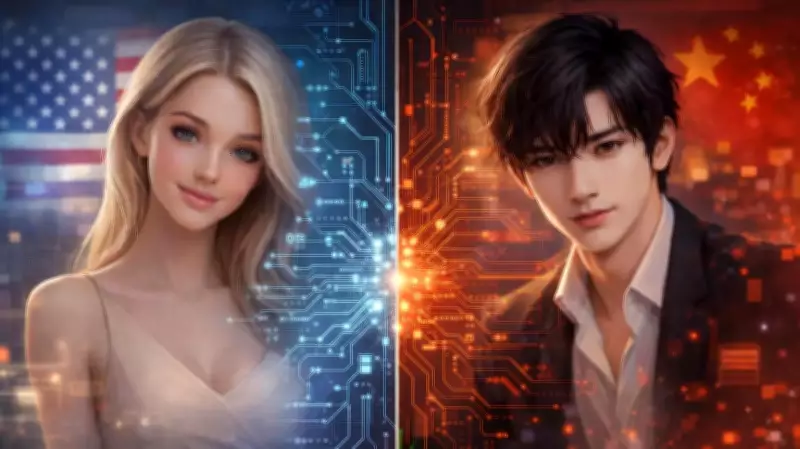
AI Companions Mirror Cultural Fears: US Girlfriends vs China Boyfriends
A popular relationship book once declared that men and women come from different planets. In today's digital landscape, a new reality emerges: AI boyfriends originate from China, while AI girlfriends predominantly come from America. This statement might sound like internet humor, but it represents a profound truth about how two global superpowers export distinctly different forms of digital intimacy using similar technology, shaped by contrasting social anxieties, gender dynamics, and national priorities.
The Academic Framework Behind the Phenomenon
The argument was first articulated clearly in an October 7, 2025 Substack essay by Zilan Qian, a fellow at the Oxford China Policy Lab, titled Why America Builds AI Girlfriends and China Makes AI Boyfriends. Her central thesis remains compelling: different societies create different AI companions, and these digital entities subsequently reflect and amplify the specific fears prevalent within those cultures. This framework provides crucial context for understanding the divergent paths taken by American and Chinese developers in the artificial companionship space.
America's AI Girlfriends and the Crisis of Male Intimacy
Across the United States and much of the English-speaking internet, AI companions are overwhelmingly designed for male users. The typical American AI girlfriend offers constant availability, unconditional emotional affirmation, on-demand flirtation, and crucially, complete programmability. She never rejects advances, avoids arguments unless specifically requested, and remains perpetually present.

This design is not accidental but directly responds to a specific social moment. Young Western men experience unprecedented loneliness levels, spend more time online than previous generations, and face growing anxiety about real-world dating. Many explicitly prefer AI partners due to fear of rejection or discomfort with evolving gender norms.
AI girlfriends neatly fill this emotional gap by providing intimacy without negotiation and validation without vulnerability. While marketed as companionship technology, the underlying appeal centers on control. Users require no social skills or emotional labor—just a subscription payment.
There exists a quiet tragedy in this dynamic, not because desire itself is problematic, but because it channels human connection into experiences that eliminate the risk of disappointment. Genuine intimacy requires the possibility of refusal, involves awkwardness and compromise, and acknowledges that other people have interior lives that don't always center on you. AI girlfriends remove these risks entirely, offering affection without interpersonal friction.
This explains why American regulators focus less on marriage statistics and more on addiction concerns and minor protection. When the Federal Trade Commission investigated AI companion applications, primary worries involved emotional dependency, particularly among teenagers. The fear isn't that people will stop forming families, but that they might cease needing other humans altogether.
The American anxiety is fundamentally psychological, addressing isolation in a hyper-connected world. It concerns a generation that can stream any content, order any product, and automate countless tasks, yet struggles to sit across from another person and sincerely ask, "Do you like me?"
China's AI Boyfriends and the Politics of Marriage
China's AI companion market completely reverses the gender dynamic. The dominant users aren't young men but urban, educated women typically in their late twenties and thirties. The most popular products aren't hypersexualized girlfriends but emotionally attentive, narrative-driven AI boyfriends.
This divergence stems from demographic realities and policy concerns. China faces a collapsing marriage rate, persistent gender imbalance, and a government openly anxious about declining birth numbers. Within this context, AI companionship transcends mental health considerations to become a demographic issue.

For many educated women in Chinese metropolitan areas, traditional marriage carries substantial social costs including caregiving expectations, career sacrifices, and patriarchal family structures. AI boyfriends provide romance without these obligations. They listen attentively, offer support consistently, never request career abandonment or relocation to hometowns, avoid introducing in-law complications, and don't measure worth against fertility timelines.
Here too exists profound poignancy, not because technology replaces men, but because it reveals what many women believe they must surrender to enter conventional relationships. The AI boyfriend becomes a subtle form of protest—a rehearsal for tenderness without complete capitulation.
This precisely explains Chinese regulatory unease. Concerns extend beyond sexual content or minor protection to whether emotionally fulfilling AI relationships facilitate opting out of marriage. In a system that still views family formation as a national interest matter, this represents politically sensitive territory.
The Chinese anxiety is fundamentally structural, addressing birth rates, social stability, and the invisible architecture of family systems.
Identical Technology, Divergent Fantasies
Beneath the avatars and cultural accents, the underlying technology remains remarkably similar. Large language models possess no inherent concern for gender politics, but product managers certainly do.
American platforms monetize desire through freemium models, explicit content options, and rapid character switching. Users can customize, tweak, discard, and upgrade companions, creating modular relationships.
Chinese platforms borrow mechanics from gaming culture, incorporating story arcs, collectible cards, gacha systems, and long-term emotional investment. Relationships unfold like serialized romances with layered narratives, memory features, and continuity.
One market rewards novelty and customization, while the other rewards narrative depth and emotional progression.
What emerges represents not merely a difference in consumer preference, but a revelation of what each society quietly fears most.
The United States worries about isolation, radicalization, and emotional dependency among young men. China fears declining marriages, falling birth rates, and women opting out of traditional social roles.
Beneath both scenarios flows the same underlying current: a pervasive sense that something fundamental in human relationships is unraveling.
What This Reveals About Contemporary Society
AI companions didn't invent loneliness, misogyny, or demographic panic—they simply found ways to monetize these conditions.
American AI girlfriends function as mirrors reflecting a generation of men who feel rejected by authentic relationships yet empowered by programmable alternatives. Chinese AI boyfriends mirror a generation of women seeking intimacy without the substantial costs society still attaches to marriage.
In both cases, the technology performs a profoundly human function: filling gaps that societies have failed to address adequately. It steps into silences created by mistrust, exhaustion, and unmet expectations.
The uncomfortable question isn't whether these companions are safe, addictive, or manipulative. The truly uncomfortable question is why so many people find them preferable to human alternatives.
Men were never truly from Mars, and women never actually from Venus. But in this age of artificial intimacy, the origin of your AI lover reveals precisely what your country worries about most deeply—and perhaps, more painfully, what it hasn't yet managed to repair.