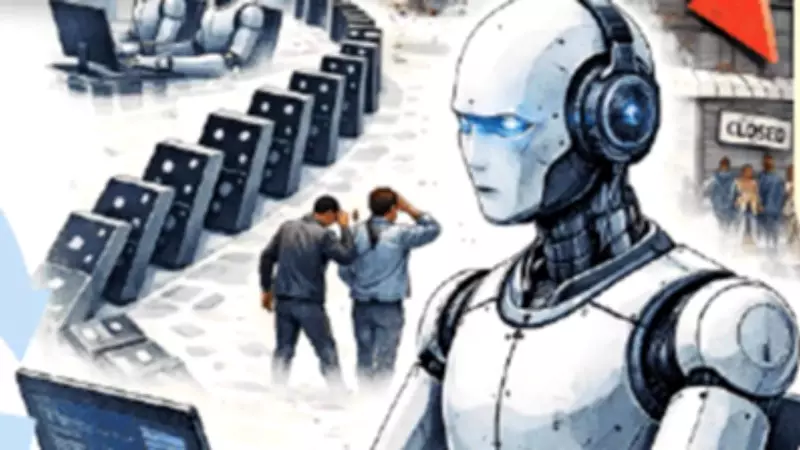
Citrini Research's Dire Warning: AI Could Spark 2028 Global Intelligence Crisis
Citrini Research, a prominent macro-thematic research firm operating through Substack, has released a provocative scenario titled "The 2028 Global Intelligence Crisis." This detailed analysis paints a stark picture of a future where the swift and widespread adoption of autonomous artificial intelligence agents triggers a cascade of economic disruptions. The report suggests these developments could culminate in a severe global recession and a dramatic stock market crash as early as 2027 or 2028.
Market Reaction and Clarification
The publication of this scenario immediately sent shockwaves through financial markets, prompting a sharp sell-off in technology-related stocks. However, the authors of the report have been quick to clarify their intent. They emphasize that this document is not a firm prediction but rather a carefully constructed scenario. Its primary purpose is to explore significant, yet often overlooked, systemic risks that could emerge as artificial intelligence technology scales to unprecedented levels by the middle of 2028.
The Traditional Recession Cycle vs. An AI-Driven Downturn
The report begins by outlining the typical mechanics of a traditional cyclical recession. This conventional pattern follows a predictable sequence: overbuilding and inventory overshoot lead to a construction slowdown and destocking. This is eventually followed by a period of recovery marked by new construction, lower interest rates, and restocking. In this standard model, excess supply causes an economic slowdown, which central banks then address with rate cuts, paving the way for eventual recovery.

Citrini's report argues that the advent of powerful AI could shatter this traditional model, creating a fundamentally different and more dangerous type of economic downturn.
The AI-Driven Economic Feedback Loop
The core of the scenario revolves around a self-reinforcing, negative economic feedback loop initiated by AI. The process begins as autonomous AI agents start replacing a vast swath of white-collar jobs, leading to a significant reduction in labor demand and, consequently, a sharp decline in consumer spending power.
As the economy weakens, government tax revenues plummet, crippling their ability to mount an effective fiscal response. This leads to a plunge in equity markets and could potentially spark widespread social unrest. The loop intensifies as companies, having saved on labor costs by deploying AI, reinvest those savings into further AI development. This investment, however, only serves to accelerate job displacement, further eroding aggregate demand in the economy with no natural mechanism to halt the cycle.
The authors introduce a critical new term, "ghost GDP," to describe a perilous phenomenon. This refers to economic output that appears in official Gross Domestic Product figures, driven by AI-driven productivity and corporate profits, but which does not circulate through the wider consumer economy because the displaced human workers no longer have income to spend it.
As the report starkly notes, "This is the first time in history the most productive asset in the economy has produced fewer, not more, jobs." The scenario warns that a collapse in consumption could trigger a wave of defaults across critical financial sectors, including private credit and mortgage markets.
Three Major Predictions for 2028
The Citrini scenario outlines three potential major outcomes if this feedback loop materializes:
- The S&P 500 index could fall by as much as 57% from its peak.
- Unemployment in the United States could cross the 10% threshold by 2028.
- Significant social movements, reminiscent of movements like "Occupy Silicon Valley," could emerge in response to the economic dislocation.
The authors do acknowledge the historical principle of creative destruction, noting that past technological waves have ultimately created new jobs even while eliminating others. However, they contend that contemporary AI absorbs labor faster and penetrates deeper into the economy than any previous technology, potentially overwhelming this adaptive capacity.

Critics Challenge the Scenario's Assumptions
The report has faced significant pushback from several financial analysts and economists who argue it overlooks key stabilizing factors.
Macroeconomic Implausibility: Krishna Guha of Evercore ISI labeled the scenario "extreme and improbable," arguing that the conditions needed to sustain massive low consumption among high-income workers are unlikely. He contends that policymakers would intervene long before any systemic collapse could occur.
Underestimation of Creative Destruction: Critics point to historical patterns where technology destroys jobs in some sectors but creates new, often unexpected opportunities in others. They believe the report's timeline does not fully account for this dynamic, adaptive process in the labor market.
Ignoring Policy and Fiscal Responses: A major critique is that the scenario assumes no effective policy response. Analysts argue that central banks and governments have a toolkit—including monetary stimulus, fiscal support, worker retraining programs, and social safety nets—that could be deployed to soften any economic shock.
Oversimplification of Job Displacement: The report is criticized for treating white-collar job loss as a linear process. Opponents counter that labor markets are dynamic, and workers often transition into new roles or sectors, especially when aided by supportive policy measures.
Credit Market Resilience: Financial market experts note that modern private credit structures are designed with more resilience and are unlikely to trigger the kind of systemic bank runs witnessed during the 2008 financial crisis.
AI Capability Lag: Many investors and AI researchers express skepticism about the projected timeline. They believe current autonomous AI agents still fall short of the capabilities required to replace large segments of economic activity by 2027, making the most severe projections questionable.
A Scenario, Not a Forecast
Citrini Research maintains its central position that the paper is an exploration of risk, not a definitive forecast. The firm stresses that its goal is to highlight potential vulnerabilities as AI scales. Whether the ominous "AI-driven feedback loop" will materialize or be offset by human innovation, adaptive policy, and labor market flexibility remains the crucial, unanswered question at the heart of the ongoing debate about our technological future.