AI Technology Bridges the Gap Between Musical Dreams and Beginner Skills
Picture a young child who hears a beautiful melody for the first time. She feels an instant connection to the music. A strong desire to play that song on the piano fills her heart. She searches for the sheet music with excitement. But when she finds it, the notes look impossibly complex. The pages show dense chords and fast passages that would require years of practice to master.
This child now faces a difficult choice. She can either work through boring beginner exercises that have no relation to her favorite song. Or she can simply give up on her musical dream. Sadly, most children choose to abandon their aspirations at this point.
A Fundamental Problem in Music Education
This frustrating scenario repeats itself millions of times every single year. It highlights a critical weakness in traditional music teaching methods. The music people genuinely want to play rarely matches the music they can actually play at their current skill level. What if modern technology could solve this persistent problem?

Imagine if artificial intelligence could automatically adapt any song to any ability level. This technology would create a customized learning path from the very first lesson all the way to a complete performance. This vision has now become a reality thanks to groundbreaking research.
The Researcher Behind the Innovation
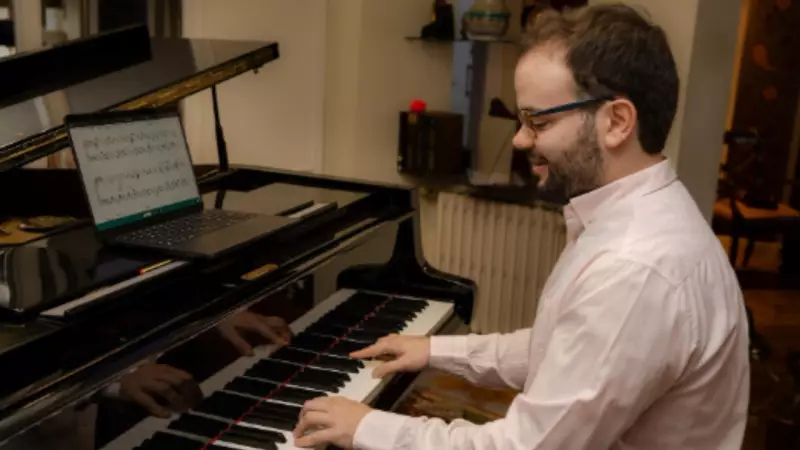
Pedro Ramoneda has dedicated his professional career to solving this exact challenge. As a leading researcher in artificial intelligence and music technology, Ramoneda has developed revolutionary systems. His technology can analyze how difficult a musical piece is to perform. It then generates simplified versions specifically tailored to a student's current abilities.
This work opens the door to a completely new era of personalized music education. In this new approach, the curriculum adapts to fit the learner rather than forcing the learner to fit the curriculum.
Ramoneda completed his doctoral research at the prestigious Music Technology Group of Universitat Pompeu Fabra in Barcelona. This institution ranks among the world's top centers for music technology innovation. He worked under the guidance of Professor Xavier Serra during his studies.
Personal Motivation and Professional Recognition
As an accomplished pianist himself, Ramoneda explains his core motivation clearly. "My goal was to reduce the gap between the motivational spark a musician has to learn a song and the available tools students, teachers, and institutions had to kindle that spark into a flame," he states. His approach "places the performer at the center and understands music as a creative and educational activity, not only as a consumer product."
The research has earned significant recognition at the field's most important international conferences. These include ISMIR, ACM Multimedia, and ICASSP. Leading academic journals have published his findings.
In 2024, Universitat Pompeu Fabra honored him with the Open Science Award. This recognized the best use of open data in a doctoral thesis. Dr. Dasaem Jeong, Professor at Sogang University in South Korea, collaborates internationally with Ramoneda. He describes him as "one of the world's most talented music information retrieval researchers." Jeong notes that his work "applying state-of-the-art AI/ML methodologies to music leveling has established himself as a global pioneer in the space."
Industry Attention and Real-World Application
Major music technology companies have taken notice of Ramoneda's expertise. Sony's Computer Science Laboratories in Tokyo funded a research internship where he worked on AI-powered music generation. He also completed additional research at Yamaha's R&D division. There he focused on creating personalized practice exercises for music students.
These important collaborations demonstrate growing industry recognition. Adaptive music technology clearly represents the future of how people will learn to play instruments.

Now Ramoneda is bringing his laboratory research into practical application. He recently joined Songscription, a U.S.-based education technology startup. The company's mission is to "empower musicians worldwide to play, share, and learn the songs they love." Songscription has developed artificial intelligence that can automatically transcribe audio into sheet music. The company recently raised funding to expand its research team.
Transforming Music Education Globally
Andrew Carlins serves as Songscription's Co-Founder and CEO. He explains the strategic hiring decision. "Most musicians—and most of our user base—are amateurs. Being able to turn any song into sheet music tailored for a specific level of play would be a complete game changer. This technology has the potential to finally make music accessible to millions of people who historically have been left out. We hired Pedro because we believed that if there was anyone in the world who could solve this problem, it was him."
The implications extend far beyond Western classical music training. Raman Khanna offers valuable perspective on this expansion. He previously served as Stanford University's Chief Information Officer. He now works as Managing Director of Dell Technologies Capital. Khanna also acts as an angel investor in Songscription.
He sees tremendous potential for preserving and sharing musical traditions across the globe. "Indian classical music has been an oral tradition with limited ways to notate," he explains. "Songscription's technology creates a way to automatically transcribe ancient melodies so we can ensure they will be preserved for future generations. And if they can successfully develop technology that automates music leveling, it stands to make genres like Indian classical music more accessible to millions of amateur musicians globally."
A New Future for Music Learners
For many generations, music education followed a rigid one-size-fits-all model. Standardized curricula dictated fixed progressions. Students faced a long, difficult road before they could play the music that originally inspired them.
Ramoneda's pioneering research points toward a fundamentally different future. Learning music could become as personalized as the playlists we listen to every day. That enthusiastic ten-year-old with a favorite song might finally have a clear path to start playing it on her very first day of lessons.