

Artificial Intelligence Emerges as Cornerstone for India's Viksit Bharat 2047 Vision
During a pivotal session at the Advantage Vidarbha 2026 event—Vidarbha's Mega Industrial Expo, Business Conclave, and Investment Summit held on Friday in Nagpur—artificial intelligence was spotlighted as a fundamental pillar in India's ambitious roadmap toward achieving Viksit Bharat by 2047. Industry leaders, government officials, and academics converged to underscore how AI-driven solutions can revolutionize diverse sectors, including mining, logistics, tourism, agriculture, and education, while fostering inclusive and sustainable economic growth. The discussion emphasized that Generation Z holds significant potential to contribute to this national vision through innovation and technology adoption.
Visionary Insights from Industry Experts
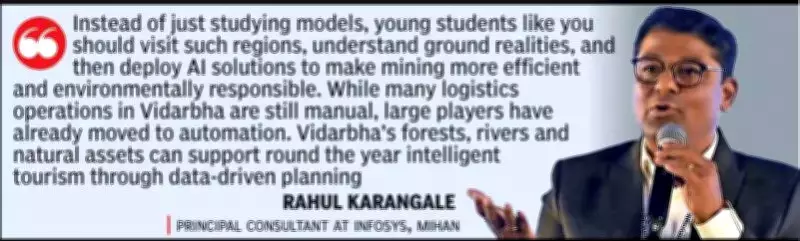
Rahul Karangale, principal consultant at Infosys, Mihan, set the foundational tone by articulating the holistic vision of Viksit Bharat. "Development cannot be seen in isolation. Ecology, economy, and overall growth have to move together," he asserted. Using Gadchiroli as a case study, Karangale highlighted the urgent need for sustainable mining practices, which can be enhanced through AI-based precision technologies. He urged young students to move beyond theoretical models and engage directly with ground realities, deploying AI to make mining operations more efficient and environmentally responsible.
Karangale also pointed to substantial opportunities in automated logistics and intelligent tourism. "While many logistics operations in Vidarbha remain manual, large players have already transitioned to automation," he noted. He further elaborated that Vidarbha's rich natural assets—such as forests and rivers—can support year-round intelligent tourism through data-driven planning and management.

Evolution and Everyday Applications of AI
Shantanu Vishwanadha, developer relations (APAC) at Zencoder, traced the remarkable evolution of AI from rigid, rule-based systems to today's advanced, adaptive models. He explained everyday applications, stating, "Famous food delivery platforms track user history through APIs to personalize recommendations—that is AI in action." Vishwanadha highlighted the paradigm shift between 2005 and 2025, citing examples from autonomous vehicles to digital payments, and underscored AI's critical role in platforms like UPI, where machine learning is essential for security and threat detection.
Showcasing Real-World Implementations
Ranjan Pandhare, head of MahaSTRIDE's Nagpur division, delivered a concise presentation on India's first smart intelligent village, Satnavari, showcasing practical AI and IoT use cases already in implementation. These include:
- Smart healthcare systems that connect rural patients with specialist doctors remotely.
- Precision agriculture techniques that optimize pesticide usage for better crop yields.
- AI-driven water monitoring systems to enhance quality and ensure reliable supply.
Pandhare revealed that each model village requires an investment of approximately Rs 60-70 lakh, with nearly 75 such villages planned across Maharashtra, demonstrating a scalable approach to rural development.
Bridging Skills and Employment Gaps
Dr. Pramod Jumle, director of training at the Board of Apprenticeship Training, Government of Maharashtra, focused on the practical implications of Viksit Bharat for students and educators. Referencing the National Education Policy (NEP) 2020, he emphasized its strong focus on employability through skill-based learning and apprenticeships. Dr. Jumle highlighted that while India boasts nearly 16% of the world's AI talent and a rapidly expanding pool of over 600,000 AI professionals, demand for expertise in AI, data science, cybersecurity, cloud computing, and related fields continues to outstrip supply, signaling a need for accelerated skill development.

Youth and Academia's Role in Responsible AI Adoption
Dr. Smita Singh (Dabholkar), assistant professor at IMT, Nagpur, accentuated the pivotal role of youth and academic institutions in harnessing AI responsibly to support the national development vision. She called for ethical frameworks and collaborative efforts to ensure that AI advancements align with sustainable and inclusive growth objectives, empowering the next generation to drive innovation while addressing societal challenges.
This comprehensive dialogue at Advantage Vidarbha 2026 not only reinforced AI's transformative potential but also charted a clear path for integrating technology into India's journey toward Viksit Bharat 2047, with a strong emphasis on sustainability, inclusivity, and youth engagement.
