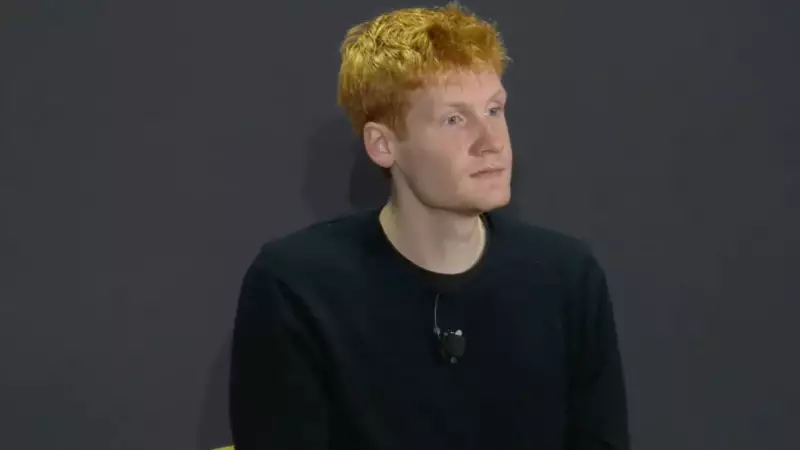
The CEO of a leading AI-powered coding startup has issued a serious warning to software developers worldwide. Michael Truell, the 25-year-old head of the $29.3 billion startup Cursor, cautions that relying blindly on artificial intelligence to write code is a dangerous practice that builds applications on unstable ground.
The Perils of 'Vibe Coding' in Software Development
Speaking at Fortune's Brainstorm AI conference, Truell criticized the trend of 'vibe coding'—where developers let AI generate code without proper review or understanding. He argued that while this method might work for quick prototypes, it creates a fragile foundation for serious, large-scale applications.
'If you close your eyes and don't look at the code and have AIs build things with shaky foundations, as you add another floor, and another floor, things start to kind of crumble,' Truell explained. He drew a vivid comparison, stating that this hands-off approach is like constructing a house without understanding its electrical wiring or plumbing. The structure might appear fine initially, but serious problems will emerge as complexity increases.

Industry Leaders Echo Concerns Despite Rapid AI Adoption
Truell's warning comes at a time when AI is rapidly transforming software engineering. Google CEO Sundar Pichai recently revealed that AI now writes over 30% of new code at the tech giant, up from 25% just months ago. Similarly, Anthropic CEO Dario Amodei claimed that the Claude AI model generates a staggering 90% of his company's code.
However, Truell and other experts draw a critical distinction. They separate AI-assisted coding, where developers remain actively engaged and comprehend the output, from 'vibe coding,' where programmers essentially outsource thinking to machines.
This skepticism is shared by other pioneers in the field. Boris Cherny, the creator of Anthropic's Claude Code, acknowledged that vibe coding works for 'throwaway code and prototypes' but fails when developers need 'maintainable code' requiring thoughtful attention to every line. Andrej Karpathy, the former Tesla AI director who coined the term 'vibe coding,' recently admitted the method was useless for his Nanochat project, which he had to write entirely by hand because AI agents 'just didn't work well enough.'
Research Reveals Productivity Paradox and Market Response
Real-world data supports these cautionary views. Research from METR found that AI coding assistants actually decreased the productivity of experienced developers by 19%, despite participants expecting a significant boost. In a separate report, consultancy Bain & Company noted that programming delivered 'unremarkable' cost savings, even though it was among the first fields to embrace generative AI.
Despite these productivity questions, the market's hunger for AI coding tools is undeniable. Truell positions Cursor as offering the right balance—embedding AI into developers' environments to predict code and handle routine tasks while ensuring programmers stay involved. 'In the places where you want to take a step back and ask the AI to do something end-to-end, you can do that too,' he said, stressing the continued need for developer oversight.
The response has been enthusiastic. Founded by four MIT graduates in 2022, Cursor secured $8 million from OpenAI's Startup Fund in 2023. It recently closed a massive $2.3 billion funding round. The company now employs 300 people and generates $1 billion in annualized revenue.
Truell's core message remains clear: while AI coding offers tremendous power, treating it as a magical black box that produces flawless software is a recipe for disaster, especially as applications scale. The key is intelligent collaboration, not blind delegation.