

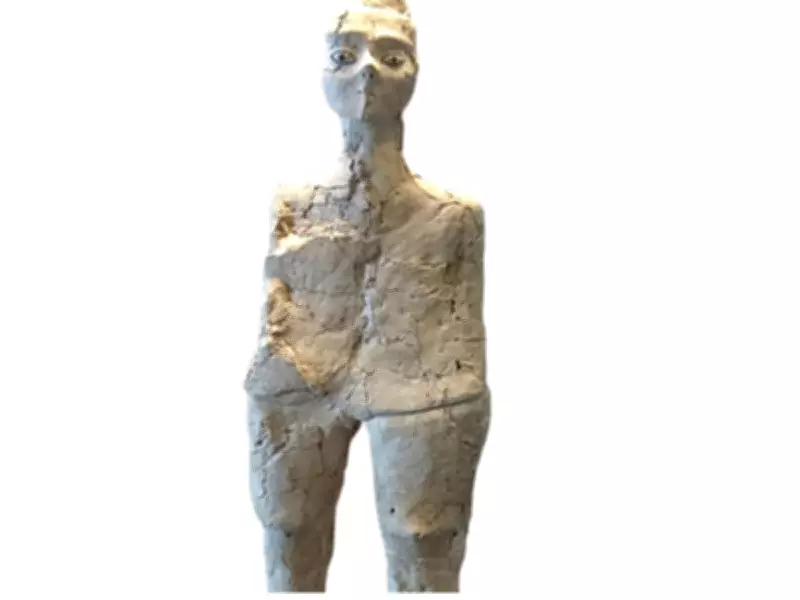
In 1983, a routine road construction project just outside Amman, Jordan, uncovered an extraordinary find. Workers digging into the earth broke into a buried pit, exposing a cache of humanlike plaster faces, preserved for millennia.
The Ancient Site of 'Ain Ghazal
This was the ancient site of 'Ain Ghazal, a major Pre-Pottery Neolithic settlement that flourished during the 7th–6th millennium BCE, approximately 7,000 to 9,000 years ago, depending on calibration. The pit was not just any pile of debris but a carefully arranged collection of plaster statues and busts. This discovery challenged earlier views of how early human communities evolved from simple farming settlements into complex social, symbolic, and ritual societies.
Scheduled Burial in an Ancient Village
The 'Ain Ghazal discovery is profound not only because of the age of the statues but also because of the exact context in which they were found. The statues were deliberately buried in a cache and were not reported as lying under the floor of a building used repeatedly over generations. An archived research record catalogued by the Smithsonian Museum Conservation Institute states that twenty-two plaster human statues and busts were recovered from this single intentional deposit. This deliberate positioning of items within an occupied village indicates that they were not merely discarded as rubbish.

Stone Age Technology and Sophisticated Craftsmanship
These figures were carefully made and highly sophisticated. They were engineered objects requiring careful planning, specialist materials, and a defined production sequence. Technical analyses show that the 'Ain Ghazal artisans constructed these figures by carefully building up layers of lime plaster in stages over internal bundles of reeds bound tightly together with cordage. Some larger statues were assembled from separately modelled body parts that were joined together. This complexity demonstrates that these early villagers had very controlled techniques and shared community knowledge to produce such fantastic artistic engineering, centuries before widespread metallurgy.
More Than Just Farming to Survive
For a long time, scholars treated early villages primarily as functional, economic settlements dedicated solely to agriculture, housing, and basic survival needs. 'Ain Ghazal complicated that simple picture. In 1985, a second cache of statues was discovered, showing that these creations were not a one-off event but part of a wider cultural pattern. In the University of Texas 'Ain Ghazal presentation, these statues are set in a dense symbolic landscape of tokens, figurines, modelled skulls, standing stones, and wall paintings. Interestingly, the peak of this intense artistic production occurred in the very early period of the village's occupation. This evidence suggests that early settled communities developed complex systems of ritual, memory, and shared belief.
Why the Plaster Faces Still Resonate
The faces of 'Ain Ghazal are striking because they are both humanlike and abstract. Their wide-set eyes and realistic expressions create a vivid link to the distant past. These figures indicate that the shift to settled life involved not just economic changes but also social, symbolic, and ritual developments. The people of 'Ain Ghazal were preoccupied with organising labour, managing rituals, and inventing visual culture to figure out who they were. More than 8,000 years later, these plaster faces continue to prompt new ways of thinking about the first villages.






