

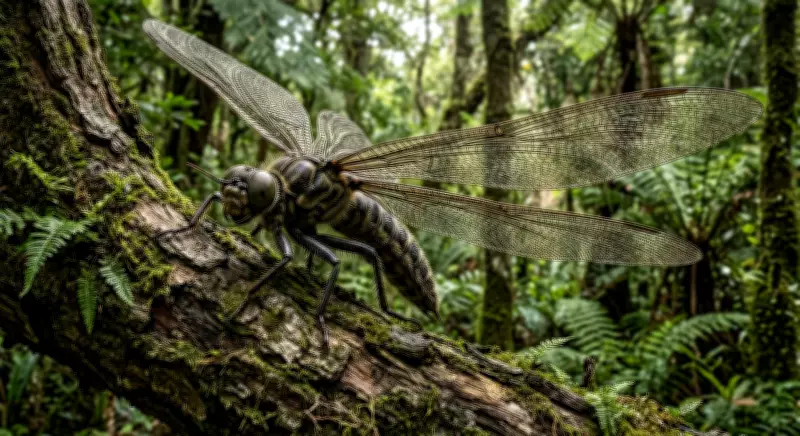
Imagine a dragonfly with a two-foot wingspan whizzing by your head. That was prehistoric Earth, and scientists just realized they have had the wrong explanation all along. Some 300 million years ago, Earth was almost unrecognizable. A huge supercontinent called Pangaea covered the globe, and swampy coal forests extended for miles near the equator. Insects flew above that were so enormous that today's bugs look laughably small: griffinflies with wingspans up to 27 inches and mayfly-like creatures nearly as wide as a standard ruler is long.
For decades, scientists had a tidy explanation for all this: more oxygen in the air. The prehistoric atmosphere had about 45% more oxygen than we breathe today, and researchers thought that enabled insects to balloon to such proportions. However, a new study has thrown a giant wrench in that theory, and the truth is way more interesting.
Why scientists blamed oxygen in the first place
Insects do not breathe as we do. No lungs are involved. Instead, they have a system of tiny branching tubes called tracheoles, which carry oxygen directly to the muscles by diffusion. The efficiency of diffusion decreases over longer distances, so scientists thought there was a hard limit to how big an insect could get, and that limit increased with more oxygen in the air. In 2010, a study identified several plausible mechanisms linking tracheal oxygen delivery to insect body size, and the case for high oxygen levels enabling prehistoric gigantism seemed well supported. It was a clean story: more oxygen, bigger bugs. Everybody moved on.

What researchers found when they looked closer
A team led by Edward Snelling of the University of Pretoria used high-powered electron microscopy to examine exactly how much space tracheoles actually occupy within insect flight muscles. The answer? Hardly any. Tracheoles make up about 1% or less of the flight muscle in most insect species, and that pattern holds true for ancient griffinflies. That is a surprisingly low footprint. In contrast, the capillaries in the heart muscle of birds and mammals occupy about ten times more relative space than the tracheoles in insect flight muscle. If oxygen transport really was the bottleneck limiting insect size, you would expect evolution to have packed in far more tracheoles, especially during a period when giant insects were thriving. It did not.
What actually made them so huge?
Now here is where it gets really mysterious. No one knows for sure. The oxygen theory has been called into question, but nothing has come along to cleanly replace it. A 2012 study found that insect size tracked atmospheric oxygen levels for the first 150 million years of insect evolution, but then completely decoupled, indicating that other factors eventually took over. One popular candidate is predation. There were no birds, no bats, no fast-moving vertebrate predators hunting from above when griffinflies dominated the skies. When those animals developed, being huge was a liability, not an asset. It is easier to catch a larger insect. The other option is physical limitations on the exoskeleton. There may be hard limits to how large an insect's body can become before it ceases to work efficiently, no matter how much oxygen is available.
Why this matters beyond prehistoric trivia
It is easy to put this one in the 'cool but irrelevant ancient history' file, but its implications are larger than they seem. Understanding the rules of biology that govern body size matters for how we model ecosystems, how we think about evolution, and how we think about the limits of life on Earth or potentially elsewhere. So, the griffinflies may be gone, but the questions they leave behind are very much alive. Scientists essentially have to go back to the drawing board on one of paleontology's most persistent puzzles, and that is rarely a bad thing for science.






