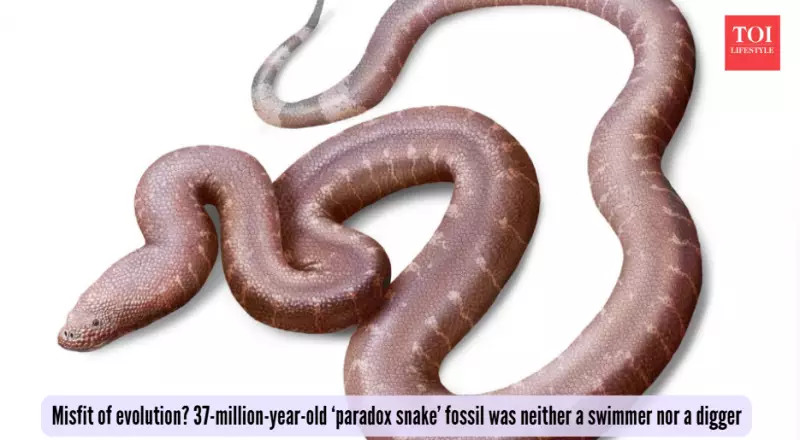
Ancient 'Paradox Snake' Fossil Discovered in England Challenges Evolutionary Theories
Imagine discovering a puzzle piece that doesn't belong to any known picture, forcing you to reconsider the entire puzzle's design. This is precisely what happened when paleontologists examined a 37-million-year-old snake fossil from England that defies classification within existing evolutionary frameworks. The remarkable discovery has sent shockwaves through the scientific community, prompting a complete reevaluation of snake evolution timelines and ancient habitat distributions.
Decades of Obscurity Before Revolutionary Discovery
For forty long years, these tiny snake vertebrae collected from England's Hordle Cliff remained tucked away in London's Natural History Museum drawers, gathering dust and escaping scientific scrutiny. As documented in the museum's fossil history records, these specimens initially received minimal attention when revisited in 1981. The breakthrough came when Dr. Georgios Georgalis decided to take a fresh look at these forgotten remains. Collaborating with Dr. Marc Jones, the research team employed advanced μCT scanning technology to reveal astonishing anatomical features that matched no known snake species in the scientific record.
The newly identified species, officially named Paradoxophidion richardoweni, originates from rock formations dating back 37 million years. This discovery has effectively turned established snake family trees upside down, challenging long-held assumptions about evolutionary pathways and relationships between ancient species.

Baffling Anatomical Features That Defy Classification
The fossilized vertebrae exhibit remarkably sturdy, chunky structures with distinctive spike-like hypapophyses running along their length. According to detailed analysis published in the scientific journal Comptes Rendus Palevol, these anatomical characteristics bear no resemblance to adaptations found in burrowing snakes or fully aquatic species. While displaying some superficial similarities to extinct russellophiids or contemporary elephant trunk snakes, crucial differences prevent classification within either group.
The name "paradox snake" perfectly captures this creature's confusing combination of traits that seem to contradict established evolutionary patterns. Scientists hypothesize it might represent an early offshoot of caenophidian snakes, the most modern snake group, suggesting far greater biodiversity existed in ancient England's subtropical environments than previously imagined. Without a preserved skull, researchers cannot determine exact behavioral patterns, but evidence clearly indicates this snake wasn't a dedicated burrower or full-time swimmer.
Vertebrae remain the most commonly discovered fossil elements for ancient snakes, containing distinctive characteristics that enable species identification and evolutionary classification.
Reconstructing England's Ancient Subtropical Environment
Thirty-seven million years ago, southern England experienced dramatically different climatic conditions, baking under subtropical heat while positioned closer to the equator with significantly elevated atmospheric CO₂ levels. Hordle Cliff has served as a paleontological treasure trove since the 1800s, previously yielding important specimens like early constrictors such as Paleryx. The site's scientific exploration was pioneered by Richard Owen, the Natural History Museum's founder, whose early excavations laid groundwork for modern discoveries.
According to the Comptes Rendus Palevol publication, all thirty-one vertebrae—each measuring just a few millimeters in length—originated from a single individual snake, as confirmed through detailed digital scans now accessible to researchers worldwide. The specimen's minuscule size likely contributed to its decades-long obscurity within museum collections, highlighting how technological advancements continue to reveal hidden secrets in previously examined materials.

Evolutionary Implications and Scientific Reevaluations
If subsequent research connects Paradoxophidion richardoweni to the Acrochordidae family (wrinkly water snakes), this would push their documented European history back by an astonishing fifteen million years, completely rewriting established range maps and migration patterns. Snake evolution already presents considerable complexity for researchers, and reliance on vertebral evidence alone frequently generates scientific debate and reinterpretation.
This enigmatic specimen challenges existing familial groupings within snake taxonomy and underscores the importance of reexamining museum collections with modern analytical techniques. Exhibiting neither specialized digging adaptations nor swimming modifications, this ancient snake likely occupied a unique ecological niche—a lifestyle grey zone that defies easy categorization. The discovery emphasizes how much remains unknown about prehistoric ecosystems and evolutionary pathways, encouraging scientists to approach established theories with renewed curiosity and investigative rigor.