

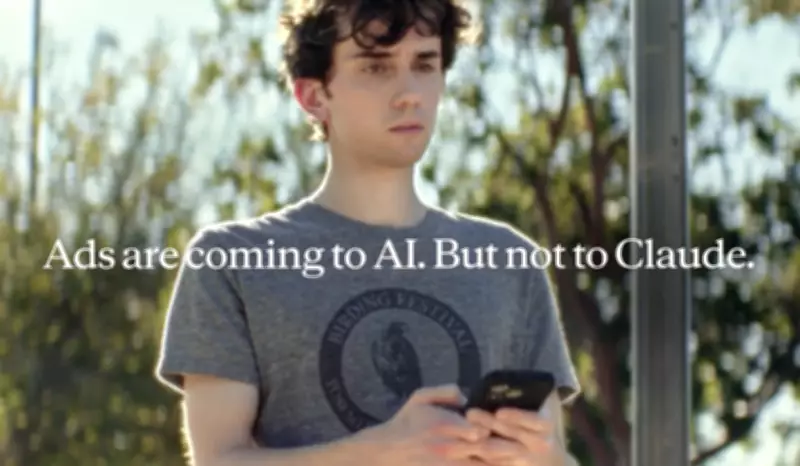
In a bold marketing move, Anthropic, the artificial intelligence startup behind the Claude chatbot, made its Super Bowl advertising debut with a clever 30-second commercial that directly targets rival OpenAI's recently announced plans to introduce advertisements within its ChatGPT platform.
The Super Bowl Spot That Mocked AI Advertising
The commercial, which aired during the highly-watched championship game, dramatized the potential frustration of advertisements intruding into artificial intelligence conversations. The advertisement features a young man performing pull-ups in a park who asks a muscular bystander for advice on achieving six-pack abs. After listening to the question, the bystander begins with a robotic, chatbot-like response before abruptly pitching 'StepBoost Max' insoles, complete with a promotional discount code.
The tagline effectively drives the point home: 'Ads are coming to AI, But not to Claude.' This clear positioning statement establishes Anthropic's stance against advertising within AI assistant conversations while simultaneously taking a jab at OpenAI's business strategy.

Direct Response to OpenAI's Announcement
While the Anthropic advertisement does not explicitly mention OpenAI by name, industry observers immediately recognized it as a direct response to OpenAI CEO Sam Altman's recent announcement that advertisements will soon appear within ChatGPT. Last month, Altman revealed that OpenAI would begin testing advertisements in ChatGPT in the coming weeks, specifically targeting users on the Free tier and the newly launched ChatGPT Go plan.
The ChatGPT Go plan represents an $8-per-month subscription that recently debuted in the United States market. Notably, Altman clarified that higher-tier subscribers on Plus ($20 per month), Pro ($200 per month), and Enterprise plans would remain advertisement-free, creating a tiered approach to monetization.
'We are starting to test ads in ChatGPT free and Go tiers,' Altman wrote on the social media platform X (formerly known as Twitter). He added that the company 'will not accept money to influence the answer ChatGPT gives you, and we keep your conversations private from advertisers.'
Altman further explained the business rationale behind this decision: 'It is clear to us that a lot of people want to use a lot of AI and don't want to pay, so we are hopeful a business model like this can work.'
Sam Altman's Response to the Anthropic Advertisement
Interestingly, Altman himself acknowledged the advertisement created by Anthropic and shared his thoughts through a post on the social media platform X. 'First, the good part of the Anthropic ads: they are funny, and I laughed,' Altman wrote. 'But I wonder why Anthropic would go for something so clearly dishonest. I guess it's on brand for Anthropic doublespeak to use a deceptive ad to critique theoretical deceptive ads that aren't real, but a Super Bowl ad is not where I would expect it.'
This public exchange highlights the growing competitive tension between two of the most prominent artificial intelligence companies in the rapidly evolving AI assistant market.
Anthropic's Broader Advertising Campaign
Beyond the 30-second Super Bowl commercial, Anthropic also aired a 60-second pregame advertisement that continued the theme of mocking intrusive advertising. This longer spot featured a therapy session that humorously veers into a promotional plug for a fictional dating site called 'Golden Encounters.'
This coordinated campaign signals a significant shift in artificial intelligence marketing strategies. Rather than focusing on reassuring messages about safety and employment impacts, Anthropic has adopted a more playful, competitive positioning that directly contrasts its approach with that of its main rival.
Andrew Stirk, Anthropic's head of brand marketing, explained the company's strategic thinking behind the campaign: 'There's a time and place for ads, and we don't believe your conversations with AI should be one of them.' This statement clearly articulates Anthropic's brand values while simultaneously criticizing OpenAI's advertising plans.

The Evolving AI Assistant Landscape
The public exchange between these two artificial intelligence giants reflects the intensifying competition in the AI assistant market. As companies seek sustainable business models for their expensive-to-develop AI technologies, different approaches to monetization are emerging. While OpenAI appears to be exploring advertising as a revenue stream for its free and lower-tier users, Anthropic is positioning itself as an advertisement-free alternative.
This competitive dynamic extends beyond mere feature comparisons to encompass fundamental differences in business philosophy and user experience. The Super Bowl advertisement represents one of the most public manifestations of this growing rivalry, bringing what was previously an industry discussion into mainstream consciousness through one of advertising's most prestigious platforms.
As artificial intelligence continues to integrate into daily life and business operations, the question of how these powerful tools will be funded remains central to their development and accessibility. The contrasting approaches of Anthropic and OpenAI provide a fascinating case study in how different companies are addressing this fundamental challenge in the rapidly evolving AI landscape.
