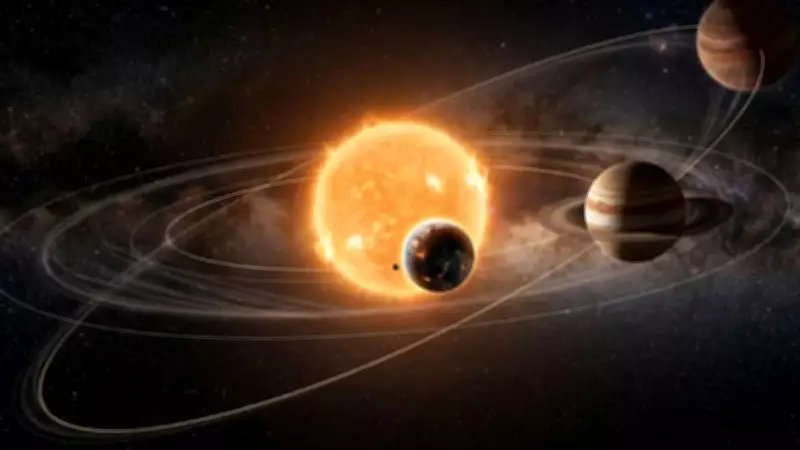
Astronomers have announced the discovery of the TOI-201 planetary system, a remarkable find that significantly expands our understanding of how solar systems form and evolve. Located 370 light-years from Earth, this system comprises three distinct objects: a super-Earth, a warm Jupiter, and a very massive brown dwarf. Unlike the relatively stable 'pea in pod' architecture of our own solar system, the planets in TOI-201 are all in misaligned orbits that are rapidly shifting in real-time due to extreme gravitational interactions.
Dynamic Instability Observed in Real-Time
Researchers have determined that the gravitational tug-of-war among these three planets is continuously altering the overall structure of the TOI-201 system on human-observable timescales. This dynamic instability is a rare phenomenon that present telescopes have seldom observed. According to a study published in Science Advances, the gravitational interaction between the outer brown dwarf and the two inner planets is causing large variations in orbital angles over time. Because of this non-coplanarity, the planets will eventually move out of Earth's line of sight. Scientists estimate that in as little as 200 years, the inner super-Earth will no longer transit its parent star, with the other planets following in close succession.
The Role of the Brown Dwarf
The TOI-201 system consists of three distinct astronomical objects: a rocky super-Earth (TOI-201 d), a gaseous 'warm Jupiter' giant (TOI-201 b), and a brown dwarf (TOI-201 c). The brown dwarf is the second most massive object in the system, after the central star, and follows a highly elliptical orbit that takes approximately 7.9 years to complete. This massive brown dwarf causes 'transit timing variations' observed by NASA's TESS mission, as its gravitational force affects the timing of the inner planets' transits. These variations allow astronomers to derive crucial information about the overall system architecture.

Unlocking Planetary Migration
Most planetary systems appear static, with only subtle changes occurring over millions or billions of years. TOI-201 is scientifically invaluable because it offers a real-time laboratory to study how planets migrate and evolve through secular evolution. By combining data from TESS with ground-based observatories, such as the ASTEP telescope in Antarctica, scientists have created a 3D map of this planetary system. This map will enable researchers to investigate the mechanisms of giant planet inward migration and the complex interactions that lead to systems unlike our own orderly, coplanar solar system.
This discovery underscores the diversity of planetary architectures in the universe and provides a unique opportunity to witness planetary dynamics on human timescales.