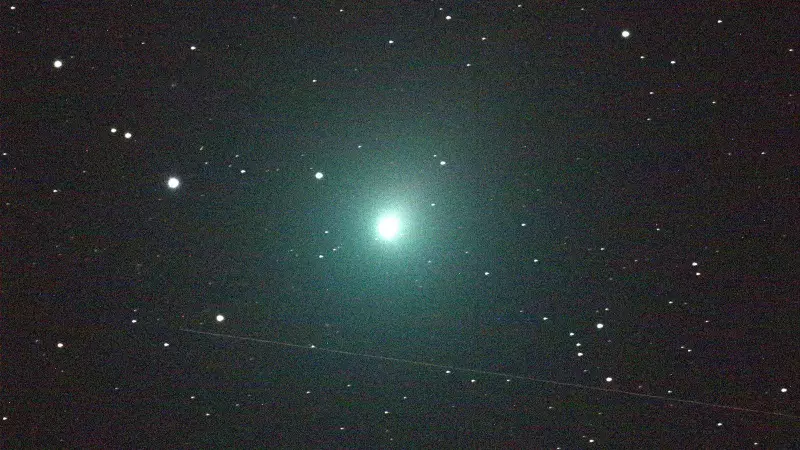
Interstellar Intruder ATLAS Ignites Alien Debate After Earth Encounter
Astronomers have sounded a prowler alert in our solar system. A mysterious object, named ATLAS, has arrived from deep interstellar space. It made its closest approach to Earth in December 2025 before swinging away on a path that clearly shows it is not bound by the Sun's gravity. This discovery has sparked intense speculation, with some experts even suggesting it could be an alien-controlled spaceship targeting our planet.
A History of Cosmic Trespassers
ATLAS is not the first interstellar visitor to capture our attention. In the past five years, astronomers have spotted three such intruders. The first, Oumuamua, was discovered in November 2017. It moved too fast to be a normal solar system object and had a strange, pancake-like shape. Its jerky motion resembled a comet, but it lacked the typical fuzzy halo. Scientists theorized it might be a nitrogen-rich fragment from a distant planetary system, ejected billions of years ago.
Then, in August 2019, amateur astronomer Gennadiy Borisov found a second object. Borisov displayed a cometary halo and contained unusual amounts of carbon monoxide and carbon dioxide. Observations with the Hubble Space Telescope later showed it fragmenting, a common behavior for icy comets.

ATLAS: The Fastest Visitor Yet
Discovered in July 2025, ATLAS has been confirmed as an interstellar object. It moves faster than both Oumuamua and Borisov. On December 19, 2025, it passed Earth at a distance of 270 million kilometers, more than twice the Earth-Sun gap. It is now heading toward Jupiter and will soon exit our solar system entirely.
ATLAS shows a comet-like glow but lacks a typical tail. Spectral analysis reveals it has more carbon dioxide relative to water than most solar system comets. This suggests it formed in an extremely cold region of a distant star system, where dry ice dominates. Its eerie greenish glow, caused by nickel vapor, has fascinated observers, though this is not uncommon in comets.
Alien Theories and Scientific Explanations
What has really fueled alien rumors is the sighting of an "anti-tail" on ATLAS, pointing toward the Sun instead of away from it. Some claim this could indicate suspicious maneuvers by a spaceship. However, astronomers note that such anti-tails can occur naturally and have been seen in other comets.
Most researchers dismiss the alien hypothesis. They point out that no radio signals have been detected from ATLAS, which would be expected if it were artificial. Instead, they view these interstellar objects as valuable scientific opportunities. They allow us to study distant planetary systems without leaving our solar system, testing theories of comet formation and probing cosmic environments.
For scientists, ATLAS and its predecessors are not threats but welcome messengers from the cosmos. They enhance our understanding of the universe's diversity and origins. The writer, a visiting professor at IISER Mohali and former astrophysicist at the Raman Research Institute in Bengaluru, emphasizes that these visitors should inspire curiosity, not fear.