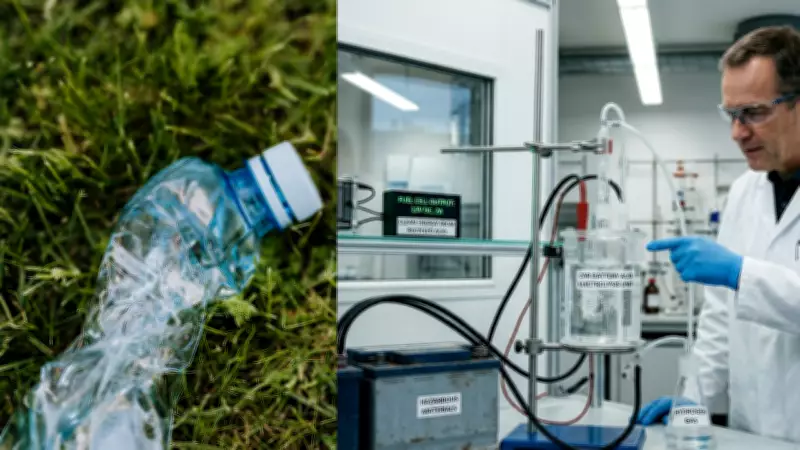
Cambridge Breakthrough: Transforming Battery Acid and Plastic Waste Into Clean Energy
In a groundbreaking development that tackles two of the world's most persistent environmental challenges, scientists from the University of Cambridge have unveiled an innovative process. This technique simultaneously addresses the global plastic waste crisis and the disposal of corrosive battery acid by converting both into clean hydrogen fuel and useful chemical compounds.
The Dual Waste Solution: Solar-Powered Chemical Transformation
The research, published in the scientific journal Joule under the title 'Solar reforming of plastics using acid-catalyzed depolymerization,' introduces a method called solar-driven acid photoreforming. This approach utilizes sulfuric acid recovered from spent automobile batteries to break down plastic polymers into smaller chemical components.
The process operates in two distinct phases: First, plastics are treated with the reclaimed battery acid, which degrades the complex polymer structures into simpler chemicals including ethylene glycol. Subsequently, these intermediate compounds undergo conversion into hydrogen gas and acetic acid through exposure to sunlight in a specially designed reactor system.

Challenging Conventional Chemical Wisdom
Professor Erwin Reisner, senior author of the research, revealed the surprising nature of their discovery: "We initially believed that using acid in this manner was completely impractical based on established chemical principles. However, our catalyst system demonstrated remarkable effectiveness, fundamentally challenging previous assumptions about acid chemistry in recycling applications."
This breakthrough has opened new possibilities for recycling plastics that have traditionally resisted conventional recycling methods, including challenging materials like nylon and polyurethane that typically end up in landfills or incinerators.
Producing Clean Hydrogen From Waste Streams
Among the most significant benefits of this innovation is the production of hydrogen gas, widely regarded as a crucial clean energy source for future sustainable energy systems. The process not only reduces plastic pollution but simultaneously generates renewable fuel without requiring additional resource extraction.
Lead researcher Kay Kwarteng emphasized the dual advantage: "The sulfuric acid from used batteries represents a substantial untapped resource that has previously been treated as hazardous waste. Our approach transforms this liability into an asset while addressing plastic pollution—creating a genuine win-win scenario for environmental management."
Practical Implementation and Economic Benefits
The system demonstrates impressive practical characteristics, with laboratory tests confirming continuous operation for more than 260 hours without performance degradation. The acid catalyst can be recycled multiple times within the process, significantly reducing both production costs and disposal expenses associated with hazardous waste management.
This economic efficiency, combined with the environmental benefits, makes the technology particularly promising for scaling toward industrial applications where both plastic waste and battery acid disposal present substantial logistical and financial challenges.
Advancing the Circular Economy Vision
This discovery embodies the principles of a circular economy, where waste products from one industrial process become valuable inputs for another. With global plastic production exceeding 400 million metric tons annually and less than 18 percent currently recycled, such innovative approaches are increasingly critical.
The Cambridge team describes their method as creating "one waste stream that solves another," effectively using battery acid waste to address plastic waste while generating clean energy—a triple benefit rarely achieved in environmental technology.

Realistic Perspectives and Future Potential
Despite the promising results, researchers maintain realistic expectations about the technology's limitations. Professor Reisner cautioned: "We are not claiming to have solved the global plastics crisis with this single development. However, we have demonstrated a fundamentally new approach that could contribute significantly to waste management solutions when combined with other strategies."
The research represents a paradigm shift in how society views materials traditionally classified as waste. Both plastic polymers and battery acids, when approached with innovative chemistry, can transform from environmental liabilities into valuable resources for energy production and chemical manufacturing.
While additional development is necessary to scale the technology for industrial implementation, the underlying chemistry has been rigorously validated. In an era grappling with plastic pollution and seeking sustainable energy alternatives, such creative reimagining of waste materials offers hope for more integrated environmental solutions that address multiple challenges simultaneously.