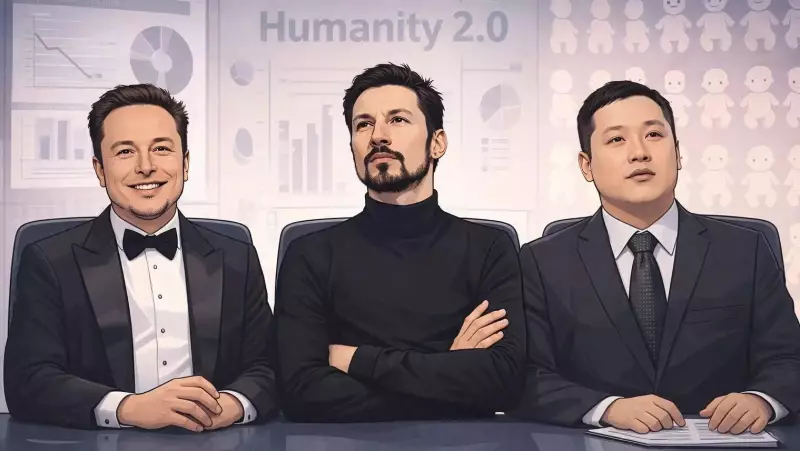
For centuries, the story of human reproduction was written by necessity. Large families were a practical shield against high infant mortality, a source of labour, and a form of old-age security. The poor had many children out of need, while the wealthy, secure in their assets, often chose smaller families. Today, in a dramatic inversion, that ancient logic has been turned on its head in a development that is both counter-intuitive and deeply revealing.
The Great Demographic Flip: From Necessity to Strategic Choice
In the early 21st century, across vast swathes of the globe, ordinary people are consciously opting out of parenthood or limiting themselves to a single child. The driving forces are starkly material: soaring urban costs, relentless work cultures, punishingly expensive childcare, and the hard-won autonomy of women who now weigh motherhood against personal and economic survival. For most, this is a pragmatic, not ideological, choice.
Simultaneously, a small but influential cohort of the ultra-wealthy, particularly technology billionaires, is charging in the opposite direction. They are not just having children; they are deliberately expanding their biological footprint on a significant scale. Utilising legal frameworks and advanced reproductive technologies like IVF and international surrogacy, they are treating human reproduction as a project that can be optimised and scaled.

The Tech Titans and Their Pronatalist Missions
This new philosophy is voiced most prominently by figures like Elon Musk, who consistently frames population collapse as civilisation's greatest threat, surpassing climate change or war. His personal life mirrors this belief, with a large and growing number of children across multiple relationships. His rhetoric frames reproduction as a duty and a form of leadership, conspicuously omitting discussions on childcare systems or the physical and career toll of pregnancy.
Taking this logic further is Pavel Durov, the founder of Telegram. He has spoken openly about plans to father over a hundred children via sperm donation, offering to fund IVF and promising equal inheritance. This model radically separates biology from upbringing, transforming fatherhood into a distributive, logistical act rather than a relational one. It is parenthood designed for genetic reach, not daily attachment.
In a Los Angeles courtroom, a more traditional yet tech-enabled dynastic vision was laid bare by Chinese tech billionaire Xu Bo. He revealed plans to father dozens of children, primarily sons, through American surrogates so they could one day inherit and run his business empire. For him, reproduction is a corporate succession strategy, leveraging international surrogacy to circumvent domestic constraints.
Why This New 'Billionaire Fertility' Trend Is So Disquieting
Demographically, even a few thousand billionaire children will not reverse global trends. The unease stems from what this movement normalises. Firstly, it hardwires inequality into biology, allowing wealth to engineer opportunity across generations in unprecedented ways. Secondly, it often reframes women's bodies as instruments for fulfilling male demographic anxiety, while outsourcing the labour of care.
Most critically, it represents a profound misdiagnosis. The core issue is not that people lack the moral conviction to have children. The issue is that modern socio-economic structures make parenting exceptionally difficult. Billionaires using technology to bypass this reality do nothing to fix it for the vast majority. Their approach imagines the future not as a shared social project built on supportive policy, but as a private inheritance problem to be solved by the ultra-wealthy.
In essence, while most of humanity hesitates to bring children into an unstable world, some of the richest men are ensuring, through technology and capital, that the future bears their genetic imprint. This is not a solution to a demographic transition. It is a stark statement about power, legacy, and who gets to shape tomorrow.