

Astronomers Witness Unprecedented Cosmic Phenomenon: 'Jetty McJetface' Black Hole Jet
Imagine a jet of cosmic energy so immensely powerful that it dwarfs even the fictional Death Star from Star Wars. This is precisely what astronomers are now observing from a supermassive black hole located an astonishing 665 million light-years away from Earth.
A Stellar Cataclysm of Unimaginable Scale
The extraordinary jet, which has been affectionately nicknamed Jetty McJetface by researchers, is traveling at velocities approaching the speed of light. This phenomenal cosmic event originated from the violent destruction of a star that ventured too close to the black hole's immense gravitational pull.
Scientific experts are declaring this one of the most luminous and energetically intense astronomical events ever recorded in human history. The sheer scale of energy release is almost incomprehensible, with preliminary estimates suggesting it emits between one trillion to one hundred trillion times more energy than the fictional Death Star superweapon.

The Violent Birth of a Cosmic Jet
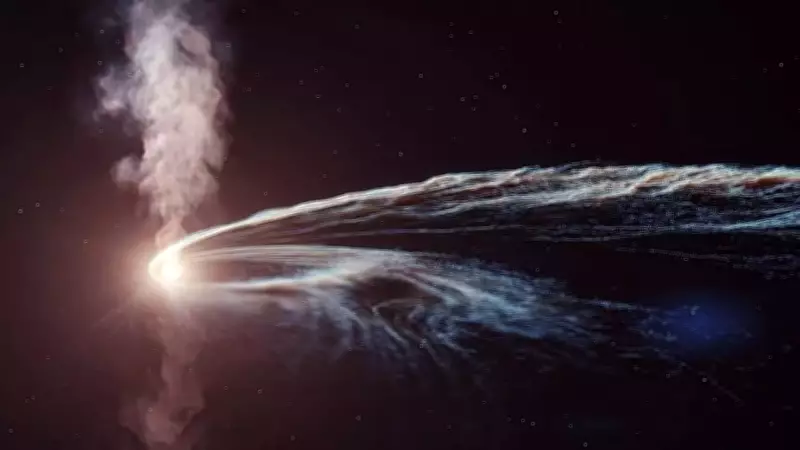
This spectacular cosmic drama began when an unfortunate star wandered perilously close to the supermassive black hole. The black hole's overwhelming gravitational forces stretched and ultimately tore the star apart in a process known as a tidal disruption event (TDE).
While some of the stellar material was inevitably consumed by the black hole, the majority was violently ejected outward, propelled by powerful magnetic fields that channeled the debris into an incredibly focused relativistic jet.
The Mysterious Reawakening of AT2018hyz
Officially designated as AT2018hyz, this cosmic phenomenon initially appeared relatively quiet to astronomers, who remained uncertain about its true nature for several years. The shredded stellar material gradually formed what scientists call an accretion disk around the black hole, slowly feeding the cosmic behemoth and eventually generating the spectacular jet.
In a surprising development during 2022, AT2018hyz suddenly experienced a dramatic brightening in radio wave emissions. This intense flare is believed to have been caused by synchrotron radiation emanating from the relativistic jet. Remarkably, the jet currently shines approximately fifty times brighter than when it was first discovered.
The jet's highly focused nature and recent alignment with Earth's line of sight explain why it appears to be gaining energy years after the original star was consumed. While magnetic fields are suspected to play a crucial role in producing these extraordinary jets, scientists acknowledge that the precise mechanisms remain incompletely understood.
An Exception Among Cosmic Events
This particular tidal disruption event stands in stark contrast to typical TDEs, which generally release energy gradually through more spherical outflows. Jetty McJetface represents an exceptional case, with energy estimates reaching an astonishing 5 × 10^55 ergs.
Current astrophysical models suggest the jet might reach its peak brightness around 2027, potentially becoming twice as luminous as its current state. However, astronomers remain cautious about providing definitive predictions, as numerous complex factors could influence the final outcome.
The energy output from this event is truly unprecedented in observational astronomy. Such powerful, focused jets are exceptionally rare, representing only about one percent of all known tidal disruption events, while the remaining ninety-nine percent exhibit far less dramatic characteristics.
Scientific Implications for Future Space Research
Extraordinary cosmic phenomena like Jetty McJetface offer invaluable opportunities for scientists to advance our understanding of fundamental astrophysical processes. These observations could provide crucial insights into:

- The complex physics governing black hole behavior and evolution
- The nature and behavior of extreme magnetic fields in cosmic environments
- The complete lifecycles of stars and their violent interactions with black holes
With next-generation astronomical instruments like the Square Kilometer Array becoming operational in the coming years, astronomers anticipate detecting many more of these rare cosmic events. Such discoveries would significantly enhance our understanding of how frequently supermassive black holes violently eject matter across interstellar space.
For now, humanity can only observe and marvel at this cosmic spectacle. The reality that a black hole can tear apart an entire star and subsequently launch a jet more energetic than any fictional superweapon seems almost surreal. Yet this extraordinary event is occurring within our own universe, not within the realm of science fiction cinema.
