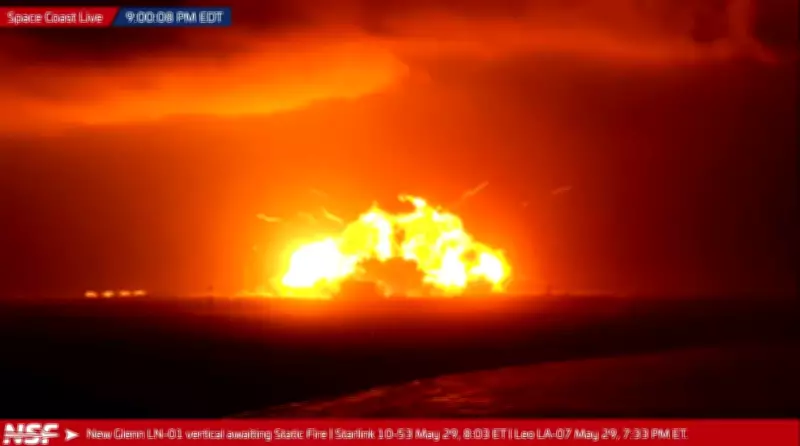
A dramatic setback hit Jeff Bezos' space venture and SpaceX rival Blue Origin on May 28 when its New Glenn rocket exploded on the launchpad during a hot fire test, sending a towering plume of fumes and smoke into the Florida sky. As reported by Reuters, a video posted by NASASpaceflight showed the rocket igniting at around 9 p.m. ET before erupting into a massive fireball.
Blue Origin Confirms Anomaly
Blue Origin confirmed the incident, stating, "We experienced an anomaly during today's hotfire test. All personnel have been accounted for. We will provide updates as we learn more." A hot fire test involves firing a rocket engine while it is anchored to the ground, a critical step before flight readiness.
Preparations for Amazon Satellite Launch
The incident comes just a day after Blue Origin announced it was preparing New Glenn to launch 48 Amazon Leo satellites into low-Earth orbit, part of efforts to build a broadband constellation to rival Elon Musk's Starlink. No launch date had been announced.

Jeff Bezos Responds to the Explosion
In a post on X (formerly Twitter), Blue Origin founder Jeff Bezos acknowledged the setback and wrote, "All personnel are accounted for and safe. It's too early to know the root cause but we're already working to find it. Very rough day, but we'll rebuild whatever needs rebuilding and get back to flying. It's worth it."
Elon Musk Reacts
Elon Musk, whose SpaceX is Blue Origin's chief rival, responded to the post, writing: "Sorry to see this, I hope you recover quickly."
Blue Origin Wins NASA Contract for Lunar Mission
Recently, NASA selected Blue Origin to carry out the first of three planned uncrewed lunar missions aimed at preparing for the construction of a moon base. NASA said the missions, planned for 2026, are part of a broader effort to establish a long-term human presence on the moon. The project could eventually lead to a semi-permanent moon base as part of the Artemis program.
NASA administrator Jared Isaacman announced the plans during a press conference in Washington DC. He said the three uncrewed missions scheduled for 2026 would be followed by more than a dozen future missions to test technology, landers, and scientific systems. "People are looking up again, believing in big things again, and paying attention as America returns to the moon again, and this time to stay," Isaacman said.
NASA said Blue Origin will receive $230.4 million to support each of its first two missions, although much of the project funding will come from the company itself.