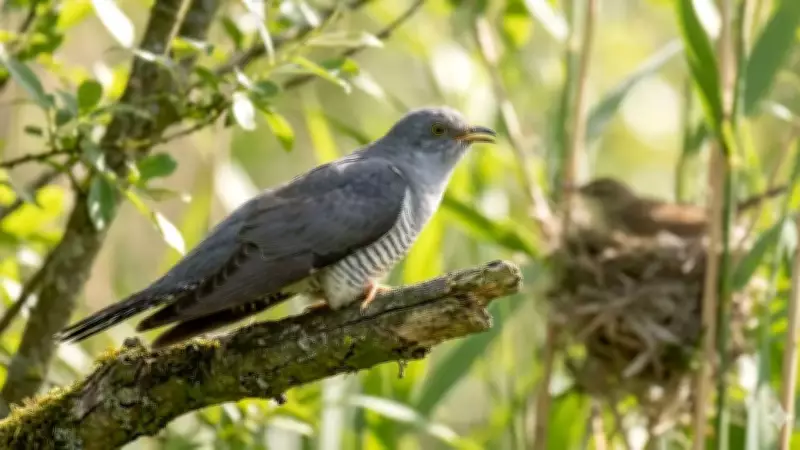
Marshes and woodland edges often appear deceptively calm during the breeding season. Nests are concealed beneath reeds, hidden among branches, or pressed into long grass, while adult birds move in and out carrying insects in quick, repetitive flights. Yet, inside some of those nests, the young being fed are not the offspring of the attending parents. Across several bird families, reproduction depends on intrusion rather than direct parenting. Eggs are placed into another species' nest, hatch under borrowed care, and grow at the expense of unrelated chicks already occupying the space.
Brood parasitism has existed long enough for entire ecosystems to adjust around it. Host birds have altered nesting habits, egg markings, and defensive behaviors, while parasitic species continue to refine ways to avoid detection. The relationship functions less like a fixed strategy and more like an ongoing evolutionary contest, in which both sides repeatedly adapt to each other over time.
How Parasitic Birds Trick Other Species into Raising Their Young
For parasitic birds, entering a nest is only part of the process. The egg must remain unnoticed afterward. Many cuckoo species have evolved eggs that closely resemble those of their targeted host, matching color, shape, and speckling with surprising precision. Some female cuckoos specialize in a single host species throughout their lives, producing eggs that blend into one nest type almost exclusively.

According to a paper in Biological Reviews examining interspecific brood parasitism, this mimicry is tied to long-term coevolution between host and parasite species. Hosts gradually improve their ability to identify unfamiliar eggs, while parasites respond by developing more convincing imitations. The balance shifts constantly. A host species that becomes too effective at rejection places pressure on the parasite population to adapt again.
The deception extends beyond appearance. Timing also plays a critical role. Female parasites often monitor nests before laying, waiting for the briefest absence of the parents. In several cuckoo species, the egg is deposited within seconds.
The Fight for Survival Inside a Parasitised Nest
The conflict inside the nest rarely ends with incubation. In many brood parasite species, the chick becomes the dominant competitor almost immediately after emerging from the egg. Some cuckoo hatchlings instinctively remove host eggs or chicks by pushing them out of the nest before they can develop. This behavior occurs despite the absence of parental guidance, suggesting it is deeply embedded through inherited instinct rather than learning.
Other parasitic birds rely less on aggression and more on manipulation. Brown-headed cowbirds, for example, often grow alongside host nestlings but outcompete them through faster growth and louder feeding calls. Foster parents continue responding to the strongest begging signals, even when the demands come from an unrelated chick.
Recent research on brood parasites has described how some parasitic nestlings mimic the sound patterns of an entire brood rather than a single chick. To the adult birds returning with food, the nest can appear fuller and more urgent than it actually is.
The Defensive Strategies Host Birds Use Against Cuckoos
Many host species have developed defensive behaviors that go well beyond simple egg recognition. Reed warblers and other small birds frequently mob adult cuckoos near nesting sites, attempting to drive them away before eggs can be laid. Certain Australian species appear to teach embryos vocal signatures before hatching, creating recognition calls that parasitic chicks struggle to reproduce accurately.
According to a report available through the US National Library of Medicine examining brood parasitism from a social immunity perspective, some bird communities respond collectively to parasite threats. Alarm calls spread rapidly between nearby nests, and multiple adults may participate in mobbing behavior once a parasite is detected in the area. The defense becomes communal rather than individual.

Even then, rejecting a foreign egg is not always straightforward. Some parasitic birds are believed to retaliate by damaging nests after their eggs are removed, a behavior sometimes referred to as "mafia retaliation" within behavioral ecology literature. This possibility creates a difficult trade-off for host birds. Accepting the parasite may reduce breeding success, but rejection can carry risks as well.
Evolutionary Survival Strategy Behind Brood Parasitism
Brood parasitism unsettles familiar ideas about reproduction because it removes nearly every element associated with parental investment. Nest building, incubation, and feeding are transferred entirely onto another species. Yet the behavior persists because it remains evolutionarily effective under certain conditions.
The pressure does not fall evenly across species. Hosts lose food, time, and offspring. Parasites gain opportunities to produce more eggs across wider territories without raising young themselves. Over generations, these pressures have altered behavior on both sides. Some hosts now produce eggs with highly individual markings, while certain parasites continue refining mimicry to keep pace.
The system survives through constant adjustment rather than stability. Each breeding season adds another round to a conflict that has likely been unfolding for millions of years, mostly unnoticed inside nests hidden from view.