CEAT Tyres' Chennai Factory Embraces AI for Revolutionary Manufacturing Gains
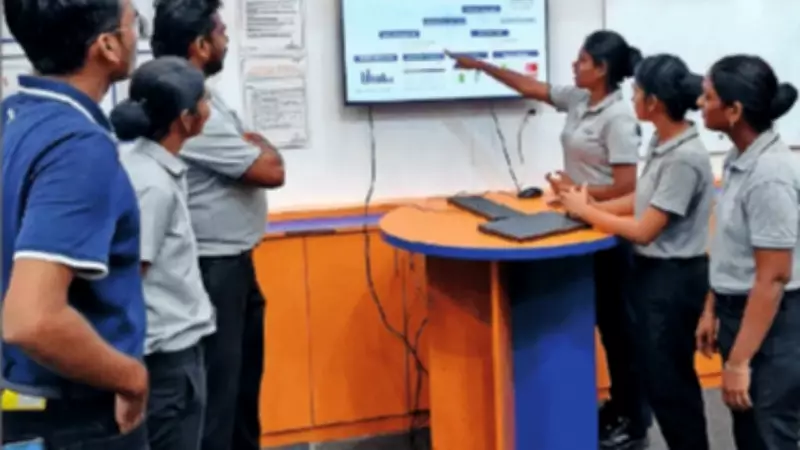
In the bustling industrial zone of Sriperumbudur, on the outskirts of Chennai, CEAT Tyres' factory stands as a beacon of technological advancement. Here, the integration of sensors, computer vision models, and artificial intelligence has transformed traditional tyre manufacturing into a data-driven powerhouse. This shift has led to significant reductions in defects, waste, and energy usage, while simultaneously improving labor and machine efficiency. The factory now operates on sophisticated algorithms, marking a departure from heavy physical labor to skill-based automated roles, with 70% of shop floor positions converted in recent years, fostering greater participation of women in the workforce.
Optimizing the Mixing Process with Machine Learning
The mixing stage is critical in tyre production, akin to kneading dough in a bakery, where raw materials like natural and synthetic rubber, carbon black, and chemicals are blended. Traditionally, machines followed rigid, pre-set recipes, often mixing for fixed durations without accounting for real-time variations. Natural rubber properties fluctuate by batch and season, and mixer temperatures change with continuous operation, affecting how quickly the rubber melts. This lack of adaptability resulted in wasted time and reduced daily output.
To address this, CEAT developed a gradient boosting regression model, a machine learning system that continuously monitors parameters such as temperature and energy consumption. By comparing real-time data against historical "golden" batches, the model makes intelligent adjustments to maintain optimal conditions. This innovation has yielded an 18% reduction in mixing cycle time, a 29% decrease in power consumption, and a 32% increase in master mixer capacity. These improvements are vital as the factory now produces 350 different tyre types weekly, up from just 100 six years ago.

Predicting Die Dimensions with Advanced AI
As CEAT expands globally, the need for new tyre designs tailored to diverse terrains has grown. Designing dies—metal templates that shape hot rubber into treads—is challenging due to rubber's elasticity, which causes die swelling upon extrusion. For instance, to achieve a 200 mm wide rubber strip, a 180 mm hole might be necessary, with exact dimensions depending on chemical composition, temperature, and machine speed.
Previously, employees manually mapped around 60 data points per tyre variant on spreadsheets, leading to inaccurate predictions and up to three physical trials, prolonging time-to-market and increasing compound scrappage. CEAT deployed a Gaussian process regression machine learning model to predict accurate die dimensions, resulting in a 37% reduction in time-to-market and a 30% decrease in wastage.
Enhancing Troubleshooting and Operational Efficiency
Beyond mixing and die design, CEAT has implemented AI solutions for export container optimization and machine performance management. An agentic AI system assists junior engineers by converting unstructured breakdown resolution videos into a searchable knowledge base, accessible via a conversational chatbot. This enhances troubleshooting efficiency, enabling faster problem resolution and minimizing downtime.
Cultural Shifts and Industry Recognition
These initiatives have fostered a data-driven culture, with teams attending external conferences and hackathons to adopt best-in-class technologies. Before developing AI use cases, they evaluate whether production issues are valid business problems with available data. The Chennai factory's advancements have been validated by experts from IIT Madras and recognized with a Lighthouse certification from the World Economic Forum, an award honoring leaders in technology-driven industrial transformation.

Significant Productivity Gains and Decentralized Digital Teams
The digital transformation has led to a 20-30% reduction in factory conversion costs, improved yields, and lower energy usage. Order-to-dispatch times have been cut by more than half, and export turnaround times have dropped from 120 days to 55 days. CEAT built these solutions internally, starting digitization efforts in 2021 with sensor installations, manufacturing execution systems, and dashboards. The company now allocates 10% of its manufacturing capital expenditure to digital initiatives.
To bridge the gap between technical teams and shop-floor realities, CEAT introduced business translators—individuals with strong technical skills who work directly with operators to identify pain points. According to Debashish Roy, Chief Digital Transformation Officer, this decentralized digital team approach accelerates process learning, unlike centralized teams that might take years to adapt.