The Revolutionary Insight That Changed Physics Forever
In the year 1905, a young 26-year-old patent clerk named Albert Einstein gazed into the cosmos and made a discovery that would forever alter humanity's perception of reality. He revealed that time, which had been considered a linear and universal constant for centuries, was not what we had always believed it to be. For generations, the prevailing assumption was that space existed as a static, empty container, while time flowed steadily like a river at a single, unchanging speed. Whether one was in London, aboard a moving train, or drifting in the vastness of space, a second was universally accepted as a second. The universe was perceived as a colossal, ticking clock, with all of existence operating within its rigid framework.
The Shattering of Conventional Wisdom
Einstein's theory of relativity completely dismantled this comforting notion, much like an unexpected guest overstaying their welcome disrupts the tranquility of a household. He realized that time is not a universal river flowing at a constant pace; instead, it depends entirely on the observer. This groundbreaking insight emerged from meticulous studies of light, where scientists had uncovered a peculiar phenomenon: no matter how fast an individual moved, the speed of light remained constant. Whether chasing after it or fleeing from it, light's velocity refused to budge, as if the universe had etched this limit in stone.
Einstein took this fact to heart, reasoning that if light's speed was immutable, then something else had to yield. That something was time itself. He demonstrated that two individuals moving at different speeds do not experience time in the same manner. A clock in motion can tick slower than one at rest, and this is not an illusion but a fundamental aspect of reality. For instance, a person traveling at extremely high velocities ages slightly less than someone who remains stationary.

The Practical Implications of Time Dilation
At everyday speeds, this difference is minuscule and goes unnoticed, but under extreme conditions, such as near the speed of light, the effect becomes measurable. Astronauts returning from space missions, for example, are a fraction of a second younger than they would have been if they had stayed on Earth. The universe, in its silent majesty, bends time without seeking our permission, showcasing its inherent flexibility.
The mathematician Hermann Minkowski eloquently captured the essence of Einstein's revelation, stating, "Henceforth space by itself, and time by itself, are doomed to fade away into mere shadows." This poetic declaration highlighted the fusion of space and time into a single, interconnected structure known as spacetime, where distance and duration became intertwined. Moving through space inevitably altered one's journey through time, revealing a deeper cosmic harmony.
Gravity Reimagined as Geometry
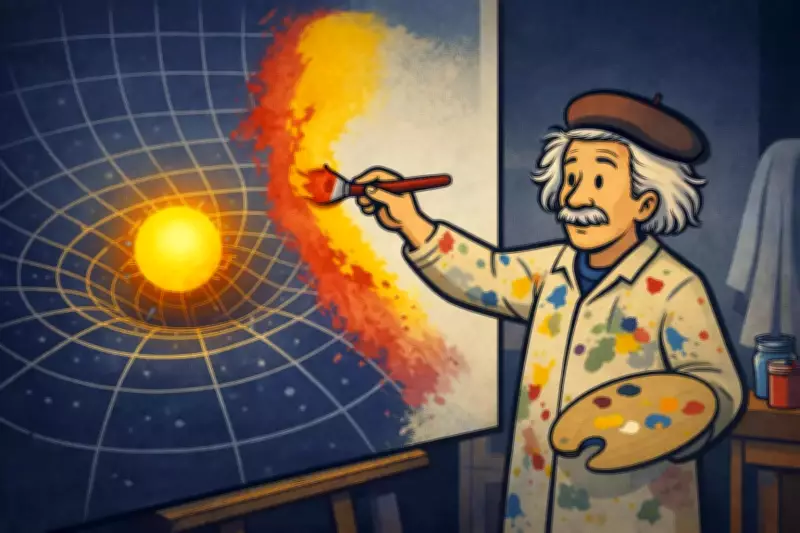
Einstein did not stop there. In 1915, he redefined gravity, moving away from the traditional view of it as an invisible force pulling objects together. Instead, he described gravity as a curvature in the fabric of spacetime. Massive entities like stars and planets warp this cosmic fabric, and other objects simply follow these curves. The physicist John Archibald Wheeler succinctly summarized this concept: "Spacetime tells matter how to move; matter tells spacetime how to curve." Thus, Earth orbits the sun not due to a mysterious pull, but by rolling along the indentation the sun creates in spacetime, transforming gravity into a geometric phenomenon.
Relativity in Everyday Life and Beyond
While these ideas may sound abstract, they have tangible impacts on daily life. The Global Positioning System (GPS) in smartphones functions accurately only because engineers account for relativistic effects. Satellites in orbit experience time differently than on Earth, and without corrections based on Einstein's equations, location data would drift by kilometers. Relativity is not mere science fiction; it is integral to modern infrastructure.

The philosophical implications are equally profound. There is no master clock hovering outside the universe, nor a single, universally correct viewpoint. Every observer carries their own version of time, and the cosmos accommodates all these perspectives simultaneously. Reality becomes relational rather than absolute, as noted by physicist Richard Feynman: "The imagination of nature is far, far greater than the imagination of man." Relativity stands as a testament to nature's boundless creativity, challenging human intuition shaped by slow speeds and gentle gravity.
The Legacy of a Simple Question
Einstein's journey began with a simple yet profound inquiry: what if the speed of light never changed? This question forced science to reevaluate its deepest assumptions, revealing that space is not a fixed stage and time is not universal. The background of reality became dynamic and alive, expanding the map of existence. Although the everyday world feels solid—with watches ticking normally and coffee cooling predictably—relativity lurks in extremes, reshaping our cosmic perspective. The universe transforms from a rigid box into a flexible fabric responsive to motion and mass.
Once this idea permeates human thought, it becomes indelible. The cosmos expands without physical movement, time grows stranger without halting, and reality gains depth without losing clarity. Relativity did not merely add a new rule to physics; it unveiled that the rules themselves are part of a grander narrative, forever enriching our understanding of the universe.