

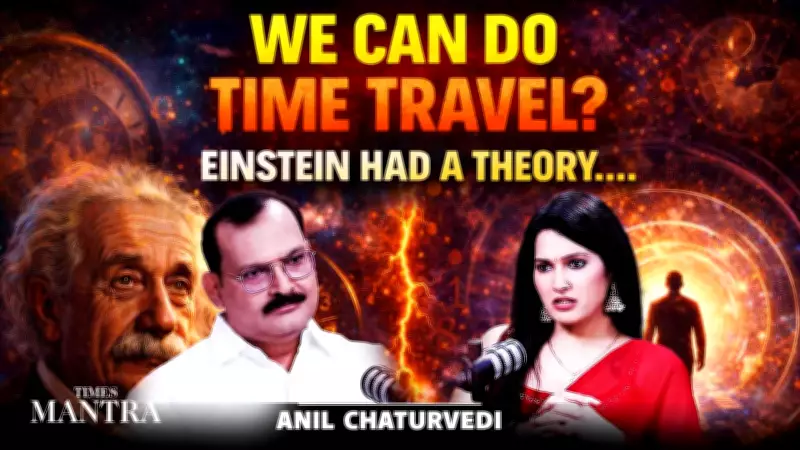
Time Travel: Scientific Possibility or Pure Fiction?
The age-old question of whether humans can journey through time has captivated imaginations for centuries, blending science fiction with serious scientific inquiry. In a detailed analysis, expert Anil Chaturvedi delves into Albert Einstein's groundbreaking theories to uncover if they hold clues to making time travel a reality.
Einstein's Relativity and Its Implications
Albert Einstein's theories of relativity, particularly special and general relativity, revolutionized our understanding of space, time, and gravity. These concepts suggest that time is not a fixed constant but can be influenced by factors such as speed and gravitational fields. For instance, time dilation effects, where time passes slower for objects moving at high velocities or in strong gravitational fields, have been experimentally verified, hinting at theoretical pathways for time travel.
Chaturvedi explains that while relativity provides a framework for time manipulation, practical implementation remains a monumental challenge. The energy requirements and technological advancements needed to achieve significant time travel, such as through wormholes or cosmic strings, are currently beyond human capabilities. However, ongoing research in physics continues to explore these frontiers.

Current Scientific Perspectives and Future Prospects
Modern science acknowledges the theoretical possibility of time travel based on Einstein's equations, but it is fraught with paradoxes and practical hurdles. Concepts like the "grandfather paradox," where altering the past could create contradictions, pose significant philosophical and physical questions. Scientists are investigating whether quantum mechanics or advanced technologies might offer solutions.
Looking ahead, Chaturvedi emphasizes that while time travel may not be achievable in the near future, advancements in fields like astrophysics and quantum computing could bring us closer. The discussion breaks down complex ideas into accessible insights, encouraging viewers to consider the ethical and scientific implications of such a breakthrough.
Conclusion: How Close Are We to Unlocking Time Travel?
In summary, Einstein's theories provide a scientific basis for time travel, but it remains largely theoretical with current technology. The journey from concept to reality involves overcoming immense technical and ethical barriers. As research progresses, the dream of time travel continues to inspire both scientists and the public, blending curiosity with the quest for knowledge.
This exploration invites readers to ponder the mysteries of time and space, highlighting the ongoing dialogue between science and imagination in our pursuit of understanding the universe.






