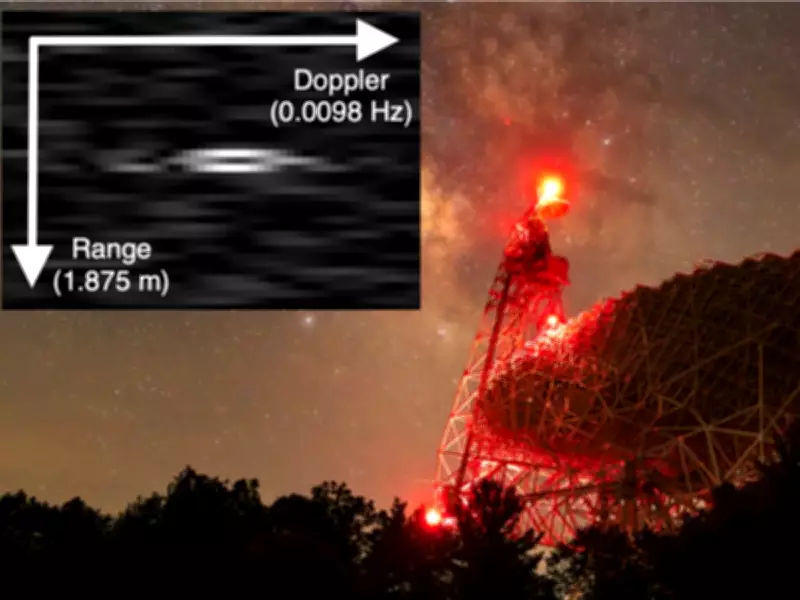
The enormous radio telescope nestled in the mountains of West Virginia captured a grainy black-and-white grid featuring one small white blob that seemed unremarkable at first glance. However, this tiny smudge of pixels signified a major leap in deep-space exploration.
The National Radio Astronomy Observatory (NRAO) recently revealed a spectacular view of NASA's Artemis 2 spacecraft as it orbited the Moon. The Green Bank Telescope (GBT), standing 485 feet high and weighing 17 million pounds with an antenna larger than two soccer fields, observed the Orion spacecraft, affectionately named Integrity by the crew, from approximately 200,000 miles away.
Young adults and millennials are eagerly anticipating the dawn of a new era in space exploration. This milestone confirms that humanity is not merely launching rovers with mechanical motors into space but is actively paving the way for humans to walk on the lunar surface.

The Dark Echo of the Night
How do you track a spacecraft navigating dark, pitch-black space? While conventional optical telescopes rely on clear skies and reflected sunlight, radio astronomy operates under a different set of principles. The GBT observed Integrity over five consecutive days, translating minute changes into real-time speed and trajectory data. This capability is rooted in ground-based radar systems, which provide extremely accurate range and Doppler measurements, offering precision that helps identify paths through space.
By transmitting and receiving powerful radio signals, scientists create an invisible, continuous digital link between the West Virginia valley and the four astronauts on the far side of the Moon.
Each dot in the tiny, grid-like image precisely represents the spacecraft's location and velocity along its downward-sloping axis. This remarkable fusion of engineering and cosmic-scale navigation gives NASA unparalleled situational awareness. The pixels in this image depict the Orion spacecraft. The vertical (range) axis shows distance to the spacecraft, increasing downward, while the horizontal (Doppler) axis indicates a frequency shift from the expected return signal. This image was captured when the spacecraft was over 213,000 miles (343,000 km) from Earth. Will Armentrout, an NSF GBO scientist, shared with colleagues, 'There are four people in those pixels.' Image Credit: JPL & NSF/AUI/NSF NRAO.
More Than Electronics and Metal
It is easy to get caught up in the technical specifications of a 17-million-pound satellite dish. However, the Green Bank Observatory team keeps the focus where it belongs: on the pioneering astronauts inside the cockpit.
In an address to coworkers, National Science Foundation scientist Will Armentrout put the universe into perspective with a simple observation. He highlighted the pixelated picture, noting that the dots represent the human crew embarking on a historic deep-space journey.
This multi-agency partnership marks a significant step in cooperation between NASA and the National Science Foundation. It demonstrates that tools originally designed to explore cosmic origins can also protect human spaceflight.
The GBT has a track record of supporting high-stakes space maneuvers. In 2022, the giant dish played a vital role in observing NASA's Double Asteroid Redirection Test (DART) and tracking the physical effects when humanity deliberately crashed a spacecraft into the asteroid Dimorphos to determine if its orbit could be altered.
The Future of Cosmic Transparency Tracking
The technology behind lunar orbit tracking will also usher in a more inclusive era of space exploration. Space exploration is no longer reserved solely for top scientists confined to windowless government bunkers.
The tracking methods used by the GBT mirror established frameworks for orbital and planetary defense mechanics. Research titled 'Radar Observations of Spacecraft in Lunar Orbit' showed how ground-based radar systems can accurately detect and determine the orbits of non-communicative or active spacecraft orbiting the Moon. This technique ensures that even as the lunar environment becomes increasingly crowded with international and commercial satellites, we can avoid collisions and maintain precise control over cosmic traffic.

The impact of this technology is felt closer to home than one might imagine. Thanks to technological advances, amateur astronomers and scientists can sit at home, observe spacecraft light curves, and log data alongside international observatories.
As deep-space missions become more daring and exploration ventures deeper into the universe, the line between professional astronomer and curious stargazer begins to blur. History unfolds live, pixel by pixel.
About the Author
TOI Science Desk: The TOI Science Desk is an inquisitive team of journalists dedicated to curating captivating news, features, and articles from the ever-evolving world of science for readers of The Times of India. They deliver a daily dose of wonder and enlightenment, covering topics from genetic engineering and space exploration to artificial intelligence. The team is committed to demystifying science, making it accessible and engaging for all backgrounds.