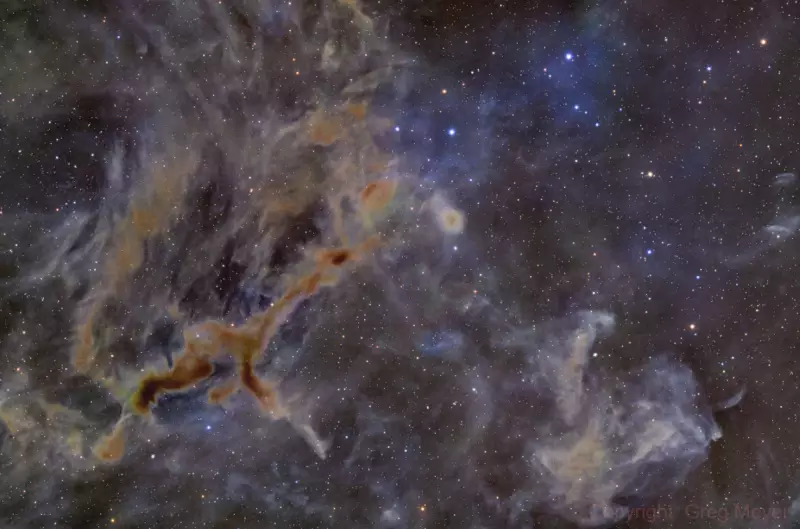
Astrophotographer Captures Giraffe-Shaped Nebula in Cassiopeia Constellation
A striking dark shape has been circulating across social media platforms recently. This image captures attention despite its stationary nature. It originates from deep space, showing a narrow shadow slicing through a dense star field.
Texas Photographer Shares Celestial Discovery
Greg Meyer, an astrophotographer based in Texas, captured this remarkable view. He was working through targets in the Cassiopeia constellation when he photographed this object. Meyer shared the image online, where it quickly gained traction.
People immediately noticed the distinctive shape before learning its scientific name. Many observers saw an animal form, elongated and upright. The silhouette reminded them of a giraffe caught mid-stride. The image spread rapidly across platforms, often shared without detailed explanation.

This celestial object sits approximately 1,000 light-years from Earth. However, that astronomical detail matters less than the compelling outline itself. Astronomers know this object exists, but it rarely appears framed in this particular manner.
The Nature of Dark Nebulae
This object represents a dark nebula, specifically cataloged as LDN 1245. Dark nebulae consist of dense cosmic dust that blocks light from objects behind them. They don't emit colorful glows or energetic gas displays.
The giraffe shape becomes visible because of its bright background. The Milky Way fills the frame with countless stars. The dark dust cloud cuts sharply into this stellar backdrop. This contrast creates the clear, recognizable silhouette.
Without the surrounding star field, observers would see very little. The bright background essentially illuminates the darkness, making the shape discernible to human eyes.
Social Media Names the Celestial Shape
Scientific catalogs list this cloud as LDN 1245, part of a survey compiled during the 1960s. Nearby regions carry different numerical designations, with boundaries that often blur together. Online communities pay little attention to these technical labels.
People have begun calling this formation the Giraffe Nebula. This name serves as a convenient reference point rather than an official designation. The nickname sticks because the outline strongly resembles the long-necked animal. A tall section rises upward while smaller pieces angle away, completing the giraffe-like appearance.
The Shape Changes With Perspective
Interestingly, the giraffe shape isn't fixed or permanent. Shifting the framing or adjusting contrast alters the appearance. What appears as a neck in one image might look like separate cloud formations in another view.
Along the edges, faint light sometimes becomes visible. This soft blue glow occurs when dust scatters light from nearby stars. The effect remains subtle and easy to overlook. In Meyer's photograph, this scattered light stays just barely visible.
Accidental Discovery Through Patience
Meyer reports he couldn't find other images of this object taken with his specific telescope setup on Astrobin. This absence motivated him to attempt the capture himself. He used a Sky Watcher Esprit 120 telescope, equipment that many astrophotographers consider standard.
The real key involved patience rather than specialized gear. Meyer invested time in long exposures, careful alignment, and meticulous adjustments. His approach focused less on discovering new objects and more on noticing existing ones in novel ways.
Cassiopeia's Hidden Treasures
The Cassiopeia constellation contains numerous similar formations. This region sits along the Milky Way's plane, crowded with dust clouds that interrupt starlight. Most of these clouds remain unnamed and unnoticed unless someone frames them perfectly.
Many dark nebulae connect to star-forming regions, though that activity isn't visible here. The image doesn't explain its own scientific context. It simply presents a striking visual that captures public imagination.
Visual Recognition Precedes Scientific Understanding
The photograph's popularity has little connection to astronomical catalogs or distance measurements. People respond first to the recognizable shape. The resemblance feels accidental, making the image easy to share across social platforms.

The image doesn't demand scientific understanding. It simply presents an intriguing shape that seems to look back at viewers. Scientific details remain quietly in the background while the compelling outline does the communicative work.
This discovery highlights how careful observation can reveal familiar shapes in unexpected places. It demonstrates that sometimes, seeing something familiar in the unfamiliar creates the most powerful connections between cosmic phenomena and human imagination.