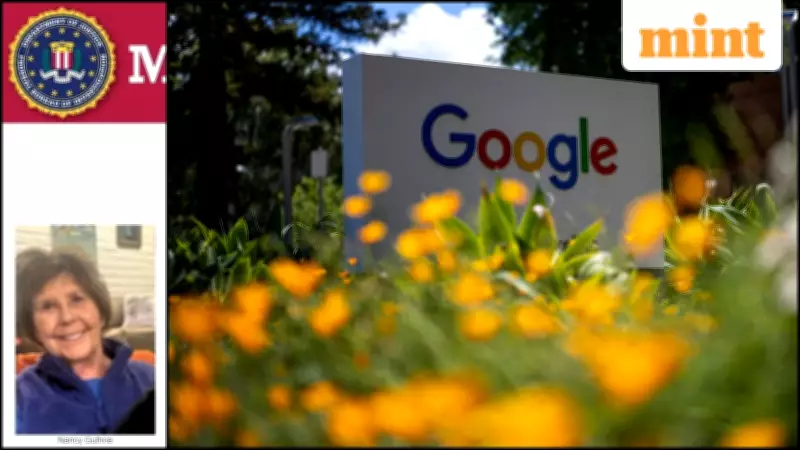
Google's Technical Prowess Enables FBI Breakthrough in Nancy Guthrie Disappearance Case
In a significant development in the investigation into the disappearance of 84-year-old Nancy Guthrie, the FBI released crucial surveillance footage on Tuesday, thanks to the technical expertise of tech giant Google. This breakthrough led to one person being detained in Arizona and a police search of a property in Rio Rico, marking a pivotal turn in a case that had previously stalled due to a lack of video evidence.
Initial Setback and Google's Intervention
The probe into Nancy Guthrie's disappearance, who is the mother of Today show host Savannah Guthrie, faced a major initial setback. Pima County Sheriff Chris Nanos had stated that no security camera footage was available because Guthrie did not have a subscription to Google Home, which typically stores videos from Nest cameras in Google's cloud. This absence of footage created a significant roadblock for investigators, leaving them with no leads or visual evidence of suspects.
The situation was so dire that authorities were uncertain if recovering any footage was even possible, given the technical complexities involved without backups. However, according to reports from CNN citing a source familiar with the investigation, Google stepped in to provide critical assistance, leveraging its advanced technical capabilities to overcome this hurdle.

How Google Recovered the Missing Data
CNN reported that Nest cameras retain approximately three hours of "event-based" video history for free before data deletion. This information is stored in Google's cloud and distributed across numerous servers. Even when data is marked for deletion, it may not be immediately overwritten, allowing for potential recovery if fragments remain on hard drives.
Adam Malone, a former cyber-focused FBI special agent and current top cyber crisis expert at Kroll, explained to CNN that cloud-based video data passes through multiple layers of components and can be scattered across hundreds of thousands of servers globally. This distribution increases the likelihood of residual data being left behind.
Nick Barreiro, an audio-video forensic analyst and founder of Principle Forensics, elaborated on this process, stating, "A delete function is just telling the file system to ignore that data and feel free to use that space on the hard drive for new data... so until it's actually used again, that old data is still recoverable." He added from experience that he has recovered video fragments from months or even years prior in similar cases.
FBI's Announcement and Expert Insights
FBI Director Kash Patel hinted at this technical achievement when releasing the footage, announcing that some video had been recovered "from residual data located in backend systems." Malone suggested that Google likely examined its development pipelines to identify any historical data awaiting purging, a process that ultimately took 10 days due to its complexity.
Following the video's release, former prosecutor and criminal defense lawyer John W. Day commented to the New York Post, "It gives us some insight to what Google is capable of." He noted the difficulty of the task, emphasizing that even without a paid subscription, Google managed to locate specific camera data from a particular time through extensive effort.
Google has not yet issued an official comment on its involvement. This case highlights the growing role of technology companies in law enforcement investigations, particularly in data recovery scenarios where traditional methods fall short.