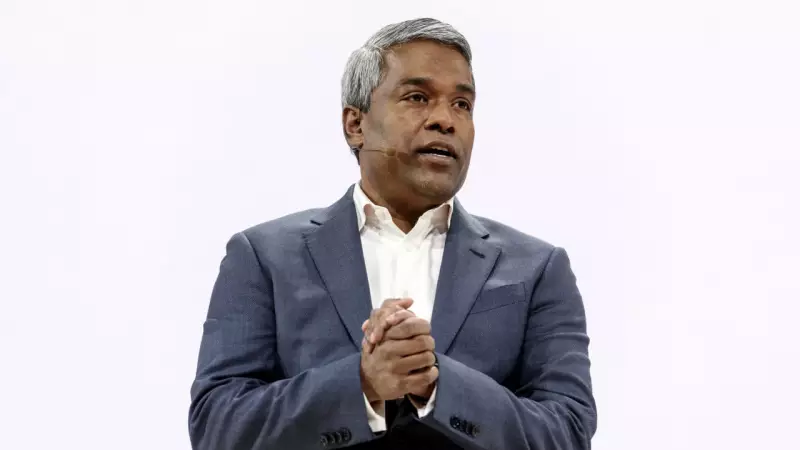
In a significant intervention, Google Cloud's top executive has publicly challenged the prevailing narrative of an intensifying "chip war" in the artificial intelligence sector. CEO Thomas Kurian has reframed the dynamic between his company's custom silicon and Nvidia's dominant GPUs, insisting it is a partnership, not a rivalry.
Kurian's Pushback on the 'Zero-Sum' Narrative
Thomas Kurian's comments come roughly a month after a turbulent period for Nvidia's stock. The market volatility was triggered by news that Meta, the parent company of Facebook, had partnered with Google to train its Llama AI models using Google's in-house Tensor Processing Units (TPUs). This announcement led to a notable drop in Nvidia's market value, wiping off billions.
Speaking to Fortune, Kurian dismissed the idea that the rise of custom AI chips like Google's TPUs represents a "zero-sum game" where one player's gain is another's loss. He emphasised the collaborative nature of the industry. "For those of us who have been working on AI infrastructure, there’s many different kinds of chips and systems that are optimised for many different kinds of models," Kurian explained. He highlighted that Google continues to optimise its flagship Gemini AI models for Nvidia's graphics processing units, even enabling them to run on Nvidia clusters.

Nvidia's Confident Counter and Market Reality
In response to the growing momentum of in-house AI chips from hyperscalers like Google, Nvidia issued a firm rebuttal. The company pushed back against any suggestion that Google had developed superior hardware, asserting that its GPUs remain "a generation ahead of the industry." This confidence was expressed in a public statement following the Google-Meta partnership news.
"We’re delighted by Google’s success — they’ve made great advances in AI and we continue to supply to Google," Nvidia stated. The company further argued for the supremacy of its platform, stating, "NVIDIA is a generation ahead of the industry — it’s the only platform that runs every AI model and does it everywhere computing is done. NVIDIA offers greater performance, versatility, and fungibility than ASICs, which are designed for specific AI frameworks or functions."
Despite this strong stance, the initial market reaction was clear: investor and analyst concerns about competition contributed to a 3% drop in Nvidia's share price at the time.
The Shift Towards Mixed Chip Infrastructures
The underlying trend highlighted by this exchange is a strategic shift among major tech giants. While Nvidia still commands an overwhelming 90% share of the AI chip market, companies like Google and Meta are increasingly investing in a balanced approach. They are building "mixed chip infrastructures" that leverage both powerful, general-purpose GPUs from vendors like Nvidia and their own custom, application-specific integrated circuits (ASICs) like TPUs.
This strategy allows them to tailor their hardware expenditure, using custom chips for specific, high-volume tasks to improve cost-effectiveness while still relying on industry-standard GPUs for other AI workloads. The episode underscores that the future of AI hardware is not about a single winner but about a complex, interoperable ecosystem where partnerships and specialised solutions coexist.