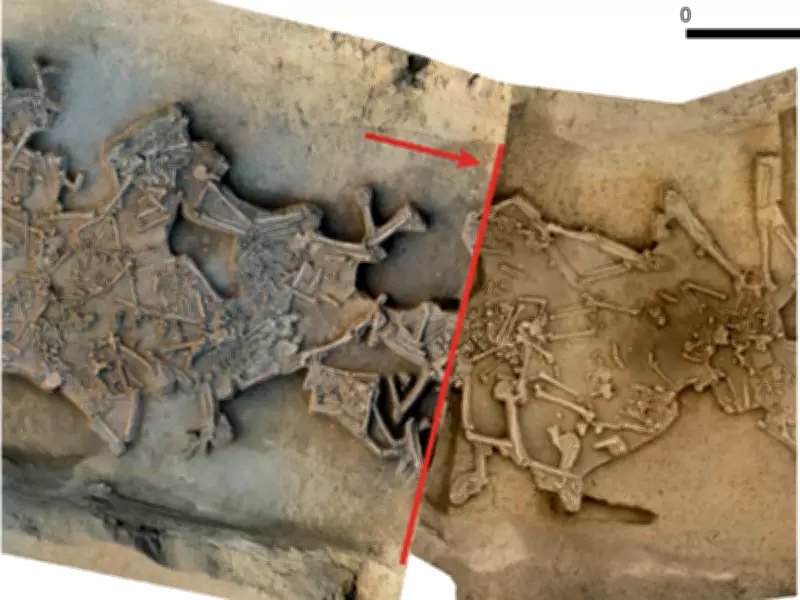
For years, a mass burial discovered at a Neolithic settlement in Slovakia has puzzled archaeologists. The site contained dozens of human skeletons, almost all missing their heads. Now, researchers believe they have uncovered an important clue that could explain one of Europe's most unusual prehistoric burials.
Ritual Decapitation, Not Warfare
It is possible that the decapitation of the buried figures at the Neolithic site of Vráble was not, as previously theorised, an act of warfare but a ritual involving their post-mortem removal, according to a study in the Proceedings of the Prehistoric Society. This could answer many questions about beliefs surrounding death, ancestry, and the human body in one of Europe's earliest farming societies, thousands of years before written language existed.
A Trench of Headless Bodies
Vráble, located in modern-day southwestern Slovakia, was settled by people belonging to the Linear Pottery Culture, one of Europe's first agricultural societies. This culture settled in the region from around 5250-4950 BC. The settlement was expansive, housing more than 300 homes distributed across three neighbourhoods. According to the study, excavations in one section of a wide defensive ditch in 2022 yielded extraordinary results: archaeologists discovered four paired headless bodies and a mass burial containing 77 or more headless skeletons. The only child burial found with a head was wearing one. These remains quickly grabbed the attention of archaeologists across the world, as a burial containing such a high concentration of headless individuals is incredibly rare in European prehistory.

Evidence of Deliberate, Post-Mortem Decapitation
Initial speculation raised the possibility that this event represented a violent battle or a large-scale killing event, but a detailed analysis of the remains painted a picture of a much more structured scenario. According to Kiel University, cut marks on the cervical vertebrae indicate that the heads were removed methodically and skilfully with sharp tools. The research noted that their absence, along with the missing mandibles of the buried figures, indicated an interest in the preservation of the skull and the face, suggesting that decapitation was not merely a means to a violent end, but an integral part of a more complex funeral ritual.
Biological anthropologist Katharina Fuchs of Kiel University said in a university statement that the first analyses suggest, above all, that violent decapitations were not conducted here, but rather the skilful removal of the skulls. The posture of many skeletons also supports this interpretation: several bodies appear to have been placed alongside the ditch walls after decapitation, suggesting a mortuary rather than a disposal function. The ditch may have also been utilised multiple times rather than during a single massacre.
Why Were the Skulls Removed?
The big questions remain unanswered. The lost skulls were never recovered, making it extremely difficult to assess their significance in Neolithic society. However, evidence from other prehistoric settlements suggests that human skulls held considerable symbolic value. In a number of Neolithic communities across the Near East, including Jericho and Çatalhöyük, skulls were disinterred and preserved, even embellished and displayed. These instances have been linked to ancestor cults, and the Vráble evidence suggests the missing crania may have served a similar purpose. They could have symbolised identification, the preservation of identity, or community belonging, acting as a link between the living community and the departed deceased.

A Boundary Defined by Bodies
It is also possible that the Vráble burial offers insights into the organisation of the Neolithic community. The three communities were bordered by this 1.3-kilometre ditch, and the entrance to one of these, on the westernmost end of the settlement, looked away from the other two. This suggests possible tension between groups or social differentiation among inhabitants, and it has been argued that the people buried in the pit may have helped establish this boundary and distinguish the living from others, possibly through links with their ancestors. It has also been speculated that the bodies and their component parts, whether head attached or otherwise, were utilised as part of more complex, meaningful, and recurring practices.
A Rare Glimpse into Neolithic Life
Excavations at Vráble are still ongoing, and it is entirely possible that new finds may provide further information and may change the current perceptions of the burial. However, the Vráble findings currently provide some of the clearest evidence to date of how Europe's first agricultural societies viewed death and the importance of remembrance. What remains abundantly clear is that the headless skeletons at Vráble do not represent a Neolithic battle site, but rather a well-organised burial custom which speaks volumes about the ancient beliefs in identity, ancestry, and the afterlife. With continuing excavations, the missing heads may still eventually be recovered and provide answers to how one community came to separate them from the bodies they belonged to so many years ago.