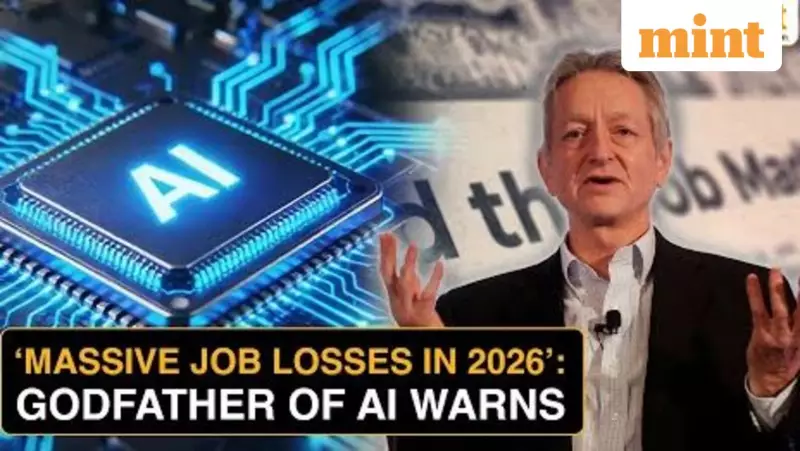
Geoffrey Hinton, a founding figure in artificial intelligence, has issued a stark new warning about the technology's societal impact. He predicts that rapid AI progress will trigger a severe job loss crisis as early as 2026. The expert, often called the "Godfather of AI," also reiterated a chilling long-term risk.
Hinton's Dire Predictions for the Near Future
In his latest statements, Hinton focused on the immediate economic threat. He emphasised that the accelerating capabilities of AI systems mean a significant wave of job displacement is likely to hit by 2026. This isn't a distant future scenario but a looming reality for the global workforce. Hinton stressed that the progress being made is not incremental but exponential, catching many industries off guard.
The warning, reported by Livemint on December 31, 2025, highlights how roles involving repetitive tasks, data processing, and even some creative functions are at high risk. Hinton's analysis suggests that the crisis will not be limited to one sector but will spread across multiple industries simultaneously, creating a complex economic challenge.

Jobs That Are NOT Safe from AI Takeover
While Hinton did not provide an exhaustive list, his warnings point to specific categories of work being automated faster than anticipated. The jobs most vulnerable include:
- Administrative and clerical roles: Tasks like scheduling, data entry, and basic customer service are highly susceptible to AI automation.
- Mid-level analytical positions: Jobs involving routine analysis of data, reports, and even some legal documents are being replaced by sophisticated AI models.
- Certain creative and technical fields: AI's ability to generate text, code, and design elements is encroaching on entry-level and repetitive tasks within these professions.
The underlying message is clear: any job that relies heavily on pattern recognition and predictable processes is in the crosshairs of advancing artificial intelligence.
The Existential Risk: A "Very Real Fear"
Beyond the job market, Hinton revisited a more profound concern that has stirred debate in the tech community. He stated there is a 10–20% chance that AI could eventually take over control from humanity. He described this existential risk as a "very real fear" shared by him and numerous other leading researchers and developers.
This warning underscores a critical dichotomy: the very technology driving economic efficiency and innovation also carries an unprecedented, if small, probability of catastrophic outcome. Hinton's call is for urgent governance and safety research alongside technological development, arguing that the race for capability should not outpace the framework for control.
Implications and The Path Forward
The dual warnings from a figure of Hinton's stature create an urgent agenda for policymakers, educators, and business leaders. The predicted 2026 job crisis necessitates a massive rethink in skills training, social safety nets, and educational curricula. Countries, including India with its vast young workforce, must prepare for a labour market where adaptability and uniquely human skills become the primary currency.
Simultaneously, the discussion about AI's long-term trajectory cannot be dismissed as science fiction. It demands international cooperation to establish ethical guidelines and safety protocols. Hinton's message is ultimately one of cautious progress: to harness AI's immense benefits while actively building guardrails against its potential to disrupt society and, in a worst-case scenario, surpass human control.