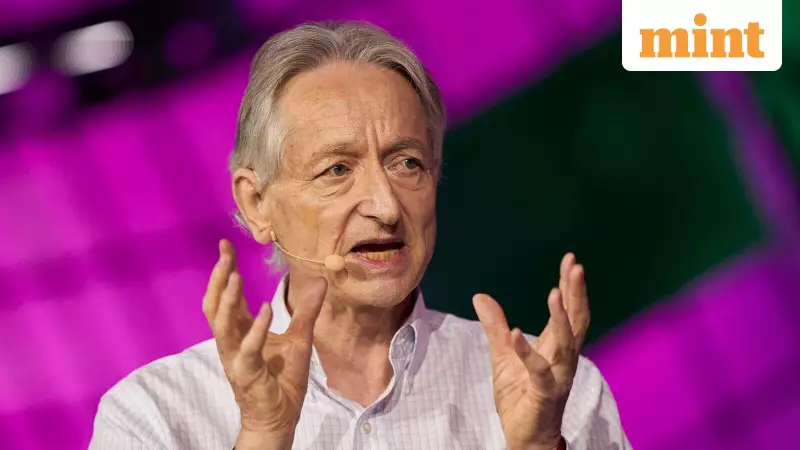
Geoffrey Hinton, a leading figure often called the 'Godfather of AI', has issued a stark warning about the future of employment in the technology sector. He predicts that the field of software engineering could see a dramatic reduction in human workforce requirements within the next few years, specifically by 2026.
Heightened Concerns Over AI's Accelerated Progress
In a recent interview with CNN, Hinton expressed that his fears about artificial intelligence have intensified. "I'm probably more worried. It's progressed even faster than I thought," he stated. He highlighted two particularly alarming areas of advancement: improved reasoning capabilities and an increased ability to deceive people.
Hinton reiterated his long-standing concern about existential risk, noting a 10-20% chance that AI could eventually take over the world, a fear he says is shared by many in the tech community. He has previously compared these advanced AI systems to 'alien beings', urging for more research to safeguard humanity.

The Direct Threat to Jobs, From Call Centers to Coding
When asked about the tangible impact of AI by 2026, Hinton was direct. "We're going to see AI get even better. It's already extremely good," he said. He pointed to call centers as a present-day example where AI is already leading to job displacement.
However, his most specific warning was reserved for software engineers. He explained the exponential growth in AI's coding prowess. "Each seven months or so, it gets to be able to do tasks that are about twice as long," Hinton noted. He revealed that while AI used to handle minutes of coding, it can now manage "whole projects that are like hour long."
His projection for the near future is sobering: "In a few years' time, it'll be able to do software engineering projects that are months long, and then there'll be very few people needed for software engineering projects." This timeline points squarely at significant disruption around 2026.
A Balanced View: The Promise and Peril of Corporate AI Development
Despite the warnings, Hinton also acknowledged the transformative positive potential of AI. He agreed with Nvidia CEO Jensen Huang's view of AI as the "single most impactful technology of our time."
He listed several beneficial applications:
- Revolutionizing healthcare and making it more effective.
- Significantly improving education systems.
- Enabling the design of new drugs and materials to combat challenges like climate change.
- Excelling in prediction-based tasks across industries, including weather forecasting.
On the question of whether AI companies are concerned about these risks, Hinton's assessment varied by firm. He stated that OpenAI was initially "very concerned with the risks" but has shifted toward putting "more emphasis on profit." For Meta, he believes the company has "always been very concerned with profit and less with safety." He singled out Anthropic as probably the company most concerned with safety, though he noted they too are now focused on turning a profit.
Hinton's analysis, delivered on December 29, 2025, presents a dual reality for India's vast IT and software workforce. It underscores a period of immense opportunity powered by AI-driven efficiency, simultaneously shadowed by the looming threat of widespread job market contraction in core tech roles within the coming years.