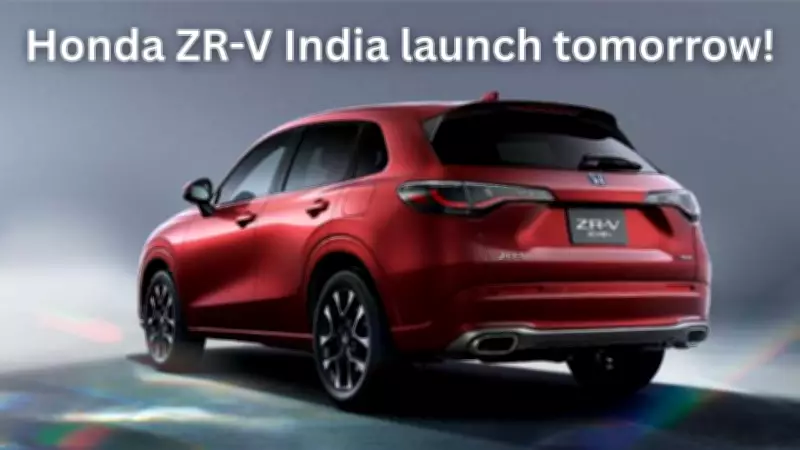
Along with the Honda City facelift, Honda Cars India will also launch the Honda ZR-V SUV in the Indian market tomorrow, i.e., May 22, 2026. The new Honda ZR-V will be introduced in India as a premium flagship SUV, arriving as a full import (CBU). This will push its pricing into a higher bracket due to import duties and related costs. The SUV is likely to be priced around ₹50 lakh (ex-showroom). When launched, it competes with the Volkswagen Tiguan, Skoda Kodiaq, Nissan X-Trail, and more. In this article, let’s take a look at all the details.
Engine and Platform
There are currently no details on which engine the Honda ZR-V will be offered with in India. It’s expected to get a 2.0-litre, 4-cylinder, naturally aspirated petrol engine paired with an e-motor. It puts out 180 hp and 240 Nm of torque. The Honda ZR-V is based on Honda’s global compact platform. It’s a monocoque construction typical of passenger cars. The architecture supports front-wheel drive, all-wheel drive, and hybrid powertrains in global markets. The ZR-V is tuned primarily for comfort and everyday on-road use rather than off-road conditions.
Dimensions
In terms of size, the Honda ZR-V measures about 4,568 mm in length, 1,840 mm in width, and 1,620 mm in height, with a wheelbase of around 2,655-2,657 mm.

Design
In terms of design, the Honda ZR-V adopts a crossover-like design instead of a traditional upright SUV form, with clean surfaces. At the front, it features a large grille and wide LED headlamps, integrated neatly into the fascia to deliver a restrained yet noticeable presence. In profile, the SUV appears lower than typical models, with a sloping roofline and a long wheelbase, giving it proportions closer to a raised hatchback than a conventional tall SUV. Subtle character lines add definition without making the design complex.
The rear continues the same approach, with wraparound LED tail lamps, a slightly raked rear glass, and a simple tailgate layout. A roof-mounted spoiler adds a mild sporty element while maintaining the overall clean design. The exterior is positioned as more urban-focused than rugged.
Interior and Features
Moving inside, the Honda ZR-V adopts a straightforward cabin design. Controls are arranged logically, with an emphasis on accessibility from the driver’s seat. The infotainment screen is positioned as a standalone unit at the top of the dashboard, clearly separated from the physical switchgear below. Honda has continued to use conventional buttons and rotary controls for functions such as climate controls.
The global spec, including the dashboard and door panels, uses softer finishes, while lower sections rely on tougher materials better suited to regular use. Subtle metallic or gloss inserts are added in limited areas. Overall, in our opinion, the interior avoids unnecessary design elements, focusing instead on uniform textures and a consistent finish.
Features-wise, it’s expected to get a large touchscreen infotainment system, wireless Android Auto and Apple CarPlay, connected car tech, multi-zone climate control, a fully digital cluster, electric and ventilated front seats, a panoramic sunroof, a powered tailgate, wireless charging, multiple airbags, ABS, and more.