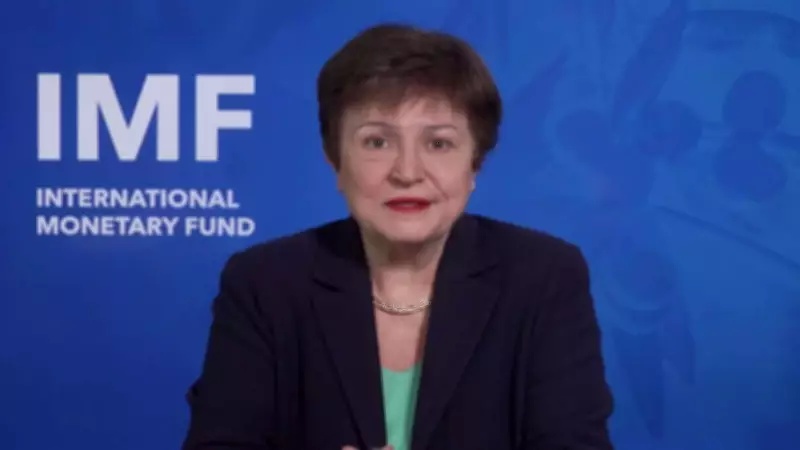
International Monetary Fund Managing Director Kristalina Georgieva has stated that the global economy is no longer returning to a calm and predictable state, and artificial intelligence represents the next major shock that governments must prepare for. Speaking on Bloomberg's Leaders with Francine Lacqua podcast, Georgieva emphasized that crisis-mode has become the default setting for the world economy. Her deeper concern is that policymakers will mishandle the AI transition in the same way they mishandled globalization, leaving entire communities behind once productivity gains concentrate among a few.
Global Shocks Are the New Normal
"I am worried that we are not completely internalizing yet that this is how the world is going to be," Georgieva told Bloomberg. "We are not going to get to a place where shocks are gone." Since taking the helm of the Washington-based lender in 2019, Georgieva has navigated the IMF through the COVID-19 pandemic, Russia's invasion of Ukraine, the tariff disputes of 2024-2025, and the ongoing war in the Middle East. The IMF currently has nearly $1 trillion in lending capacity across its 191 member countries. Her role, she explained, is to keep all members aligned. "The best ammunition we have is objective analysis," she said. The IMF cut its 2026 global growth forecast in April after the escalation of the Middle East conflict, with the next outlook due in July.
Why Georgieva Fears AI Jobs Disruption Will Repeat Globalization Backlash
The greater anxiety revolves around AI and its impact on labor markets. Georgieva acknowledged that the IMF underestimated how globalization hollowed out communities whose jobs disappeared, and she is determined not to let that pattern repeat. "We collectively, including the fund, did not appreciate the backlash against globalization," she told Bloomberg. "Many communities were hollowed out because their jobs disappeared and there was not enough attention to them. I'll tell you what I'm very keen not to see repeated is the same with artificial intelligence." This warning aligns with her earlier assessment of the AI job market. At Davos in January, Georgieva described AI as a "tsunami" hitting labor markets, predicting that 60% of jobs in advanced economies and 40% globally would be affected. In February, speaking to NDTV, she estimated India's exposure to AI-driven job changes at around 26% and identified entry-level roles as the most automatable and therefore the riskiest for young graduates entering the workforce.

IMF on AI Cyber Risks, Russia Article IV Review, and 2026 Growth Outlook
Georgieva also addressed the IMF's intermittent engagement with Russia. In 2024, the fund announced it would resume Article IV reviews of the Russian economy, which drew criticism from several EU member states. "It was a very tricky moment because bombing was going in both directions. We decided to delay," she told Bloomberg. The review will restart "at some point," she said, without specifying a date. Beyond employment, the IMF is also highlighting AI as a financial stability concern. A May blog post from its financial stability team warned that frontier AI models could identify and exploit vulnerabilities across major operating systems and browsers, raising the risk of correlated failures across banks and payment networks.
The overarching message from Georgieva is clear: shocks are not going away, AI is the next challenge, and policy groundwork must begin now.