

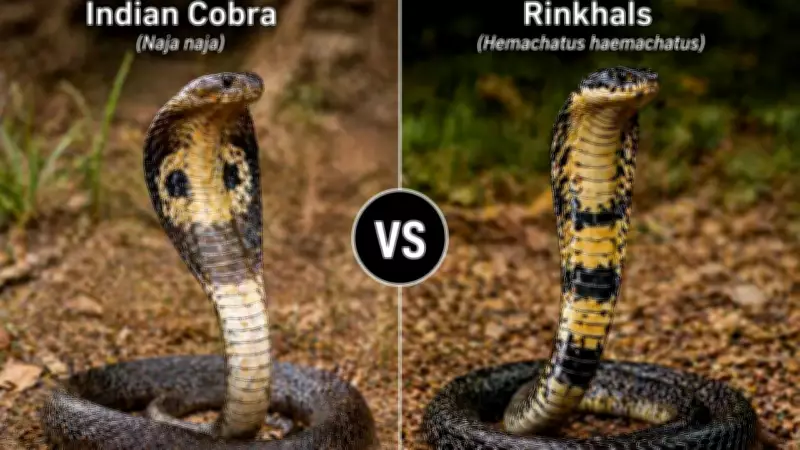
Cobras are widely recognized as some of the most iconic venomous snakes in the world, known for their ability to rear up and form a hood. Among the species that share this characteristic are the Indian cobra (Naja naja) and the rinkhals (Hemachatus haemachatus). Although they appear similar, several key differences set them apart.
Habitat and Distribution
The Indian cobra is found across the Indian subcontinent, including India, Pakistan, Sri Lanka, Bangladesh, and Nepal. It thrives in diverse habitats such as forests, savannas, marshes, and areas near human settlements. It often resides in termite mounds, rock crevices, dense bushes, and abandoned burrows, frequently coming into contact with humans, especially in agricultural regions.
In contrast, the rinkhals is native to southern Africa, specifically South Africa, Zimbabwe, and Botswana. It prefers open grasslands and marshes near water bodies. Unlike the Indian cobra, which adapts to various environments, the rinkhals favors moist areas that support its primary prey.

Size and Appearance
Both species exhibit the classic cobra posture, but their physical traits differ. The Indian cobra typically measures 1 to 1.5 meters in length, with some individuals growing larger. A distinctive spectacle-like mark adorns its hood when expanded.
The rinkhals is bulkier and more robust, often reaching similar or slightly larger sizes. It lacks the spectacle mark, instead having dark skin with one or more light bands on its neck. Additionally, the Indian cobra has smooth scales, while the rinkhals has keeled scales.
Venom and Snakebite Risk
Both snakes are venomous and dangerous, but their venoms differ. The Indian cobra's venom contains potent neurotoxins and cardiotoxins that affect the nervous system, potentially causing paralysis and respiratory failure. It is one of the "big four" snakes responsible for most snakebites in India.
The rinkhals' venom is similar but also has tissue-damaging effects. Notably, the rinkhals can spit venom at threats, aiming for the eyes. Both snakes rarely attack without provocation, typically only when threatened.
Hunting Behavior and Diet
The Indian cobra preys on rodents, frogs, lizards, and small birds, making it beneficial in agricultural areas by controlling rodent populations. The rinkhals feeds on small mammals, amphibians, and reptiles, with a particular preference for frogs and toads, explaining its affinity for wetlands. Both snakes use venom to immobilize prey before consumption.
Defensive Posture and Behavior
When threatened, the Indian cobra raises its head, spreads its hood, and hisses as a warning. It prefers to flee but will strike if necessary. The rinkhals also rears up and flares its hood but has additional defenses: it can spit venom and play dead by lying on its back.
Classification and Reproduction
A key difference is that the Indian cobra belongs to the genus Naja, making it a true cobra, while the rinkhals is classified under Hemachatus and is not a true cobra despite its appearance. Reproduction also differs: the Indian cobra lays eggs, whereas the rinkhals gives birth to live young, an uncommon trait among cobra-like snakes.
Cultural and Ecological Importance
The Indian cobra holds cultural significance in South Asia, often associated with religious and mythological traditions, particularly linked to Lord Shiva. The rinkhals lacks such cultural roles but is notable for its unique defensive mechanisms. Both species play crucial ecological roles by regulating populations of small animals.






