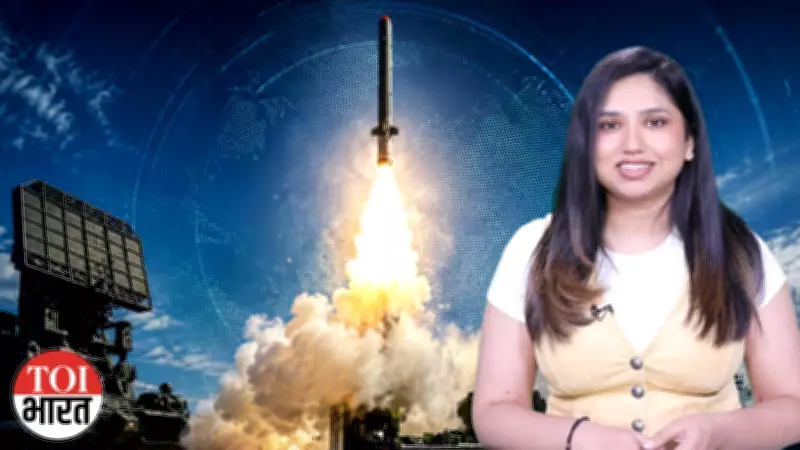
The Defence Research and Development Organisation (DRDO) has successfully tested the Long Range Land Attack Cruise Missile (LRLACM), a milestone that extends beyond a mere defence achievement. With a range of up to 1,500 kilometres, this missile marks a significant shift in India's strategic capabilities, sending a clear geopolitical signal to both Pakistan and China.
What is the LRLACM?
The LRLACM is a state-of-the-art cruise missile designed for land attack missions from extended distances. It can be launched from multiple platforms, including ships, submarines, and ground-based launchers, providing flexibility in deployment. The missile employs advanced navigation and guidance systems, enabling it to strike targets with high precision even at maximum range.
Strategic Implications for Pakistan
For Pakistan, the LRLACM threatens its traditional concept of strategic depth. The missile's range covers all major Pakistani cities and military installations, reducing the effectiveness of any defensive measures. This capability forces Pakistan to reconsider its force posture and potentially divert resources to counter this new threat.

Impact on China
China faces a direct challenge as the LRLACM can target Chinese military infrastructure in Tibet, including airfields, radar stations, and supply depots. This puts Chinese assets in the region at risk, potentially altering the balance of power along the disputed border. The missile's range also allows India to strike deep into Chinese territory from safe distances.
Technical Specifications and Capabilities
The LRLACM is equipped with a turbofan engine that provides efficient fuel consumption for long-range flight. It can carry a conventional warhead of up to 450 kilograms, making it effective against hardened targets. The missile features terrain contour matching and satellite navigation for precise targeting, with the ability to fly at low altitudes to evade radar detection.
Operational Deployment Timeline
According to DRDO officials, the LRLACM is expected to enter service within the next two to three years after completing further trials. Integration with existing platforms and user training will follow, ensuring the missile is ready for operational use by the late 2020s.
Geopolitical Significance
The successful test underscores India's growing indigenous defence manufacturing capabilities and its commitment to maintaining a credible deterrence. It also signals to regional adversaries that India can project power across the subcontinent and beyond. The LRLACM complements other missile systems like the BrahMos and Nirbhay, creating a layered strike capability.
Defence analysts note that the LRLACM's development aligns with India's strategy of countering China's military expansion in the Indian Ocean region and the Himalayas. The missile provides a non-nuclear strategic option that can be used in limited conflicts without escalating to nuclear warfare.
International Reactions
While official reactions from Pakistan and China are awaited, military experts in both countries have acknowledged the missile's potential impact. The test is expected to prompt discussions on arms control and confidence-building measures in South Asia.
In conclusion, the LRLACM represents a leap forward in India's defence capabilities, altering the strategic calculus in the region. As it moves towards induction, the missile will likely become a cornerstone of India's long-range strike doctrine.