

Interstellar Mystery Deepens as 3I/ATLAS Defies Expectations
A mysterious visitor from beyond our solar system is rewriting the rules of astronomy. The interstellar object known as 3I/ATLAS, which entered our solar system in June, has surprised scientists by behaving completely differently from what they predicted. After making its close pass by the Sun, recent observations reveal a complete absence of the cometary tail that researchers were certain would appear.
The Puzzling Absence of a Tail
When comets approach the Sun, the intense heat typically causes their icy surfaces to vaporize, creating a spectacular glowing halo called a coma and a long, visible tail pushed outward by solar radiation. Scientists had predicted that 3I/ATLAS would follow this pattern, especially since astronomers had observed unexpected acceleration in its motion last week that seemed to suggest outgassing was occurring.
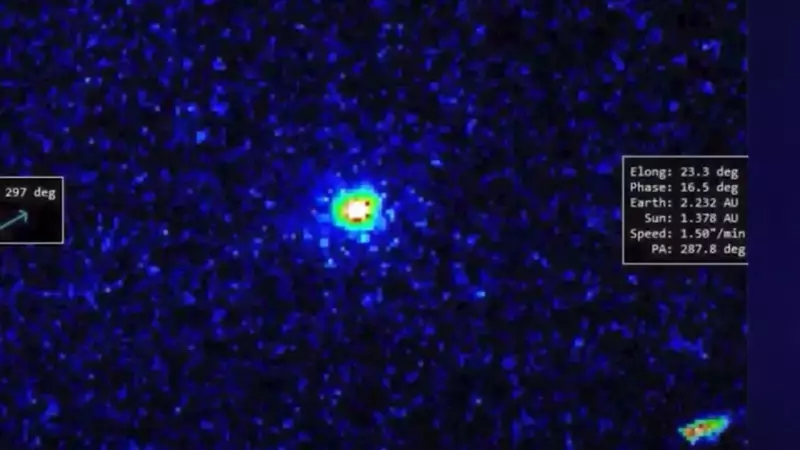
However, new images captured at the R. Naves Observatory in Spain tell a different story. Despite passing close enough to the Sun for substantial heating, the object remains a compact point of light with no visible stream of gas or debris. Harvard astrophysicist Avi Loeb noted that based on expected models, approximately 13 percent of the object's material should now be visibly dispersed, creating a visible tail. The complete absence of this feature has sent shockwaves through the astronomical community.

What Makes This Discovery So Significant?
3I/ATLAS represents only the third confirmed interstellar object to visit our solar system, following 1I/ʻOumuamua in 2017 and 2I/Borisov in 2019. Each of these visitors provides a rare opportunity to study material formed around other stars, offering clues about planetary formation in distant solar systems.
While Borisov behaved like a standard comet, ʻOumuamua also displayed unusual characteristics that sparked scientific debate. The parallels between ʻOumuamua and 3I/ATLAS have not gone unnoticed. The current mystery has intensified discussions about the true nature of these interstellar travelers and raised fundamental questions about how objects from other star systems form, evolve, and behave.
The scientific community is divided in its interpretation. Avi Loeb has suggested that the unusual motion and lack of visible outgassing could indicate a non-natural or even artificial origin. He argues that if the object continues to show no tail despite ample solar heating, it may represent an entirely new class of interstellar object. Other astronomers urge caution, emphasizing that factors like atmospheric angles, dust composition, and observation timing must be carefully analyzed before drawing dramatic conclusions.
What Comes Next in the Investigation?
The mystery is far from over. Researchers say that if 3I/ATLAS behaves like a natural comet, the coming weeks should reveal a noticeable cloud of gas as viewing angles improve. The object is now on its outbound path toward Jupiter, where it will make a close pass on March 16, 2026. Both NASA and the European Space Agency are planning detailed observations during this phase, which could provide the most comprehensive insights yet into this enigmatic traveler.
Additionally, scientists are awaiting high-resolution images taken by NASA's Mars Orbiter HiRISE camera, though the release of these images has been delayed due to the ongoing government shutdown in the United States.
For now, the scientific community watches with cautious anticipation. 3I/ATLAS may yet behave like a conventional comet, or it may continue to break all the established rules of celestial mechanics. Either outcome promises to expand our understanding of what travels between the stars and challenge our fundamental assumptions about the universe.






