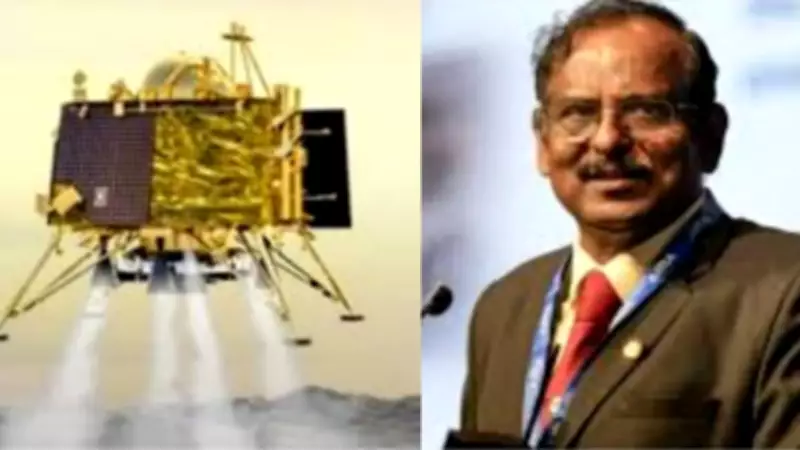
ISRO chairman V Narayanan has announced that the space agency is collaborating with the Department of Atomic Energy (DAE) to develop an advanced artificial heating system for future lunar landers. This technology will enable landers to operate for up to 200 Earth days on the Moon's surface.
Importance of the Development
The announcement is significant as the Chandrayaan-3 lander, named Vikram, operated for only 14 Earth days (one lunar day) after landing on the Moon's south pole on August 23, 2023. ISRO could gather valuable data for just two weeks due to the lander's reliance on solar energy.
Narayanan stated, "We are going to work on a project with DAE under the guidance of our minister, where we are going to develop objects... Thereby, this type of lander will survive for up to 200 days."

Challenges of Lunar Nights
Speaking at the CSIR-RISE Conclave in Bengaluru on Sunday, the ISRO chief explained that Vikram was powered by solar energy and could only operate during the lunar day when sunlight was available. The lander ceased functioning with the onset of the lunar night, when temperatures can plummet to -129°C. The advanced lander will feature artificial heaters to withstand these harsh conditions.
Future Implications
Narayanan emphasized that the new technology will significantly aid long-duration lunar exploration. With a 200-day survival capability, the lander can perform experiments for nearly seven lunar days. If successful, this breakthrough will also pave the way for more complex interplanetary missions in the future.
He also revealed that ISRO and CSIR have identified 40 areas of technological cooperation, with 17 already approved for implementation in the first phase.