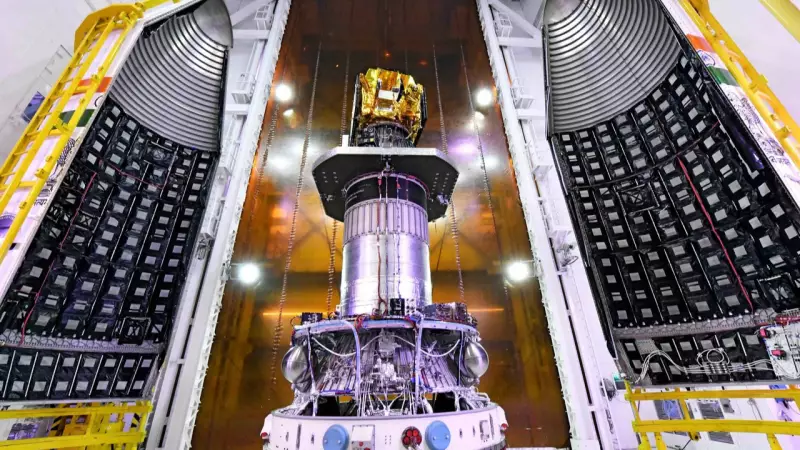
India's space ambitions faced a significant blow on Monday when ISRO's PSLV-C62 rocket veered off its intended trajectory during launch. This deviation resulted in the loss of not just a crucial defence satellite but also fifteen other satellites carrying cutting-edge technologies. The failure has impacted security agencies, startups, companies, and academic institutions alike.
ISRO Chairman Explains the Anomaly
ISRO Chairman V Narayanan addressed the media after the botched launch from Sriharikota spaceport. He detailed the sequence of events that led to the mission's failure.
"We attempted the PSLV-C62 EOS-N1 mission," Narayanan stated. "The PSLV is a four-stage vehicle. Its performance was normal until near the end of the third stage."

He continued, "At that point, we observed some disturbance in the vehicle. This caused a deviation in its flight path. Consequently, the mission could not proceed as planned."
Narayanan assured that ISRO is now analyzing data from all ground stations. The agency will provide updates once this analysis is complete.
Major Loss: DRDO's Strategic EOS-N1 Satellite
The primary payload, EOS-N1 (Anvesha), was a hyperspectral imaging satellite developed by DRDO. This advanced asset represented a strategic super-eye for India's security apparatus.
EOS-N1 possessed the capability to "see" in hundreds of wavelengths. This technology allows for precise identification of materials on the ground. Its applications spanned both military and civilian domains.
- National Security: The satellite would have enhanced border surveillance and security through advanced remote sensing.
- Civilian Benefits: Potential uses included agriculture monitoring, urban mapping, and environmental observation.
Its loss is a high-priority setback for India's defence and technological advancement.
History Repeats: Echoes of Past Failure
This incident mirrors a previous failure from May 18, 2025. On that date, the PSLV-C61 mission also encountered an anomaly in its third stage. That failure led to the loss of EOS-09, another crucial defence satellite.
EOS-09 was an advanced radar imaging satellite designed for all-weather, day-and-night surveillance. Its capabilities were vital for border monitoring, disaster response, and resource management.
Disruptive Technologies Lost in Space
Beyond the defence satellite, the PSLV-C62 carried fifteen secondary payloads. These represented innovative projects from various entities.
International and Domestic Innovations
The mission included the Kestrel Initial Technology Demonstrator (KID) from a Spanish startup. KID was a small-scale prototype of a re-entry vehicle. It was scheduled for injection as the final co-passenger, with a planned splashdown in the South Pacific Ocean.
From Bengaluru, OrbitAID Aerospace was set to launch AayulSAT. This payload aimed to be India's first on-orbit satellite refuelling system. AayulSAT promised to extend satellite lifespans and address space sustainability challenges.
Hyderabad-based startups TakeMe2Space and Eon Space Labs contributed an orbital AI lab. This lab featured the MIRA telescope and a model designed to drastically reduce space data costs. Their Satellite MOI-1 was intended to capture and process images directly from its 500 km orbit.
Academic and Startup Contributions
The launch also hosted multiple cubesats developed by university students and Indian startups:
- CV Raman Global University's CGUSAT-1
- Dhruva Space’s DA-1
- Space Kidz India’s SR-2
- Assam Don Bosco University’s Lachit-1
- Akshath Aerospace’s Solaras-S4
- Dayanand Sagar University’s DSAT-1
All these satellites, representing years of research and innovation, are now lost. Their intended sun-synchronous orbit home at 512 km altitude remains unreached.
This collective loss underscores the high stakes of space missions. It highlights the need for rigorous analysis and corrective measures to prevent future recurrences. The Indian space sector must now regroup and learn from this expensive lesson.