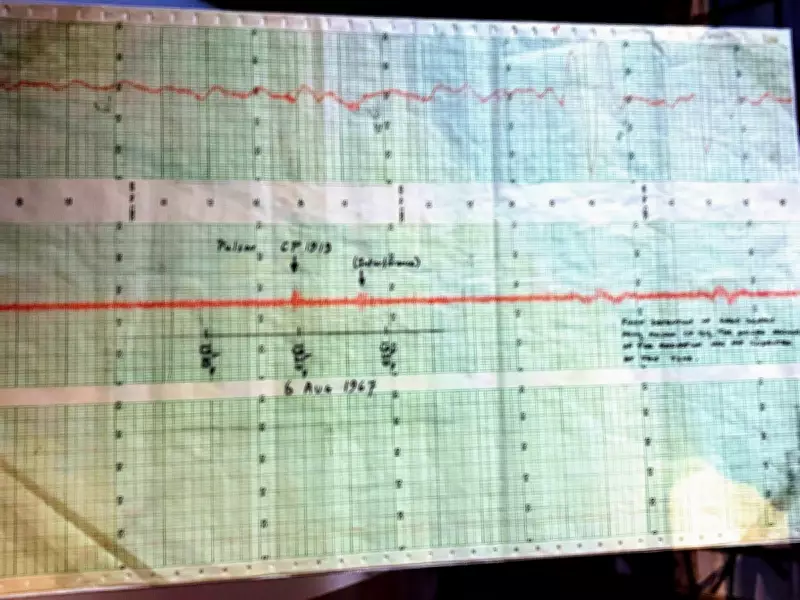
When a young postgraduate student at the University of Cambridge analyzed millions of pages of records from radio telescopes, she detected an unusually small and repetitive signal. What could have been easily dismissed as interference turned out to be one of the greatest astronomical discoveries of the 20th century.
The Discovery of the First Pulsar
According to the University of Cambridge, the first pulsar was discovered by Jocelyn Bell Burnell during research on quasars using interplanetary scintillation with a radio telescope. Bell Burnell's role involved reviewing enormous amounts of chart-recorder paper to distinguish random noise from real signals. What set the observed phenomenon apart was its periodic repetition and consistent appearance at the same point in the sky, making it impossible to ignore. Along with luck, a deep understanding of the telescope's workings, gained through years of analysis, played a crucial role in the discovery.
The 'Little Green Men' Joke
The pulses arrived at extremely regular intervals, unlike any known natural radio sources. Scientists jokingly referred to them as 'little green men' (LGM), a term popularized in media but never used seriously by researchers. The uniqueness of the signal, which did not resemble any known natural phenomenon, led to this playful nickname. However, the discovery of more signals soon confirmed that they were dealing with a new category of astrophysical objects.

What Are Pulsars?
NASA explains that pulsars are rapidly rotating neutron stars that emit beams of energy. These beams sweep across Earth, producing pulses similar to those from a lighthouse. Pulsars provided the first direct evidence of neutron stars, which were previously theoretical objects thought to form after star collapses. This discovery revolutionized astrophysics, showing that dead stars can continue to emit detectable signals.
Pulsars as Scientific Tools
An article from 1968 announced the discovery of the first pulsating radio source, characterized by fast pulsations unlike any previously known sources. Over time, pulsars became important scientific instruments, enabling astronomers to study star death processes, magnetic fields, and exotic forms of matter. Their precise timing also helped test predictions of Einstein's theory of general relativity. According to NASA, pulsars continue to be used to explore extreme conditions in the universe.
The Unassuming Breakthrough
What makes this story enduring is that the discovery was not spectacular—no dramatic telescope image or cosmic revelation. Bell Burnell's finding demonstrated the importance of recognizing patterns in difficult observational data. The pulse initially seemed like frustrating interference, far from amazing. This story resonates because it shows that scientific discovery requires careful observation and the ability to recognize when something is unexpected.
The Human Story Behind the Science
The discovery also sparked debates about scientific recognition. In 1974, the Nobel Prize in Physics was awarded to Antony Hewish and Martin Ryle for their role in the discovery, excluding Bell Burnell. Her exclusion later became a notable example of disputes over scientific credit. Nevertheless, the discovery is inseparable from Bell Burnell's tenacity and skill. Her initial sighting of an anomaly on graph paper led to an entirely new field in astrophysics, redefining humanity's understanding of dead stars. The message of the universe lay within noise, and one graduate student chose not to ignore it.