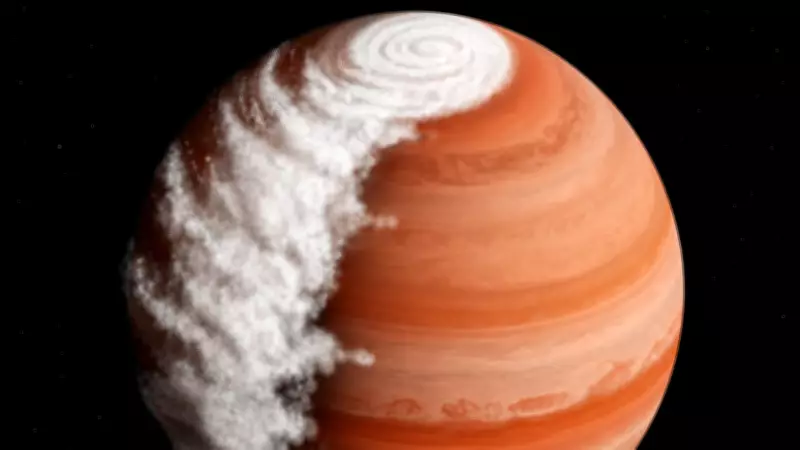
On Earth, a cloudy morning giving way to a clear evening is unremarkable, the kind of forecast that barely warrants a glance at the weather app. On a gas giant orbiting a star nearly 700 light-years from Earth, the same basic pattern plays out every single day, except the clouds are not made of water vapour. They are made of vaporised rock. And scientists, using the James Webb Space Telescope (JWST), have just watched it happen for the first time in history. The study, published in the journal Science on May 21, 2026, marks the first time a repeating daily cloud cycle has been detected on a hot Jupiter exoplanet, and it is already rewriting what astronomers thought they knew.
Meet WASP-94A b: The Hot Jupiter with Rock Clouds
The planet in question is WASP-94A b, a well-studied gas giant sitting in the constellation Microscopium, orbiting so close to its host star that a full year on its surface lasts just a few Earth days. It belongs to a class of planets known as hot Jupiters, large gas giants that orbit their stars at extreme proximity, resulting in surface temperatures that dwarf anything in our solar system. Like many tidally locked planets, WASP-94A b keeps one face permanently turned toward its star and one face in permanent darkness, a scorching dayside and a frozen nightside locked in an eternal standoff. It is the boundary between these two worlds, the terminator line where night bleeds into day, that has now produced one of the most striking meteorological discoveries in exoplanet science.
How JWST Detected a Daily Cloud Cycle on Another Planet
To study the planet, a team led by researchers at Johns Hopkins University observed WASP-94A b as it crossed in front of its star, a technique known as transmission spectroscopy, which allows scientists to analyse how starlight filters through a planet's atmosphere at its edges. Crucially, this method allows astronomers to observe the planet's morning side and evening side separately as it moves through its orbit. What they found was a dramatic asymmetry. The morning side of the planet was thick with clouds. The evening side was almost entirely clear. The study was published in the journal Science on May 21, 2026.

"I've been looking at exoplanets for 20 years, and general cloudiness has been a thorn in our side," said co-author David Sing, a Bloomberg Distinguished Professor of Earth and Planetary Sciences at Johns Hopkins. "We've known for quite a while that clouds are pervasive on hot Jupiter planets, which is annoying because it's like trying to look at the planet through a foggy window. Not only have we been able to clear the view, but we can finally pin down what the clouds are made out of and how they're condensing and evaporating as they move around the planet."
What the Rock Clouds on WASP-94A b Are Actually Made Of
Unlike the water vapour clouds that drift across Earth's skies, the morning clouds on WASP-94A b are composed of magnesium silicate, in other words, vaporised rock. On the cooler nightside of the planet, rock-forming minerals condense out of the atmosphere and rise into towering cloud formations. As those clouds are carried by powerful atmospheric winds toward the dayside, they encounter temperatures exceeding 1,000 degrees Celsius. The minerals boil away, the clouds dissolve, and by the time the atmosphere reaches the evening terminator, the sky is clear. Researchers identified two possible mechanisms driving this cycle. The first involves powerful winds lifting clouds high into the atmosphere on the cooler nightside before plunging them deep into the planet's interior on the hotter dayside, effectively burying them before sunset. The second is more familiar in concept if not in scale: the clouds simply burn off, much like morning fog on Earth, but driven by heat so extreme that rock itself cannot survive it.

Why This Discovery Changes How Scientists Study Exoplanet Atmospheres
For two decades, clouds have been one of the biggest obstacles in exoplanet science. When an atmosphere is uniformly cloudy, it acts like a frosted pane of glass; light passes through but reveals almost nothing about what lies beneath. The ability to separate the cloudy morning limb from the clear evening limb of WASP-94A b gave researchers something they had never had before: an unobstructed window into the planet's true atmospheric chemistry. What they found through that window surprised them. The clear evening side revealed strong water vapour signals and a chemical composition that placed WASP-94A b much closer to Jupiter than earlier measurements had suggested. Previous data, clouded literally by the morning atmosphere, had pointed to a different and less Jupiter-like picture. The clouds had been distorting the science all along.
What This Exoplanet Weather Discovery Means for Finding Other Worlds
The method developed by the team, isolating different parts of a planet's atmosphere by observing it at different points in its orbit, could become a standard tool for studying hot Jupiters going forward, and potentially other types of exoplanets beyond them. For a field that has long struggled to see through the haze of alien atmospheres, the ability to find the clear part of the sky, even on a world made of rock clouds and scorching winds, represents a meaningful step forward. The weather on WASP-94A b is nothing any human would survive. But the forecast it has produced for planetary science is clearer than it has been in years.