

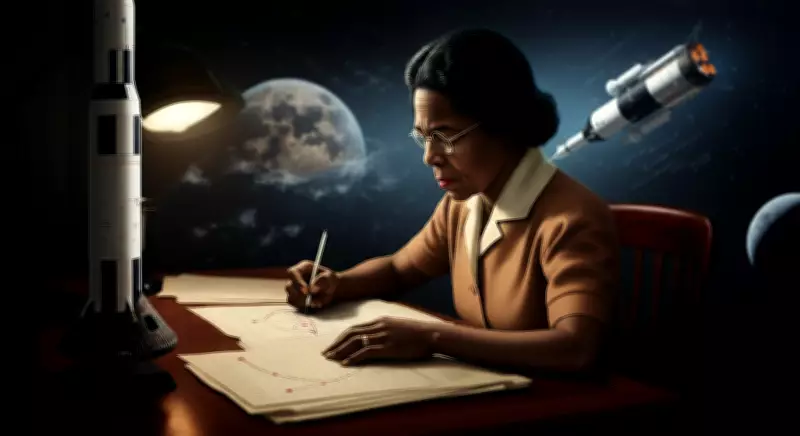
Long before laptops or calculators were anywhere near NASA's offices, a woman was doing the math by hand, deciding whether astronauts would make it to space and back alive. Katherine Johnson worked as a "human computer" at NASA's Langley Research Centre. Her calculations were behind some of the biggest moments in American spaceflight, from the first US astronaut in space to the Apollo 11 moon landing. For most of her career, almost nobody outside NASA knew her name. That changed decades later when her story finally got attention through a bestselling book and an Oscar-nominated film. Here is a look at how she got there and why her work still matters today.
Katherine Johnson's Early Life: A Childhood Obsessed with Counting Everything
Katherine Johnson was born on August 26, 1918, in White Sulphur Springs, West Virginia. Even as a small child, she had a habit of counting absolutely everything around her: steps to the road, dishes after dinner, anything that could be counted. The problem was that her hometown did not offer schooling for Black students past eighth grade, so her family moved so she could continue studying. She skipped several grades and ended up at West Virginia State College by age 15. According to NASA's account of her life, one of her professors created a new course in analytic geometry of space because she had run out of math classes to take. She graduated summa cum laude at 18 with degrees in mathematics and French.
From Teacher to "Human Computer": Joining NASA's Predecessor NACA
Johnson's path to NASA was not direct. She worked as a teacher for a while before joining the National Advisory Committee for Aeronautics (NACA) in 1953, which later became NASA. She joined the West Area Computing section at Langley Research Centre, a group of Black women mathematicians led by Dorothy Vaughan. Back then, segregation meant Johnson and her Black colleagues used separate restrooms and eating areas from white employees. According to NASA's biography, she was naturally curious and assertive, always asking questions and pushing to be included in meetings that women were not invited to. That attitude made her the first woman in the Flight Research Division credited as an author on a research report.

Calculating the Trajectory for America's First Astronauts in Space
Things picked up in 1961 when Johnson did the trajectory analysis for Alan Shepard's Freedom 7 mission, making him the first American in space. In 1962, John Glenn was preparing for his orbital flight. Even though NASA had electronic computers, Glenn personally asked Johnson to check the machine's calculations by hand before he would trust them with his life. Early computers were huge, slow, and unreliable, so having someone like Johnson double-check the numbers genuinely mattered. Glenn reportedly said that if she said the numbers were good, he was ready to fly. That was the trust her work had earned.
Her Role in Apollo 11 and Syncing the Lunar Module with the Command Module
Johnson's work did not stop with early orbital flights. When asked later what she considered her biggest contribution, she pointed to her calculations for Project Apollo, specifically those that helped synchronize the Lunar Module with the Command and Service Module orbiting the moon. That math was critical for Apollo 11 in 1969, ensuring the lander could meet back up with the orbiting spacecraft after the moon landing. Beyond Apollo, she contributed to the Space Shuttle program and the Earth Resources Technology Satellite, later known as Landsat. Over 33 years at Langley, she authored or co-authored 26 research reports.
Recognition Came Late: The Presidential Medal of Freedom and Hidden Figures
For most of her career, Johnson's contributions stayed invisible outside NASA. That started changing in 2015 when President Barack Obama awarded her the Presidential Medal of Freedom, America's highest civilian honor, at age 97. In 2016, Margot Lee Shetterly's book "Hidden Figures" and the film adaptation brought Johnson's story, along with those of other Black women mathematicians at NASA, to a wider audience. As the Smithsonian's National Air and Space Museum notes, her story inspired a generation of people who saw someone like them represented in the early history of the Space Race. Johnson passed away on February 24, 2020, at age 101.

Katherine Johnson's Legacy: A Research Building and Lasting Inspiration
NASA's recognition did not stop with the Medal of Freedom. In September 2017, when she was 99, NASA dedicated a new research building at Langley in her name: the Katherine G. Johnson Computational Research Facility. West Virginia also marks August 26 as Katherine Johnson Day, commemorating her birthday and contributions. According to NASA's science page on her legacy, her work remains a reminder of how many people quietly shaped the space program from behind the scenes. Today, her story is told in classrooms, museums, and documentaries, a fitting outcome for someone who spent her life asking "why" and refusing to accept that she should not be in the room.





