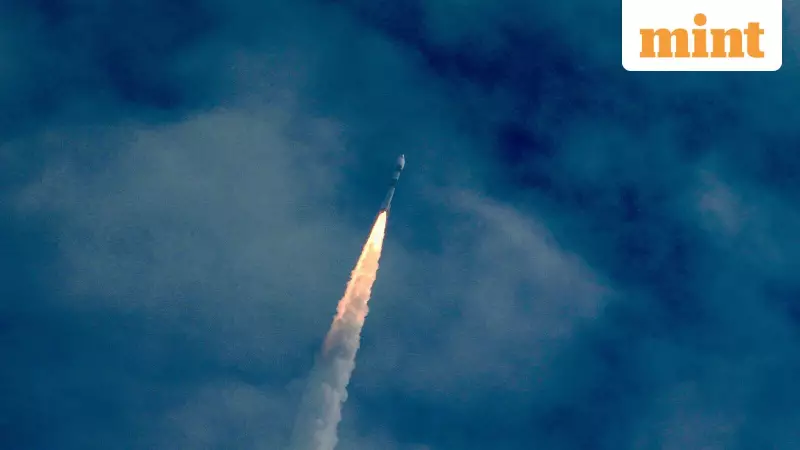
Spanish Space Capsule Defies Odds in Failed ISRO Launch
The Indian Space Research Organisation's PSLV C62 mission encountered a serious anomaly. Its time-tested rocket suffered a malfunction during midflight. However, amidst this failure, a single payload emerged as a remarkable survivor.
A Lone Survivor Transmits from the Brink
Spanish spaceflight company Orbital Paradigm announced the unexpected survival of its KID capsule. The company posted on social media platform X hours after ISRO declared the mission anomaly.
"Our KID capsule, against all odds, separated from PSLV C62, switched on, and transmitted data. We're reconstructing trajectory. Full report will come," the company stated.

The Kestrel Initial Demonstrator capsule was one of sixteen payloads on the doomed mission. It survived the mishap long enough to achieve separation from the launch vehicle. The capsule then transmitted crucial data before its inevitable crash-landing on Earth.
What is the Experimental KID Capsule?
Orbital Paradigm developed the KID capsule as a small-scale demonstrator. It serves as a prototype for the company's future reusable Kestrel space capsule.
This experiment did not carry fully-fleshed out systems. The capsule had no independent propulsion. It carried no parachutes. Engineers did not design it for recovery after landing.
KID's primary role was straightforward. It needed to separate after the PSLV rocket's fourth stage completed its de-orbit maneuver. The capsule then attempted to survive the brutal re-entry into Earth's atmosphere. Its key objective was transmitting data throughout this harrowing process.
Valuable Data Retrieved from the Ordeal
The resilient KID capsule transmitted approximately 190 seconds of data. Orbital Paradigm successfully gleaned several critical insights from this transmission before contact was lost.
The Spanish company revealed key details to the publication Payload. KID separated from the PSLV rocket roughly 18 minutes after liftoff. This separation likely resulted directly from the in-flight anomaly.
The data painted a vivid picture of the capsule's experience:
- The demo craft endured peak forces reaching an incredible 28Gs.
- KID's thermal protection material performed admirably. It maintained a comfortable payload temperature around 30 degrees Celsius.
- The back, payload-facing side of the thermal shield recorded a temperature of 85 degrees Celsius.
Francesco Cacciatore, Orbital Paradigm's CEO, provided further explanation. "To transmit the data it means KID had to separate undamaged from the launcher, switch on, and connect to the RF link," he stated.
Cacciatore elaborated on the working theory. "The working theory we have is that KID fell back to Earth coupled to PSLV stage 4, and the thermal conditions triggered separation," he explained.
A Silver Lining in a Failed Mission
The survival and data transmission of the KID capsule represents a significant success for Orbital Paradigm. It marks a positive outcome from the company's inaugural re-entry flight experiment.
This success, however, comes with a notable caveat. The PSLV's failure and the premature loss of the satellite prevented other planned experiments. Missions slated for the microgravity environment could not be carried out as intended.
Analyzing the PSLV C62 Anomaly
ISRO's mission began according to plan. The PSLV rocket lifted off successfully from the space port at Sriharikota in Andhra Pradesh. The agency soon reported an anomaly involving the vehicle's third stage.
ISRO chief V Narayanan addressed the technical issue. "The PSLV is a four-stage vehicle with two solid stages and two liquid stages. The performance of the vehicle up to the end of the third stage was expected. Close to the end of the third stage we are seeing more disturbance in the vehicle and subsequently, there was a deviation observed in the flight path," he stated.
The space agency confirmed it has initiated a detailed analysis of all mission data. This investigation aims to pinpoint the exact cause of the disturbance and flight path deviation.