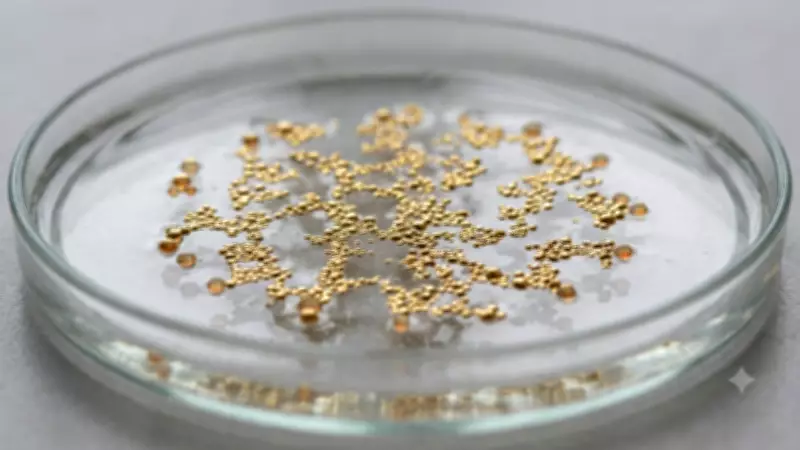
Scientists at Tohoku University in Japan have discovered that certain gold nanoparticles can display nearly fluid-like properties, enabling them to change their structures in response to heat and pressure. This breakthrough, reported in the Journal of the American Chemical Society, could revolutionize biomedical engineering, intelligent surfaces, drug delivery technologies, and microfluidic devices.
How Japanese Scientists Created Liquid-Like Gold Nanoparticles
The research team, led by Dr. Rina Sato and Professor Kiyoshi Kanie, focused on gold nanoparticles positioned at the interface between air and water. These nanoparticles exhibited remarkable flexibility, altering their structure when external factors such as increased temperature or mechanical compression were applied.
To achieve this effect, the researchers coated the nanoparticles with two types of organic molecules: a thermoresponsive liquid-crystal molecule called dendron and a linear-chain ligand. This coating enabled the particles to restructure dynamically.

Under normal conditions, the nanoparticles formed separate "island-like" structures. However, when the temperature reached approximately 40 degrees Celsius, the structures began to connect, forming a network system. Upon applying pressure, the networks reverted to island-like formations, behaving in a fluid-like manner.
Professor Kiyoshi Kanie explained, "This research highlights how slight changes at the molecular level could result in structural transformations in nanoparticles."
Why Adaptive Nanomaterials Matter in Material Science
Adaptive materials are those that react intelligently to their surroundings. Unlike traditional static materials, adaptive materials can change their physical structure, behavior, or function based on external conditions like heat, pressure, light, or humidity.
The discovery of this gold nanoparticle system is particularly significant because the structural changes occur at physiological temperatures, making it highly applicable for biomedical purposes such as targeted drug delivery and tumor-responsive treatments. Future developments could lead to materials that release drugs only at specific temperatures within the body.
Other potential applications include flexible electronics, nanosensors, and microfluidics. Since the organization of nanoparticles determines their optical, magnetic, and electronic properties, this discovery provides engineers with a new tool for creating adaptive devices.
These findings align with broader nanotechnology research exploring self-assembling and reconfigurable materials. Previous studies have shown that gold nanoparticles can organize into ordered arrangements and even exhibit liquid-like behavior.
The Future of Smart Materials and Nanotechnology
Although still in its early stages, this research represents a significant step toward creating true smart materials. Instead of using static materials with predetermined properties, future materials could adapt continuously to their environment.
The results from the Japanese scientists suggest that nanoscale engineering could enable self-healing, self-modifying, and shape-changing materials. Such technologies would be crucial for advancing medicine, robotics, renewable energy, and electronics.
What makes this discovery particularly intriguing is its simplicity. Small molecular rearrangements at the nanoparticle level can transform an entire layer of nanoparticles. This research mirrors natural processes, where complexity emerges from microscopic interactions.
Further research into responsive nanomaterials may establish liquid-like gold nanoparticles as one of the most important discoveries in the field.
The TOI Science Desk, an inquisitive team of journalists, continues to explore the realms of discovery, curating captivating science news for readers of The Times of India. Committed to demystifying science, the desk makes complex topics accessible and engaging for all backgrounds.