Pune Astronomers Uncover Galaxy's Hidden Feeding Frenzy
Scientists from Pune's Inter-University Centre for Astronomy and Astrophysics have made a startling discovery. They found that Malin 1, the largest known low-surface-brightness galaxy, is quietly consuming smaller dwarf galaxies. This finding sheds new light on how such massive, faint galaxies grow over time.
The Puzzle of Malin 1
Malin 1 has baffled astronomers since its initial discovery. Its enormous yet faint structure presents a significant challenge to current galaxy formation theories. Researchers at IUCAA decided to investigate this cosmic mystery using advanced observational tools.
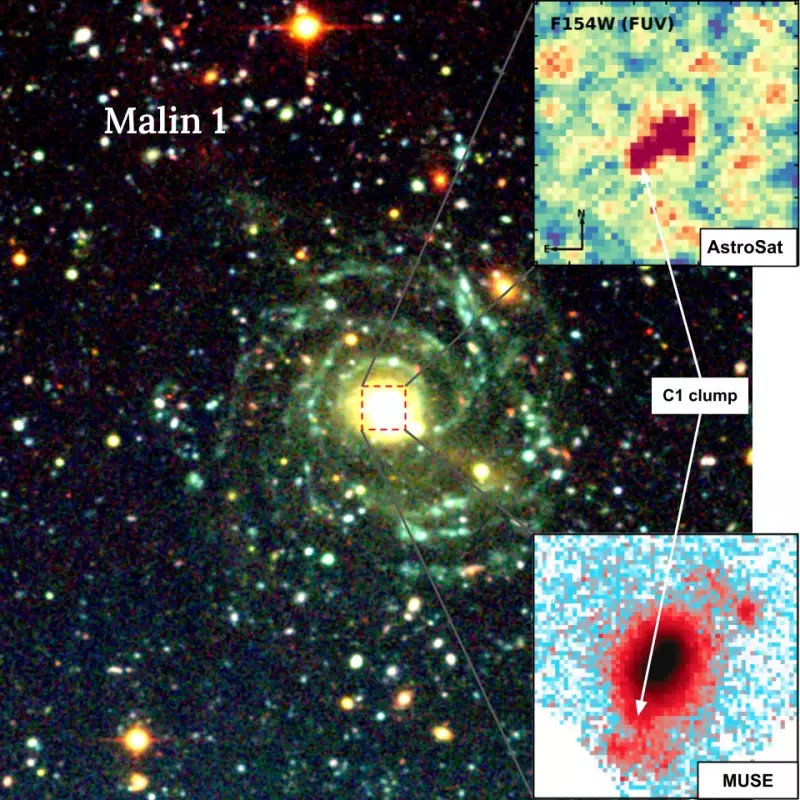
The team employed the Ultraviolet Imaging Telescope aboard India's AstroSat satellite. They focused their observations on Malin 1's central region. There, they identified several young star-forming clumps that appeared unexpectedly bright in ultraviolet light.

Unexpected Findings in a Quenched Galaxy
"The central region of Malin 1 otherwise resembles a quenched galaxy," explained researchers. "This means star formation has largely ceased there. So the presence of these bright UV clumps surprised us completely."
This discovery prompted deeper investigation. The team turned to the Multi-Unit Spectroscopic Explorer instrument on Chile's Very Large Telescope. Their spectroscopic observations revealed something remarkable about one particular clump, designated C1.
The C1 clump moves approximately 150 kilometers per second faster than surrounding material. It also exhibits high turbulence levels. "This behavior is completely unexpected for a region that appears settled and undisturbed," noted the scientists.
Evidence of Galactic Cannibalism
Further analysis provided compelling evidence. The C1 clump appears only in certain velocity channel maps. This strongly suggests an external origin. Researchers concluded it represents the remnant of an infalling dwarf galaxy.
Manish Kataria, the study's lead author and a PhD student at IUCAA, emphasized the importance of this finding. "Understanding how giant, low-surface-brightness galaxies like Malin 1 grow is crucial," Kataria stated. "Their enormous, faint structures challenge existing galaxy formation theories."
Stellar Archaeology Reveals History
The team performed detailed stellar population modeling on the MUSE spectra. They essentially conducted cosmic archaeology on the C1 clump and surrounding areas. Their analysis revealed multiple layers of history.
Beneath the C1 clump lies an ancient stellar population over six billion years old. This old population shows solar-like metallicity with low alpha-element abundance. After a long quiet period, a burst of star formation occurred within the last 200 million years.
This recent star formation produced the UV-bright stars visible in the C1 clump. It also created extremely metal-poor young stars. The young population shows high alpha-enhancement, indicating rapid enrichment by core-collapse supernovae.
The Cannibalistic Process
The chemical signatures combined with high velocities paint a clear picture. The C1 clump represents the remains of a dwarf galaxy falling into Malin 1 on a polar orbit. This specific orbital path likely delivered pristine, early-universe-like gas to Malin 1's central region.
This gas then fueled the formation of young stars observed in the clumps. The original dwarf galaxy appears to have been torn apart into at least four fragments. All these fragments share remarkably similar ages and chemical properties.
Years of Speculation Confirmed
Professor Kanak Saha, who supervised the project, recalled noticing the UV clumps years ago. While examining early UVIT data on Malin 1, he speculated they might have external origins. "Thanks to MUSE's integral-field data and Manish's careful analysis, this idea has been confirmed," Professor Saha said.
"Malin 1 is silently cannibalising smaller dwarf galaxies," he continued. "This process is actively transforming the galaxy's central region right now."
Published Findings and Future Implications
The research team published their findings in the Astrophysical Journal Letters in December 2025. Their work uncovers hidden evidence of subtle mergers occurring in Malin 1. These mergers provide crucial insights into the galaxy's ongoing growth processes.

This discovery challenges astronomers to reconsider how massive, faint galaxies evolve. The cannibalistic behavior of Malin 1 suggests such galaxies may grow through quiet consumption of smaller neighbors rather than dramatic collisions.
The IUCAA team's work demonstrates how combining multiple observational techniques can reveal cosmic processes previously hidden from view. Their findings open new avenues for understanding galaxy formation and evolution across the universe.