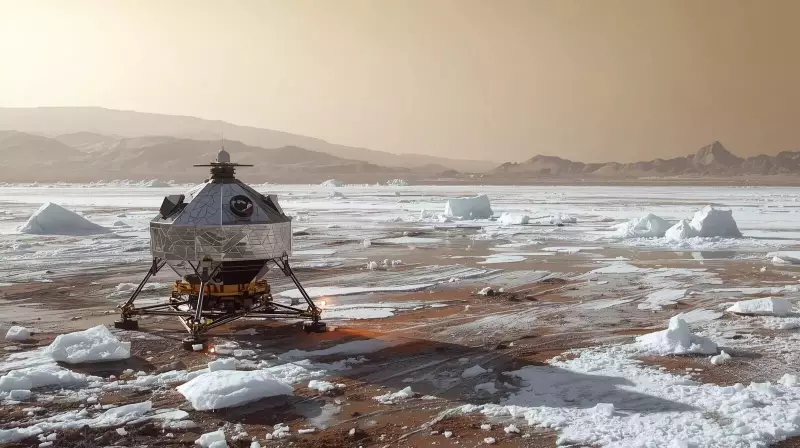
Mars's Quiet Plain Reveals Hidden Ice Treasure
Arcadia Planitia on Mars does not grab headlines like the planet's massive canyons or towering volcanoes. This broad, flat region in the northern mid-latitudes often gets overlooked in favor of more dramatic landscapes. However, recent scientific studies have thrust Arcadia Planitia back into the spotlight. Orbital data increasingly suggests that ice lies just beneath the surface here, shallow enough to be significant.
Subtle Surface Patterns Point to Buried Ice
Researchers examining the boundary between Arcadia Planitia and northern Amazonis Planitia have focused on subtle surface features rather than obvious landforms. Their observations indicate the presence of buried ice that has endured through Mars's changing climate. While the work does not answer every question, it narrows down the possibilities. For mission planners considering human expeditions to Mars, this region now appears more practical and less remote than previously thought.
Across several potential landing sites, scientists have mapped characteristics that are hard to explain without subsurface ice. Wide patches of polygonal ground show up, with cracked geometries resembling periglacial terrain on Earth. Some polygons appear knobbly, while others are smoother, but both types hint at historical freezing and thawing cycles. Expanded craters with softened rims and altered shapes also suggest that subsurface ice influenced how impacts behaved. Individually, these features do not prove ice exists. Collectively, they point strongly in that direction.

Ice Lies Surprisingly Close to the Surface
By analyzing the size and spacing of thermal contraction polygons, researchers estimated the likely depth of the ice. In many areas, it seems to be just tens of centimeters below the surface. This shallow depth is crucial. Ice that close would be much easier to access than deposits buried meters deep. Recent impact craters in the vicinity have exposed bright material that fades over time, behavior consistent with ice sublimating away. Not every crater displays this, indicating the ice distribution is patchy rather than uniform.
Climate Cycles Left Lasting Imprints
Mars does not maintain a constant axial tilt. Over millions of years, shifts in obliquity changed where ice could persist. During periods of higher tilt, atmospheric water vapor increased, and ice became stable at lower latitudes. Snow and ice likely accumulated in regions like Arcadia Planitia. When conditions changed again, dust and debris buried that ice, forming a protective layer. Models indicate this cover had to develop rapidly to preserve the ice through warmer phases. If these models are correct, what remains today is a record of past climates stored just below the surface.
Multiple Instruments Support the Findings
A study titled "Geomorphological Evidence of Near-Surface Ice at Candidate Landing Sites in Northern Amazonis Planitia, Mars" reports that radar data, neutron measurements, and thermal observations do not always agree in detail, but they often converge on broad conclusions. Radar soundings suggest ice-rich material beneath Arcadia Planitia, though debates continue over whether it is solid excess ice or ice filling soil pores. Neutron detectors have recorded elevated hydrogen levels at depths around a meter, consistent with frozen water. Thermal data reveals surface behavior matching ice-cemented ground. Each dataset has limitations, and none provides a definitive answer alone.
Human Mission Planning Gains Urgency
Beyond pure science, the presence of near-surface ice alters discussions about Mars. Ice is not just a climate record; it represents water for drinking, oxygen for breathing, and fuel for propulsion. Areas where ice can be accessed without extensive drilling become more appealing as landing sites. Teams have created detailed geomorphic maps of specific zones in northern Amazonis Planitia to aid this planning. International collaboration has expanded around this work, reflecting shared interest rather than absolute certainty. The maps do not guarantee ease of access, but they highlight a promising possibility.

The emerging picture is incomplete and somewhat uneven, much like the terrain itself. Arcadia Planitia does not offer a straightforward path from orbital observation to human settlement. It provides clues—shallow ice here, a revealing crater there, patterns that repeat but not universally. For now, that may be sufficient to keep this region in focus as Mars transitions from a distant goal to a place examined more closely than ever before.